The Nature Neuroscience study compared neural activity under general anesthesia across six species from nematodes to humans and found a conserved pattern: brain regions remain active but become isolated and temporally disordered. Predictable sequences of activity break down, reducing the brain's ability to integrate information across time and space. Independent experts say this spatiotemporal fragmentation may represent a "final common pathway" for anesthesia-induced loss of consciousness.
Anesthesia Makes Brains Behave Like Worms — Study Reveals a Universal Break in Brain Integration

(YakobchukOlena/iStockphoto/Getty Images)
Every day, thousands of people receive general anesthesia as a routine part of surgery. Despite more than 175 years since the first public demonstration of surgical anesthesia, researchers still do not fully understand how these drugs cause reversible loss of consciousness without simply turning the brain off.
A new study in Nature Neuroscience compares the effects of general anesthetics across six very different species and uncovers a surprising commonality: under anesthesia, neural activity becomes spatially and temporally fragmented in animals ranging from nematode worms to humans.
What the Study Did
Led by neuroscientist Andrea Luppi at the University of Oxford, the team analyzed neural recordings from humans, macaques, marmosets, mice, zebrafish and nematodes — species that span roughly 700 million years of evolutionary divergence. Different anesthetics and measurement methods were used depending on the species: functional MRI for the mammalian subjects and genetically encoded calcium indicators that make active neurons fluoresce in zebrafish and nematodes.
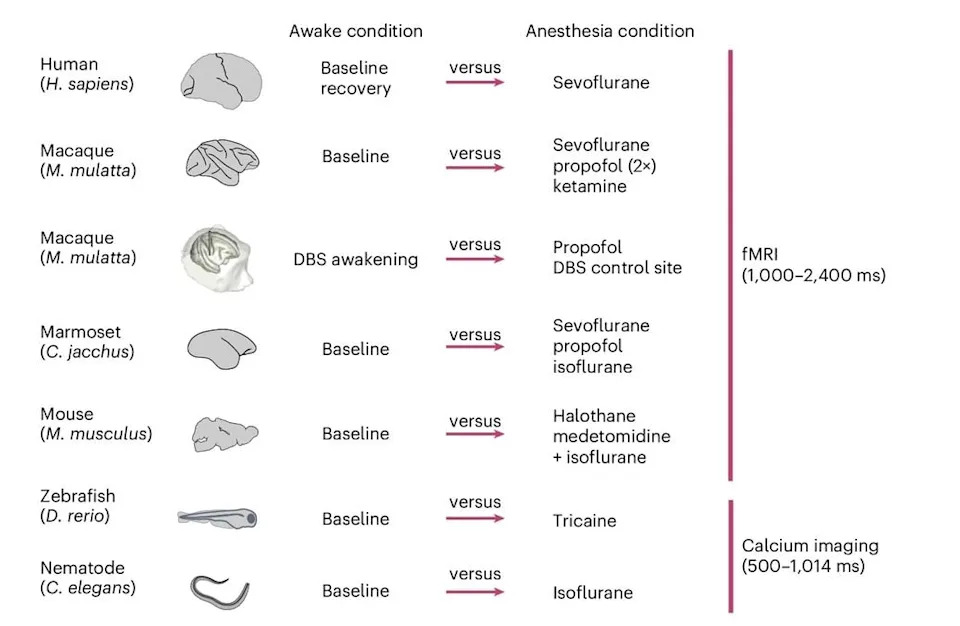
A table showing (from left to right columns) the species included in the study, an illustration of their brain, the awake condition versus anesthesia condition compared in the study, and the way brain activity was measured. (Luppi et al.,Nature Neuroscience,2026)
"Focusing on effects that are consistently shared across multiple anesthetics and species allows us to exclude physiological or methodological confounds specific to any one drug, species, or imaging modality, and instead triangulate on potential neural underpinnings of what they share: breakdown of responsiveness to the environment," the authors write.
Key Findings
Across all species studied the researchers observed two consistent changes under general anesthesia:
- Reduced Inter-Regional Coordination: Correlations between activity in different brain regions fell, indicating that local circuits remained active but interacted far less than when the animals were awake.
- Temporal Disorganization: Predictable sequences of neural activity broke down — anesthesia "induced a breakdown in the relationship between past and future of neural activity," the paper reports.
Independent experts writing in an accompanying News and Views piece describe these results as supporting a "final common pathway" for anesthesia: spatiotemporal isolation of local neural activity. In other words, consciousness may be lost not because the brain simply shuts down but because its activity fragments across space and time, preventing circuits from sustaining, propagating, and integrating information.
Why This Matters
Because the same dynamical signature appears in animals as distantly related to humans as fish and roundworms, the findings point to an evolutionarily conserved mechanism by which anesthetics disrupt responsiveness to the environment. This may also inform broader questions about the neural basis of consciousness and how it can be reversibly suspended.
The research is published in Nature Neuroscience (2026). Independent experts George Mashour and Zirui Huang contributed an accompanying commentary.
Help us improve.