WalletHub ranked all 50 states and D.C. to determine the best and worst places to be a teacher in 2026, using measures of pay, benefits, opportunity and classroom conditions. Washington rose to No. 1 after reforms and significant pay gains; New York ranks second with a cost-of-living–adjusted salary of $87,670 and the highest per-student funding. Virginia is third despite middling pay because of strong school-system quality and demand for teachers. New Hampshire ranks worst overall after finishing last in Opportunity & Competition.
Best — and Toughest — U.S. States for Teachers in 2026 (WalletHub Ranking)

FatCamera/GettyImages
Teaching remains one of the nation’s most demanding professions, and where teachers live has a big impact on pay, benefits and working conditions. WalletHub’s 2026 analysis ranks all 50 states and the District of Columbia on compensation, benefits and retirement security, opportunity and competition, and classroom and school-system conditions to identify the best — and the most challenging — places to teach.
Top Performers
Washington rose to No. 1 after a decade of reforms and major pay increases spurred by a state Supreme Court ruling. The state now posts the second-highest average annual teacher pay in the U.S. and the fourth-highest average starting salary for new teachers.
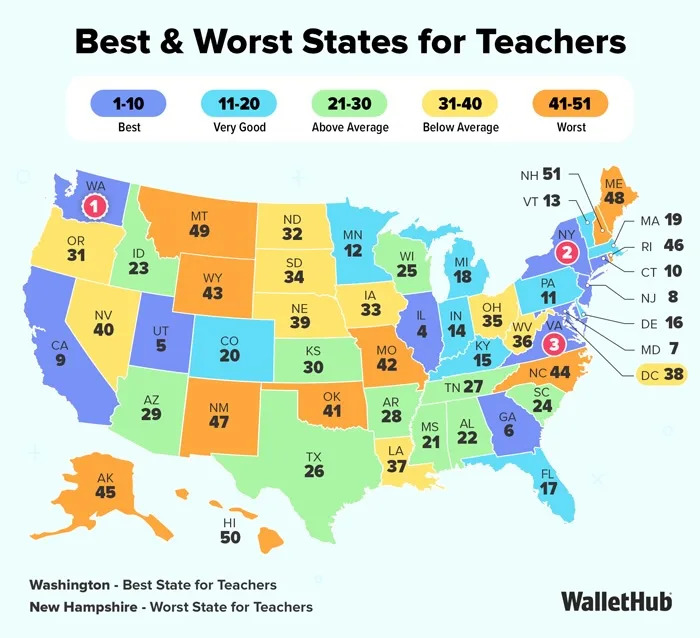
Map: Best & Worst U.S. States for Teachers | WalletHub
New York ranks second overall. When adjusted for cost of living, New York’s average annual teacher salary is $87,670, and the state leads the nation in per-student public-school funding—an important factor for classroom resources and support.
Virginia lands third. Although its pay ranks are only middling (12th for starting salary and 18th for average pay), Virginia benefits from rapid population and job growth that is increasing demand for teachers and from a strong school-system ranking (sixth nationally).
Goodboy Picture Company/GettyImages
Full Top 10 (Best States for Teachers)
- 1. Washington
- 2. New York
- 3. Virginia
- 4. Illinois
- 5. Utah
- 6. Georgia
- 7. Maryland
- 8. New Jersey
- 9. California
- 10. Connecticut
States Facing Bigger Challenges
At the other end of the ranking, New Hampshire is identified as the toughest state for teachers under WalletHub’s methodology. Despite strong scores for school-system quality, student–teacher ratio and family supports, New Hampshire finished last in the Opportunity & Competition category, which includes pay, pensions, career growth potential and tenure protections.
Hawaii is the second-lowest ranked state, weighed down by poor marks in Opportunity & Competition and the lowest cost-of-living-adjusted annual teacher salary. Montana and Maine also place near the bottom; Maine’s ranking suffers particularly from one of the lowest inflation-adjusted annual pay rates, even though it has a strong student–teacher ratio.
Full Bottom 10 (Worst States for Teachers)
- 1. New Hampshire
- 2. Hawaii
- 3. Montana
- 4. Maine
- 5. New Mexico
- 6. Rhode Island
- 7. Alaska
- 8. North Carolina
- 9. Wyoming
- 10. Missouri
What the Ranking Means
The WalletHub study provides a layered view of how pay, funding, classroom conditions and labor-market dynamics intersect to affect teacher recruitment and retention across the U.S. Its composite ranking is intended to help educators, policymakers and the public see where conditions are improving and where more support may be needed.
Source: WalletHub (analysis published on Mental Floss). Metrics include cost-of-living–adjusted pay, per-student funding, student–teacher ratio, pension and tenure measures, and other indicators.
Help us improve.