The research team has created the most accurate atomic clock to date using lutetium-176, achieving precision to 19 decimal places — roughly a 41% improvement over the previous record. Published Sept. 23 in Nature, the device is notably less sensitive to magnetic fields, temperature swings (≈5 °C) and gravity thanks to hyperfine averaging. The BIPM may use such technologies to redefine the second around 2030, and the clock could also help test whether fundamental physical constants truly remain constant.
World's Most Accurate Atomic Clock Uses Lutetium — Could Redefine the Second
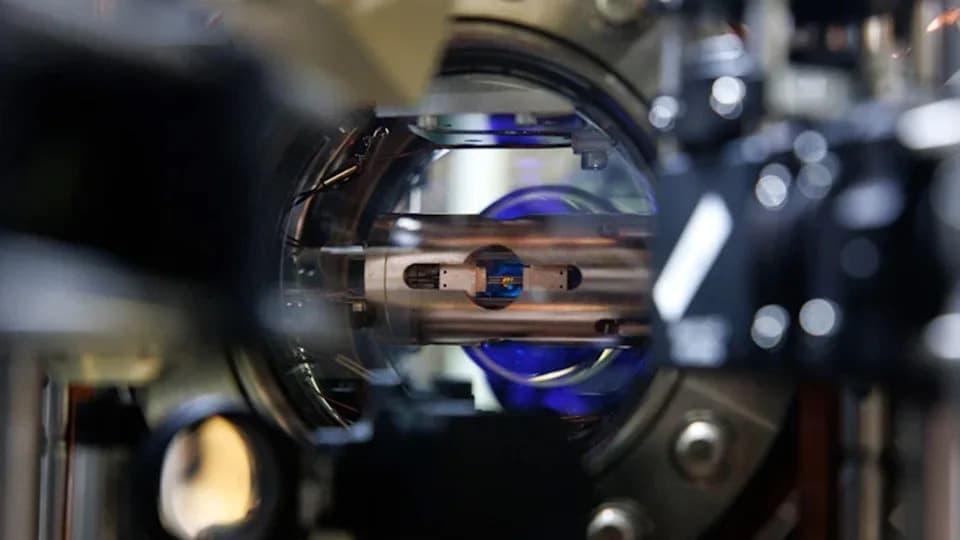
A close-up of the lutetium atomic clock's interior. | Credit: Centre for Quantum Technologies, National University of Singapore
Scientists have built the most accurate atomic clock yet, and it could prompt a redefinition of the second. The new device uses the vibrations of lutetium-176 atoms to achieve timing precision to 19 decimal places — about a 41% improvement over the previous record holder — with the results published on Sept. 23 in the journal Nature.
The clock's designers say its performance stems from both the intrinsic properties of lutetium-176 and new experimental techniques that suppress environmental disturbances. Compared with earlier optical clocks based on elements such as ytterbium and strontium, the lutetium-based system is far less sensitive to tiny variations in magnetic fields, temperature and gravitational potential.
How the Lutetium Clock Stands Out
Where many ultra-precise clocks require environmental control down to thousandths of a degree, the lutetium-176 clock remains stable across roughly a 5 °C swing in ambient temperature. The research team also applied a method called hyperfine averaging to further cancel dominant perturbations, leaving only minimal variation in the clock's ticking.
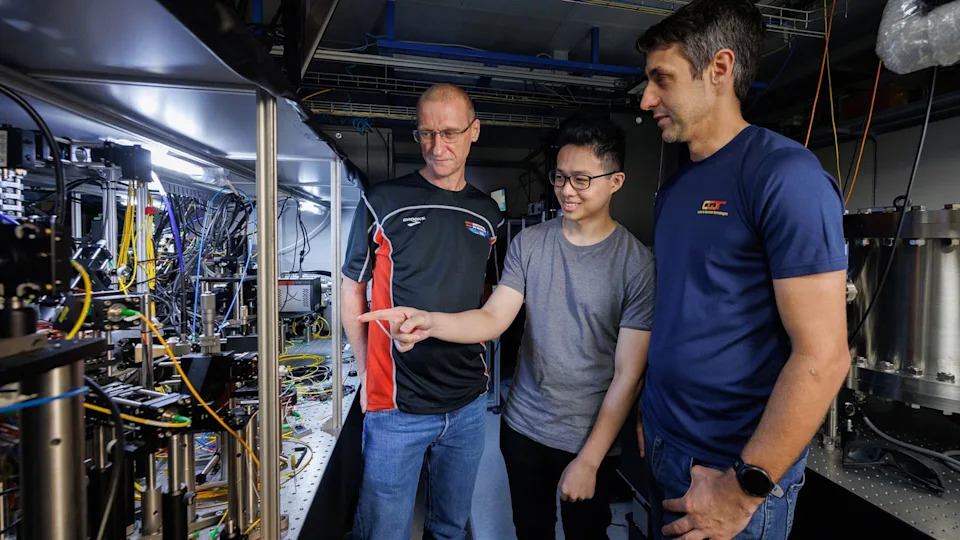
Physicists at the National University of Singapore inspect their super-accurate atomic clock in the lab. | Credit: Centre for Quantum Technologies, National University of Singapore
“To understand the challenge, imagine precise timekeeping as an ultramarathon and the clock's core elemental isotope as a runner,” said study co-author Murray Barrett of the National University of Singapore. “Our job is to make sure the runner can go the distance. Lutetium, as it turns out, is a natural-born endurance athlete.”
Why This Matters
The International Bureau of Weights and Measures (BIPM) is expected to update the formal definition of the second around 2030 to reflect advances in atomic-clock technology. Because of its robustness and record-setting stability, lutetium-176 is a leading candidate to help define that new standard.
Beyond standards, ultra-precise clocks are powerful probes for fundamental physics. Small, consistent differences between high-precision clocks over time or across locations could reveal whether so-called fundamental constants — such as the gravitational constant G or other coupling constants — vary at all. The lutetium clock’s exceptional stability improves researchers’ ability to run those tests.
Practical Implications
If adopted as part of a new definition of the second, lutetium-based clocks would tighten synchronization in navigation systems, telecommunications and scientific experiments that demand the highest timing fidelity. They could also enable new experiments in geodesy, tests of general relativity and searches for new physics.
Note: The description above summarizes the published findings and experimental claims from the research team; ongoing independent verification and international consensus via metrology institutions will determine whether lutetium becomes the new SI time standard.
Help us improve.