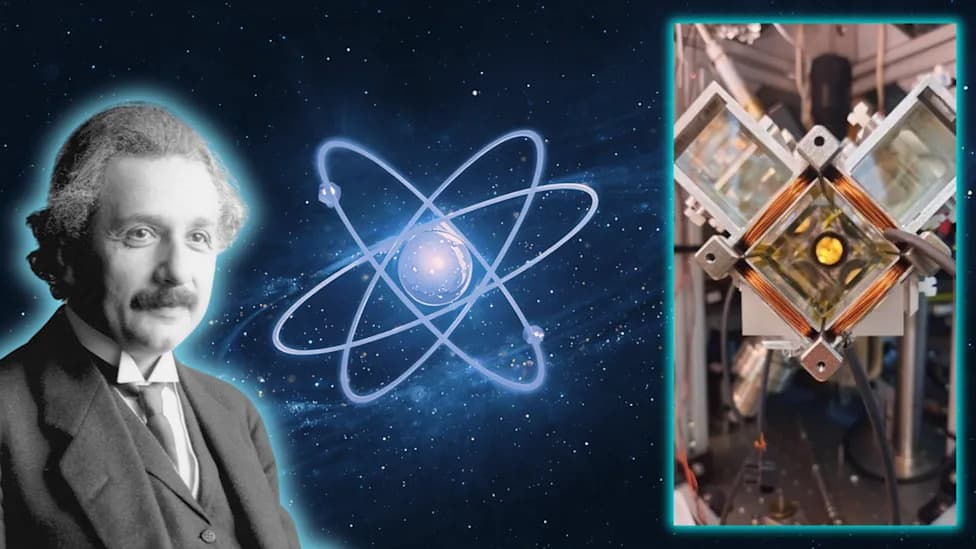
NIST physicist Stephan Schlamminger and his team report a new measurement of the gravitational constant: 6.67387 × 10⁻¹¹ m3 kg-1 s-2. The value is 0.0235% lower than the 2007 BIPM benchmark and does not resolve a persistent discrepancy in big G measurements. The team used blind analysis, corrected an air-pressure effect, and repeated tests with copper and sapphire masses to reduce bias; the result refines our knowledge but leaves the broader puzzle intact.
After a Decade, NIST's New Measurement of Gravity's 'Big G' Is Precise — But Still Disagrees
Photo Credit: iStock
After roughly a decade of painstaking work, National Institute of Standards and Technology (NIST) physicist Stephan Schlamminger and his team have published a new, highly precise measurement of the universal gravitational constant — known informally as "big G." The result is a technical success, but it does not resolve a long-standing discrepancy with a previous benchmark measurement.
In a paper in Metrologia and a public presentation on July 11, 2024, the NIST group reported a value of 6.67387 × 10⁻¹¹ m3 kg-1 s-2. That value is about 0.0235% lower than the 2007 result from the International Bureau of Weights and Measures (BIPM) in Sèvres, France.
Why the Difference Matters
Although the percentage gap is tiny, it is significant in the context of precision metrology. Measurements of big G have failed to converge on a single value for more than two centuries. Many other physical constants are known to far greater precision; gravity's central constant remains unusually stubborn. Small, persistent discrepancies can point to overlooked experimental effects or, more rarely, to new physics.
How NIST Minimized Bias and Errors
The NIST team applied rigorous controls to reduce bias and expose hidden errors. Among the steps they took:
- Blind analysis: Colleague Patrick Abbott implemented a blinding procedure by secretly perturbing part of the mass data; the true correction remained sealed until the analysis was complete.
- Correcting experimental effects: The group discovered an unaccounted air-pressure effect and took the time to correct for it — a finding that delayed the public reveal and extended the project by roughly two years while results were rechecked.
- Material cross-checks: To rule out composition-dependent bias, the experiment was repeated with both copper and sapphire test masses; both material sets produced essentially the same value.
What This Means
For everyday life — from bathroom scales to kitchen recipes — this new number will have no practical impact. For fundamental physics and precision measurement, however, the refined value matters: improving the accuracy of big G sharpens our understanding of the universe and helps calibrate experiments that depend on precise gravitational physics.
"Every measurement is important, because the truth matters," Schlamminger said. "For me, making an accurate measurement is a way of bringing order to the universe, whether or not the number agrees with the expected value."
The continued disagreement between careful experiments suggests that either subtle, unidentified systematic errors remain or — less likely but intriguing — there may be physics not yet accounted for. Until more independent, high-precision measurements converge, big G will remain a focal point of metrology and gravitational physics.
Publication note: The new measurement appears in Metrologia. The NIST team's transparency in documentation and their use of blinding and material cross-checks strengthen confidence in the reported value, even as the broader discrepancy persists.
Help us improve.