Summary: USCIS will increase several immigration fees effective October 16 as inflation adjustments authorized by the One Big Beautiful Bill Act. Key changes: annual asylum fee to $105, Form I-131 parole fee to $1,050, initial work-permit fee to $570, and Form I-821 (TPS) to $520. The new fees apply based on the postmark date; applications missing the updated fee will be rejected. Advocates warn the increases add financial strain, while USCIS cites rising processing costs.
USCIS Raises Several Immigration Fees Effective Oct. 16 — Small Increases for Asylum, Parole, TPS and Work Permits
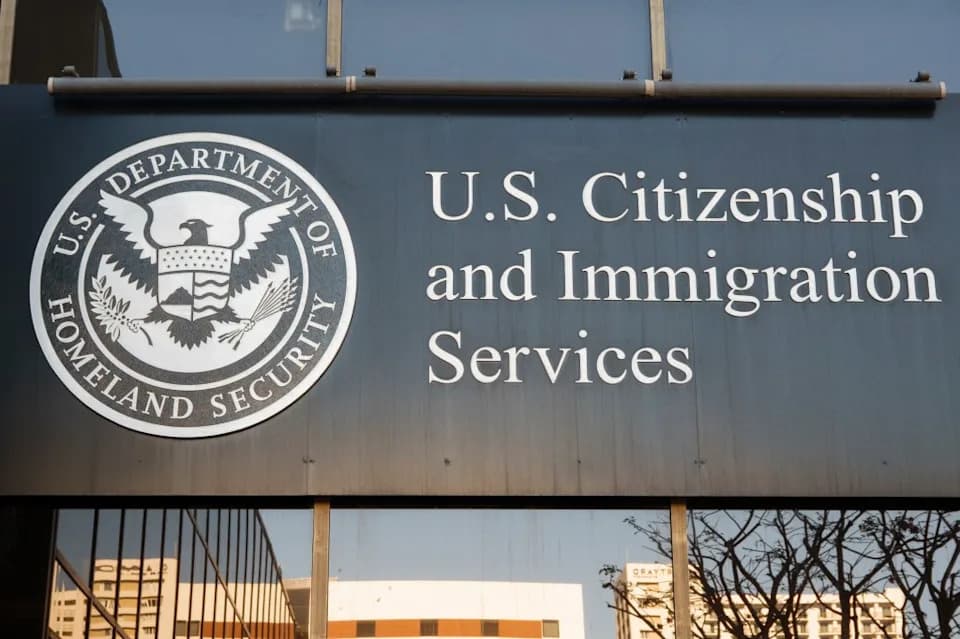
The U.S. Department of Homeland Security logo is seen at a Citizenship and Immigration Services office, January 16, 2026, San Diego.
U.S. Citizenship and Immigration Services (USCIS) will raise several immigration-related fees effective October 16 as inflation adjustments under the One Big Beautiful Bill Act, signed into law in July 2025. The changes affect asylum applicants and some people seeking work authorization, parole, or Temporary Protected Status (TPS).
What’s changing:
- Annual asylum fee: $102 → $105 (+$3, ~2.9%).
- Parole fee (Form I-131, covers travel and parole documents): $1,020 → $1,050 (+$30, ~2.9%).
- Initial employment authorization (work permit) for asylum applicants, parolees, and TPS recipients: $560 → $570 (+$10, ~1.8%).
- Form I-821 (Temporary Protected Status application): $510 → $520 (+$10, ~2%).
USCIS says the adjustments are intended to help cover rising processing costs. Immigration advocates caution that even modest fee increases can create meaningful financial barriers for people seeking humanitarian protections.
Important filing rule: The new fees apply based on the postmark date. Applications and benefit requests postmarked on or after October 16 must include the updated fee; filings submitted without the correct amount will be rejected and returned. Filings postmarked before October 16 remain subject to the prior fees.
Example: An asylum applicant required to pay both the annual asylum fee and the initial work-permit fee would pay $675 under the new schedule compared with $662 under the old fees.
TPS and Parole Context: TPS lets eligible nationals of designated countries live and work temporarily in the United States when conditions in their home country (armed conflict, natural disaster, etc.) prevent safe return. Parole permits certain people to enter or remain in the U.S. temporarily without conferring an immigration status. The current administration has moved to terminate TPS designations for a number of countries.
USCIS guidance issued in September indicates TPS for Sudan and Ukraine is scheduled to terminate on October 19, 2026, while guidance dated September 30 states that El Salvador remains protected for now pending a Department of Homeland Security announcement. The administration also ended TPS for several other countries during 2025–2026, including Afghanistan, Cameroon, Haiti, Honduras, Myanmar (Burma), Nepal, Nicaragua, Somalia, South Sudan, Syria, Venezuela, Ethiopia, and Yemen.
Other timing notes: The fee changes arrive as the Department of State published the October 2026 Visa Bulletin, the first bulletin of the new federal fiscal year. Each October, new immigrant visa numbers become available, which may allow some long-waiting employment-based applicants to move forward.
If you plan to file an application or petition, double-check the fee schedule and your postmark date to avoid rejection.
Help us improve.