Gallup finds Supreme Court approval at historic lows among independents: Approval among independent voters fell to 31 percent and overall approval to 34 percent. Partisan views diverge sharply — Republican support climbed to 65 percent while Democratic approval remained at about 12 percent. Critics cite controversial rulings and the frequent use of the expedited "shadow docket" as drivers of declining trust; experts urge greater transparency to help restore confidence.
Supreme Court Approval Hits Record Low Among Independents, Gallup Finds
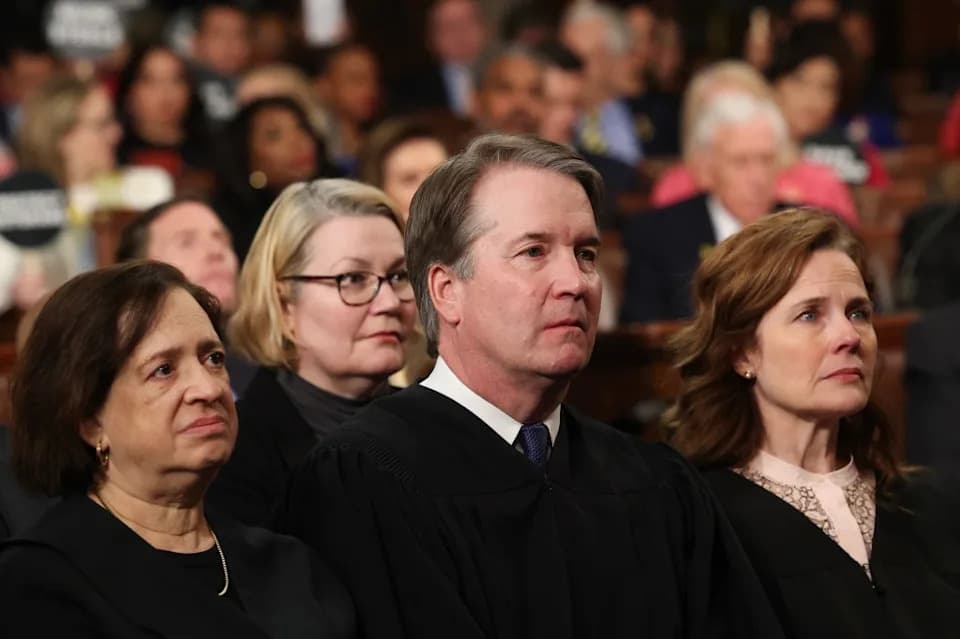
Supreme Court Justices Elena Kagan, John Roberts and Amy Coney Barrett attend President Donald Trump's address to a joint session of Congress in Washington, D.C. on March 4, 2025.
A new Gallup survey released Wednesday shows approval of the United States Supreme Court has fallen to a record low among independent voters as the justices prepare for their next term.
Key findings: Gallup reports approval among independents at 31 percent — the lowest level Gallup has measured for that group — down from 35 percent in July 2026 and 38 percent in September 2025. Overall approval for the Court stood at 34 percent in the new survey, close to the 33 percent low recorded in July 2026.
Partisan Split
The poll shows a sharp partisan divide. Republican approval rebounded to 65 percent in September from 58 percent in July, while Democratic approval remained unchanged at 12 percent, near the historic low of 11 percent recorded in July 2025. Independents are the most skeptical group, and their falling confidence is driving much of the overall decline.
Why Trust Is Eroding
Observers point to several factors behind the waning public confidence: controversial rulings, partisan attacks from both the left and the right, and the Court's frequent use of the expedited "shadow docket," which issues rapid decisions often without full briefing or oral argument.
"The Court is being bombarded with criticism and very little praise," said Stephen Wermiel, Professor of Practice in Constitutional Law at American University. "Liberals think the Court is nothing but a conservative think-tank. Trump thinks his conservative appointees have betrayed him.... All of this foment from all sides is bound to chip away at the Court's standing."
Justice Ketanji Brown Jackson has publicly questioned the fairness and transparency of the emergency docket, asking why some parties receive swift access while others wait for full consideration. Chief Justice John Roberts has warned against overruling precedent carelessly, arguing that doing so can harm the Court's legitimacy.
High-Profile Cases and Public Reaction
The Court's recent term included mixed outcomes in high-profile matters involving the Trump administration. The Court ruled 6-3 against efforts to end birthright citizenship, blocked broad tariffs imposed under the International Emergency Economic Powers Act, and prevented the removal of a Federal Reserve governor. At the same time, the justices sided with the administration on issues such as transgender athletes' participation in sports and other executive-authority questions.
The decision in Louisiana v. Callais, which struck down a second majority-Black congressional district, was widely viewed as reshaping the Voting Rights Act and prompted redistricting moves by some Republican-led states that critics say could dilute Black voting power.
Other Polls and Methodology
Other recent surveys reflect similarly low public confidence. A Marquette Law School Poll found net approval at -14 points (43% approve, 57% disapprove), and a YouGov/The Economist survey put net approval at -22 points (34% approve, 56% disapprove). Gallup's latest poll sampled 1,000 adults from September 1–17, 2026, with a margin of error of ±4 percentage points.
What Might Restore Trust?
Experts say greater transparency around the shadow docket and clearer public explanation of decisions could help restore confidence. Stephen Wermiel suggested that explaining expedited actions and highlighting instances where the Court rules against powerful interests could balance perceptions. Several justices and court observers have also urged restraint and clearer reasoning in high-stakes cases to protect institutional legitimacy.
As the justices begin their new term, debates about procedural transparency, impartiality, and the Court's role in a polarized political environment are likely to remain central to how the public evaluates the institution.
Reporting note: Gallup surveyed 1,000 adults from Sept. 1–17, 2026 (±4 percentage points). Other polls cited: Marquette Law School (Sept. 2–9, 2026) and YouGov/The Economist (Sept. 4–8, 2026).
Help us improve.