Chief U.S. District Judge Cecilia M. Altonaga allowed part of Raquel Pacheco's First Amendment lawsuit against Miami Beach to proceed, concluding she plausibly alleged that criticism of Israel motivated a police visit. Video shows detectives visiting Pacheco on Jan. 12 after a Facebook comment accusing Mayor Steven Meiner of calling for Palestinians' deaths. Civil‑liberties groups condemned the visit as a chilling pressure tactic, while the city defended it citing safety concerns; the case now moves into discovery.
Judge Lets Part Of Miami Beach Free‑Speech Lawsuit Proceed After Police Visit Over Anti‑Israel Facebook Comment
Villgecrazylady/X
A federal judge on Monday allowed part of a Miami Beach woman's First Amendment lawsuit to move forward, finding she plausibly alleged that city officials targeted critics of Israel. Chief U.S. District Judge Cecilia M. Altonaga granted in part and denied in part the city's motion to dismiss, leaving intact allegations that the mayor's actions and a municipal pattern of viewpoint discrimination warrant further factual development.
Background
Raquel Pacheco, represented by the American‑Arab Anti‑Discrimination Committee (ADC), sued Miami Beach Mayor Steven Meiner, Police Chief Wayne Jones, a city council member, and the city itself in March. Pacheco alleges that a comment she posted on Facebook criticizing the mayor's stance on the Israel‑Palestine conflict prompted two Miami Beach Police Department detectives to visit her home and question her — an action she says violated her free‑speech rights.
The Police Visit
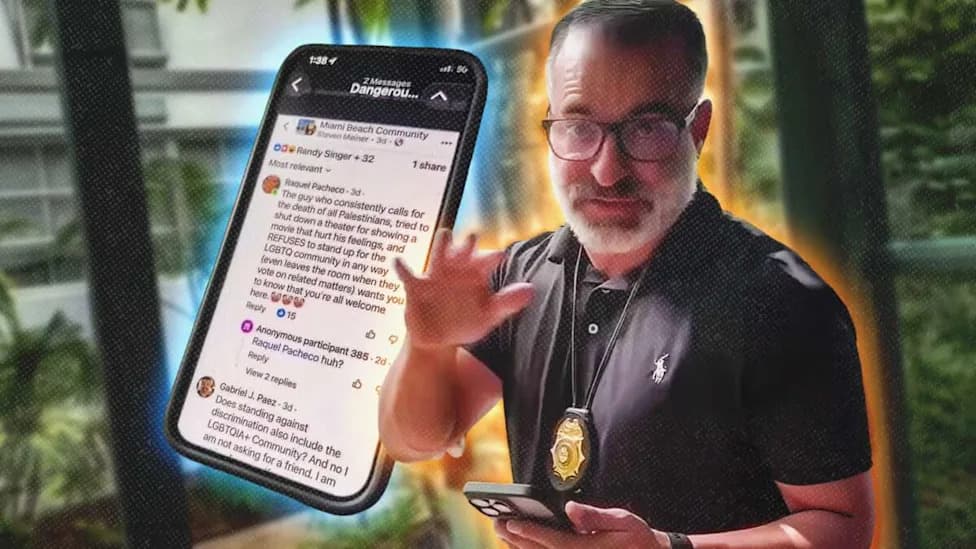
Video recorded by Pacheco shows the detectives arriving at her residence on January 12. They asked whether she had posted a comment that asserted Meiner "consistently calls for the death of all Palestinians" beneath a Facebook post in which Meiner said Miami Beach is a "safe haven for everyone." The detectives warned the comment could potentially "incite somebody to do something radical."
"This is freedom of speech. This is America, right? I'm a veteran," Pacheco told officers on camera.
One officer responded, "And I agree with you 100 percent. We're just trying to see if it's you, because if we're not talking to the right person, we want to go see who the right person is." Another detective said they were trying to "prevent someone else from getting agitated or agreeing with the statement" and added, "We're not saying it's true or not." Pacheco declined to answer further questions.
Reactions And Legal Context
After the video went viral, Chief Jones defended the decision to send officers, citing "real, ongoing national and international concerns surrounding antisemitic attacks and recent rhetoric that has led to violence against political figures" and expressing "serious concerns that her remarks could trigger physical action by others."
Civil‑liberties groups pushed back. Jenin Younes, ADC president and national legal director, called the ruling a "significant victory" and warned that sending police to someone's home to question and intimidate them over political speech can itself violate the First Amendment. The Foundation for Individual Rights and Expression (FIRE) wrote to Chief Jones that the visit appeared to be an attempt to pressure Pacheco to stop engaging in protected political expression rather than a criminal investigation.
Legal experts note the high bar for government restriction based on incitement. Under Brandenburg v. Ohio, the Supreme Court requires proof that speech was intended to and likely to produce imminent lawless action. At this early pleading stage, Judge Altonaga found Pacheco's allegations sufficient to survive dismissal on claims tied to viewpoint discrimination and the mayor's alleged motivation, while dismissing other claims.
Broader Allegations
Pacheco's complaint also cites an earlier episode in which Mayor Meiner sought to terminate the lease of a movie theater for planning to screen an Oscar‑winning documentary about the Israel‑Hamas conflict—an effort he later withdrew after criticism. The lawsuit uses that incident as part of its theory that city officials maintain a pattern or practice of singling out pro‑Palestine expression.
What Happens Next
The surviving claims will proceed to discovery, where the parties can develop the factual record. The City of Miami Beach did not immediately respond to requests for comment on the court's ruling.
Help us improve.