The Montreal study combined 1,734 records from standardized park surveys and citizen-science platforms to map coat-color variation in eastern grey squirrels. Black (melanic) squirrels made up 12.8% of observations overall but were concentrated in colder, heavily forested neighborhoods north and west of the city rather than in the urban core. Canopy cover and winter temperature were the strongest predictors of melanism, while the St. Lawrence River system may create geographic breaks that limit gene flow. The study is observational, so genetic sampling and fitness data are needed to test causation.
Black Squirrels Cluster in Cold, Tree-Rich Neighborhoods of Montreal — Rivers May Keep Populations Apart
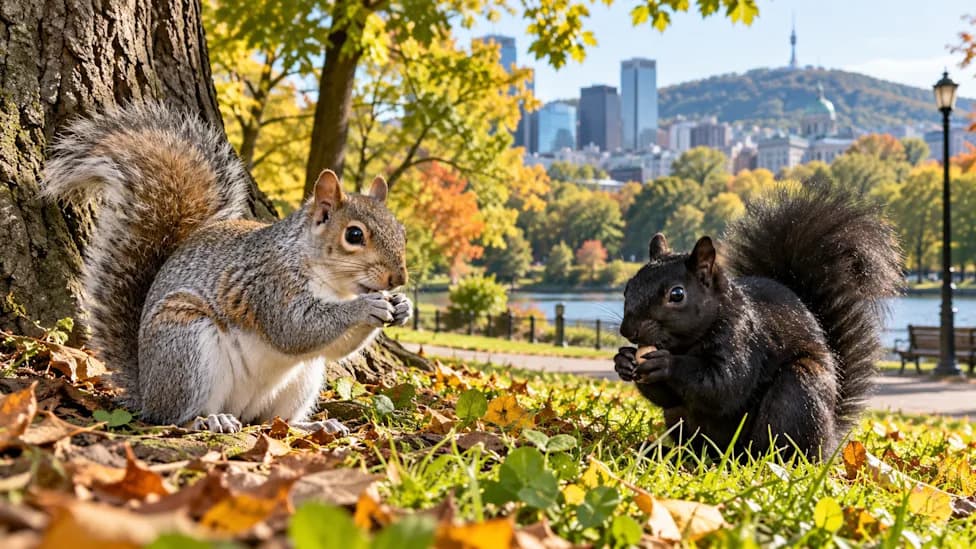
Black squirrels in Montreal are more common in colder, forested areas, revealing how local climate and rivers may shape urban wildlife. (CREDIT: Shutterstock)
A citywide analysis of eastern grey squirrels in Montreal reveals that black (melanic) individuals are not most abundant in the dense urban core but instead cluster in colder, heavily forested neighborhoods and in areas to the north and west of the city. Researchers combined standardized park surveys with citizen-science records to map coat-color variation across a metropolitan landscape dissected by the St. Lawrence River and its tributaries.
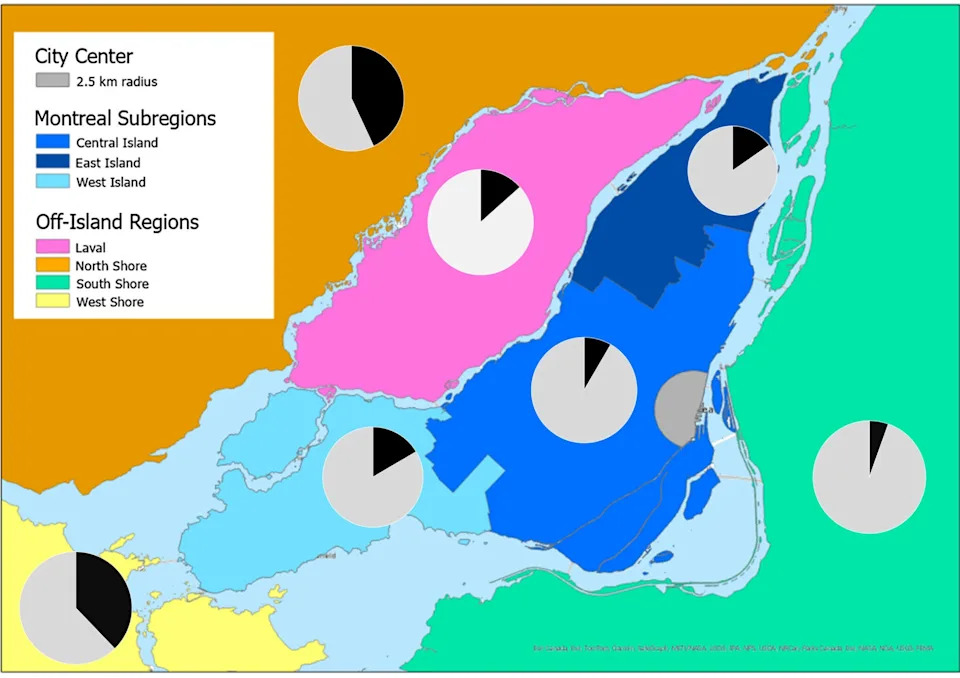
Boundaries of the major regions used in our study and proportion of melanic squirrels in the pooled data frame. (CREDIT: Francis Quang-Hai Dinh et al, Journal of Animal Ecology 2026)
What the Study Did
Researchers at McGill University integrated 1,734 squirrel observations from three datasets — visual surveys, iNaturalist reports and the SquirrelMapper project — to examine geographic patterns in melanism, the dark-fur phenotype linked to a deletion affecting the Mc1R gene. Fieldwork included standardized 20-minute searches at 197 parks across Montreal during summer 2022, supplemented by independently collected citizen-science records to cover a broader area.
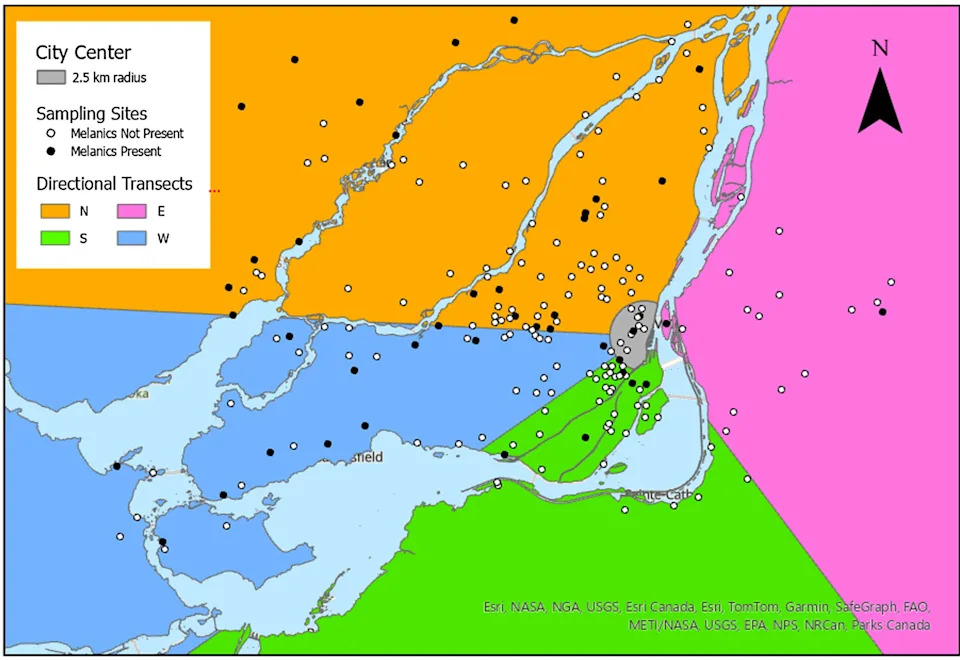
Map of the study area divided by the four directional transects. Points on the map mark our visual survey sampling sites. Black points indicate the presence of melanic individuals while white point indicates their absence. (CREDIT: Francis Quang-Hai Dinh et al, Journal of Animal Ecology 2026)
Key Findings
Overall, melanic (black) squirrels represented 12.8% of the combined 1,734 records. That citywide average masked sharp spatial contrasts: near Montreal's downtown the black morph occurred at only about 5%, while frequencies rose markedly toward the northwest and in more rural northern and western sectors, remaining low to the south and east.
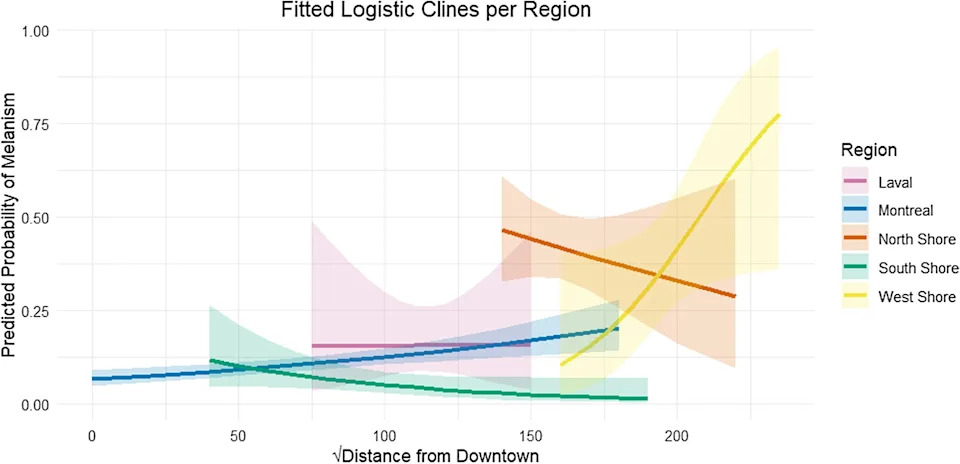
Distance-Melanism clines for each of the major regions. All three datasets were pooled (i.e. Visual Survey, iNaturalist, SquirreMapper). (CREDIT: Francis Quang-Hai Dinh et al, Journal of Animal Ecology 2026)
Statistical modeling that tested winter surface temperature, forest canopy cover, impervious surface, building density, road area and park size found canopy cover and winter temperature to be the strongest and most consistent predictors of melanic frequency. Parks with greater tree canopy tended to host higher rates of melanism, while warmer winter conditions were associated with lower frequencies of the black morph. The models suggest urbanization influences coat color largely indirectly because more urbanized sites typically have warmer winters and reduced tree cover.
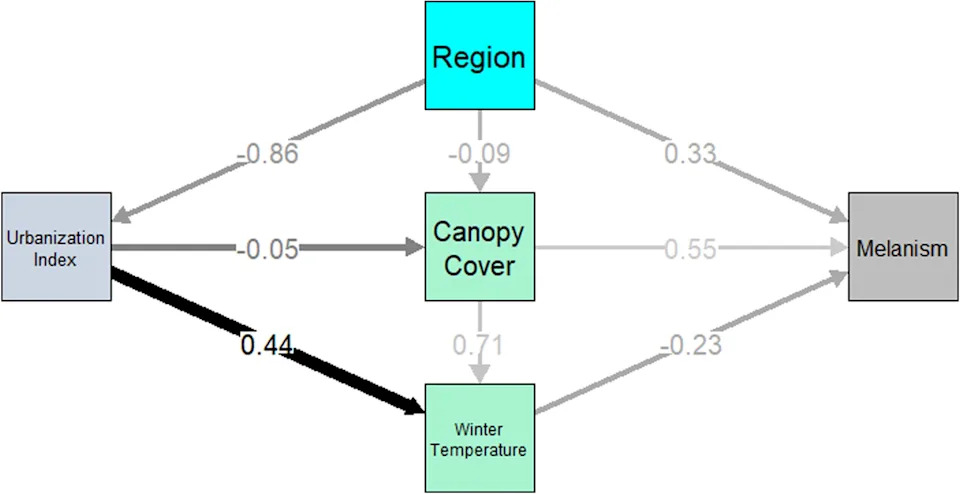
Pathways of our structural equation model. Pathway coefficients are shown on the arrows; pathway significance is represented by the thickness and darkness of the arrows. (CREDIT: Francis Quang-Hai Dinh et al, Journal of Animal Ecology 2026)
Geography and Population Structure
Large regional differences remained even after accounting for environmental variables. The authors highlight Montreal's distinctive geography — the St. Lawrence River and several tributaries that segment the metropolitan area into islands and separated shorelines — as a plausible factor limiting squirrel movement and gene flow. The team observed abrupt shifts in coat-color frequencies across some water boundaries and propose that waterways may help maintain distinct population clusters, for example separating squirrels linked to the Great Lakes region (where melanism is common) from eastern populations with lower melanic frequencies.
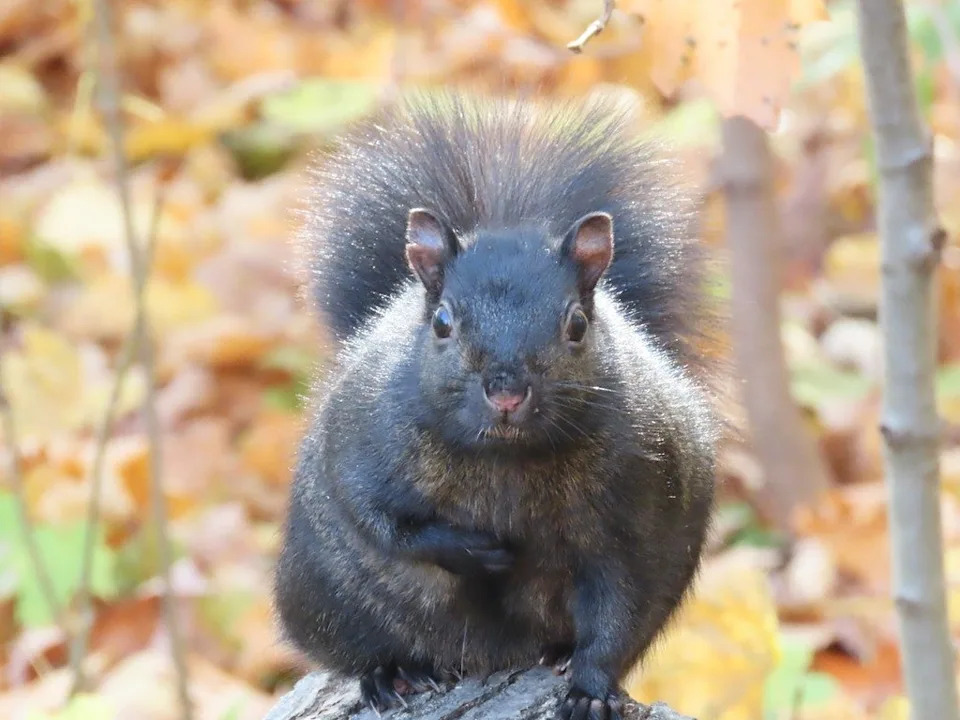
Black squirrels are particularly common in parts of the northern species range. (CREDIT: Francis Quang Hai Dinh)
Limitations and Next Steps
The study is observational and documents phenotypic distribution rather than establishing ongoing local evolution driven by neighborhood conditions. The researchers did not measure fitness differences (survival or reproduction) between black and grey morphs across habitats, so causal links to natural selection remain unproven. Detection biases are also possible: dark squirrels may be more visible on pavement but harder to spot in dense shade, and unusual black animals may attract disproportionate attention from citizen scientists. The authors recommend genetic sampling across river boundaries and direct fitness studies to test whether waterways reduce gene flow and whether selection favors particular coat colors in different neighborhoods.
Why it matters: The findings emphasize that cities are ecological mosaics. Small changes in temperature, tree cover or landscape barriers such as rivers can influence which traits become common locally — a reminder that urban wildlife patterns can vary dramatically over short distances.
Publication: The study appears in the Journal of Animal Ecology (2026). Related recent work on eastern grey squirrel melanism includes genomic studies, road-mortality research, crypsis experiments and continent-scale analyses of urban–rural clines.
Help us improve.