The Musée des Arts Décoratifs and Tiffany & Co. have launched a four-year conservation, research and digitization project to preserve Jean Schlumberger’s archive of over 10,000 items, including roughly 5,000 drawings. The collaboration will treat fragile materials, expand scholarship and make the collection more accessible to the public. Exhibitions that pair original sketches with finished jewels—such as the Hedges and Rows and Jasmine necklaces—reveal Schlumberger’s creative process and the role of artisans in realizing his vision.
Tiffany & Co. and Musée des Arts Décoratifs Launch Four-Year Conservation to Preserve Jean Schlumberger’s Archive
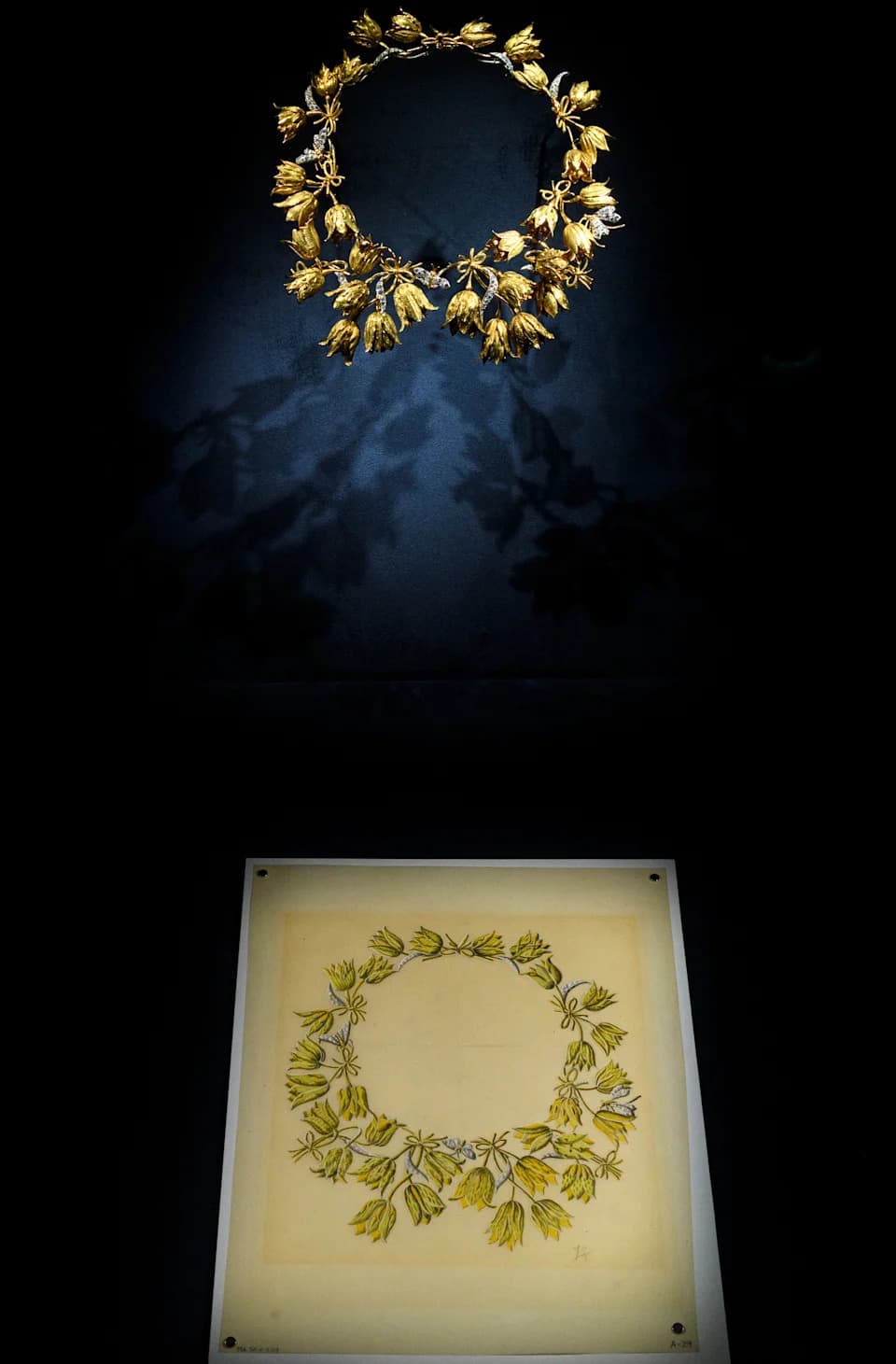
A look inside the Jean Schlumberger exhibit at the Musée des Arts Décoratifs presented by Tiffany & Co.
PARIS — Jean Schlumberger once described himself simply as “only a pencil.” Yet the designer’s imaginative reach—best known through his decades-long partnership with Tiffany & Co.—has left an extraordinary archive that now deserves careful preservation and renewed study.
More than 10,000 items—about 5,000 drawings alongside over 5,000 documents, photographs and personal papers—are the focus of a four-year conservation, research and digitization collaboration between Tiffany & Co. and the Musée des Arts Décoratifs (MAD) in Paris. MAD received Schlumberger’s archive in 1994, and the joint project addresses both the collection’s physical deterioration and its accessibility to scholars and the public.
Preserving a Working Archive
“This partnership reflects our desire to preserve and deepen the understanding of Jean Schlumberger’s extraordinary creative legacy,” said Anthony Ledru, president and chief executive officer of Tiffany. He emphasized the significance of returning this material to the 1st arrondissement—the neighborhood where Schlumberger lived and worked—and the project’s potential to reveal fresh insights into his creative process.
“Our ambition is not simply to preserve Schlumberger’s legacy, but to keep it alive — to ensure that it continues to be studied, celebrated and, above all, inspires future generations.” — Anthony Ledru
Clara Roca, MAD’s curator of drawings, wallpapers and photographs, described the collection as a record of development: “These are working documents,” she said, noting that the holdings show every stage of the artist’s process—from quick sketches to fully realized gouaches. Over time, tracing paper has yellowed, adhesives have darkened, and some sheets have become brittle; the collaboration will fund conservation treatments, scholarly research and digitization to stabilize and share the material worldwide.
Bringing Sketches and Jewels Together
To mark the initiative, Tiffany organized a private presentation that united MAD’s holdings with material from Tiffany’s archives and the Virginia Museum of Fine Arts (VMFA). The VMFA contributes roughly 160 Schlumberger jewels and some 30 objects from longtime patrons Paul and Bunny Mellon, plus hundreds of late-life drawings donated by the designer.
The presentation foregrounded colorful renderings of starfish, constellations, corals and fruit, visually anchored by a large portrait of Schlumberger amid papers. For Victoria Reynolds, Tiffany’s chief gemologist and vice president of high jewelry diamond and gemstone acquisition, the exhibition’s power lies in how it starts with the creative spark: “It’s unique to enter the mind of a genius and see how he starts ideating, then see it come to life as exceptional jewelry,” she said.
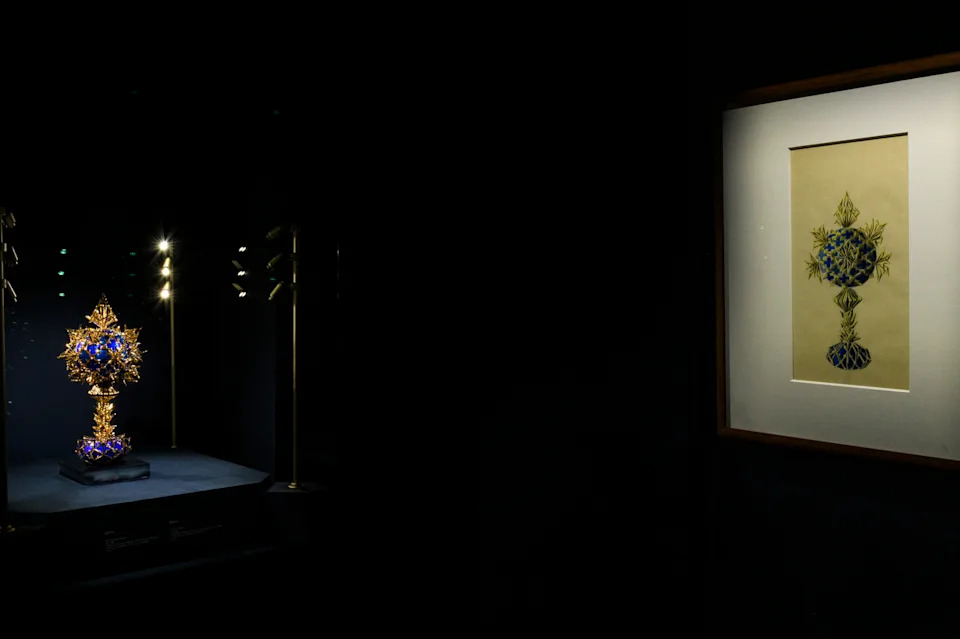
A look inside the Jean Schlumberger exhibit at the Musée des Arts Décoratifs presented by Tiffany & Co.
Pairing sketches with finished pieces—sometimes for the first time in more than half a century—clarifies how designs evolved from two-dimensional idea to three-dimensional object. Examples include the Hedges and Rows necklace (earlier called Hedges and Flowers) and the Jasmine necklace: studies show Schlumberger’s floral concept maturing over time as technical constraints and color choices were resolved.
Collaboration, Craft, and Unconventional Choices
Roca emphasized Schlumberger’s collaborative practice: he put his vision on paper and trusted skilled artisans to bring it to life. Reynolds noted how the drawings reveal an artist not bound by technical limitations—an imagination that then had to be translated into craft. Schlumberger often inverted conventions, sometimes placing flowers in the foreground while gems receded, favoring depth and texture over the obvious show of stones.
Cordier of the VMFA also pointed to a spiritual dimension in Schlumberger’s naturalism: what might read as whimsy can reflect a worldview that sees people, plants and animals as part of a larger cosmic reality, a sensibility he shared with patrons like the Mellons.
Unrealized Ideas, Now Realized
The archive continues to yield unrealized concepts. Ledru highlighted a drawing for a “Sixteen Stone” solitaire that Schlumberger imagined but never executed; Tiffany has since realized the idea under Nathalie Verdeille, the jeweler’s senior vice president and chief artistic officer. Other motifs, such as the paillonné-enamel Dot Losange, appear in multiple colorways and new iterations inspired by archive finds.
The exhibition’s final gallery celebrates Schlumberger’s avian imagery, from mythological phoenixes to the witty Bird on a Rock brooch. Reynolds recalled being struck by “the humbleness of the lapis”—unfaceted yet intensely colored—used as a rock base. “Bird on a rock — it's a rock, not a gemstone,” she said. “But it’s witty. It’s beautiful.”
By stabilizing fragile materials, expanding research, and digitizing the collection, the partnership between Tiffany & Co. and MAD aims to preserve Schlumberger’s legacy while making it more discoverable and inspiring for future generations.
Help us improve.