World News Day has drawn support from over 1,000 outlets to underscore the importance of trusted journalism as confidence in news hits a global low in 2026. Research from the Reuters Institute and Ofcom shows audiences increasingly rely on social media and AI for news, even as legacy outlets remain more trusted. Branko Brkic, co‑organiser of the campaign, urged rival news organisations to cooperate to avoid an existential decline and to reinforce journalism's role as essential infrastructure for an information society.
World News Day: Media Must Adapt or 'Society Will Struggle', Warns Co‑organiser

[Getty Images]
More than 1,000 news organisations worldwide, including The New York Times, Reuters and the Kyiv Independent, are taking part in World News Day to highlight the value of professional, fact‑based journalism as the industry faces mounting challenges.
Why This Matters
Organisers say the campaign is timely: trust in news fell to a new global low in 2026, according to the Reuters Institute's Digital News Report, while audiences increasingly turn to social media and AI chatbots for information. At the same time, legacy outlets remain more trusted than many online platforms, even as social networks and video sites overtake news sites as primary sources of online news.
Key Findings From Recent Research
The Reuters Institute report described public sentiment toward news as marked by "anxiety, disengagement and cynicism" — but also noted openness to new formats and continued belief in high‑quality journalism. The UK regulator Ofcom found that YouTube is "growing rapidly" as a news source and that about 20% of people now use AI tools to access news. Greater choice has increased uncertainty about what and whom to trust.
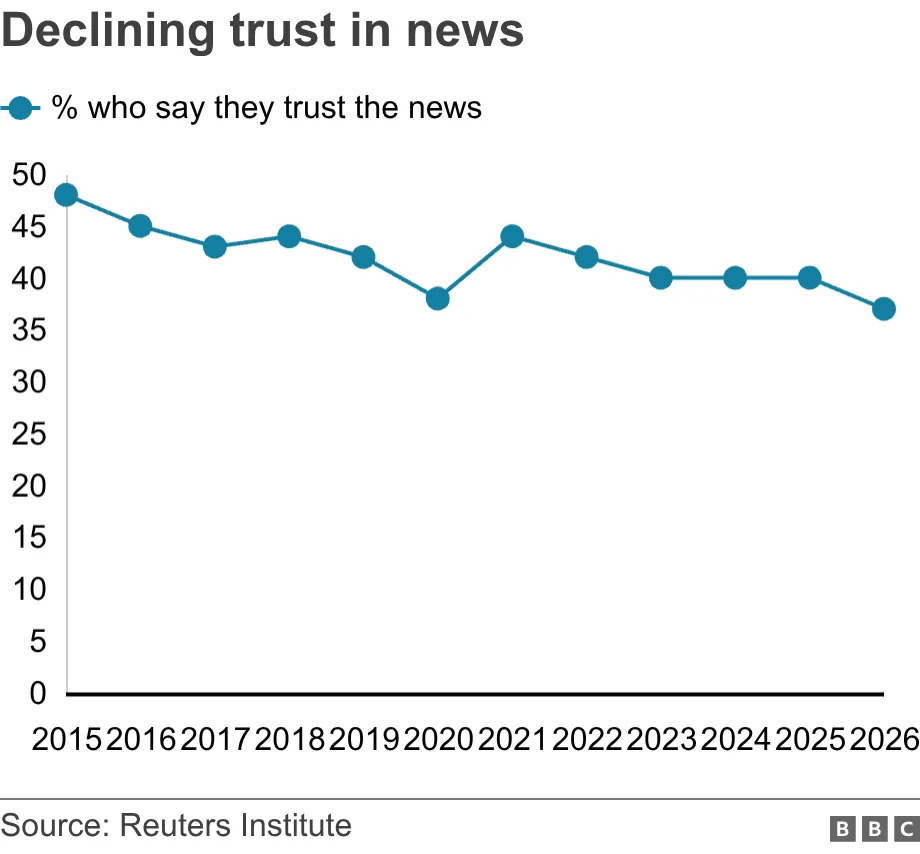
Declining trust in news. . A graph showing the % of people who say they trust the news, declining from almost 48% in 2025 to 37% in 2026 .
Calls For Urgent Change
Branko Brkic, co‑organiser of World News Day and founder of South Africa's Daily Maverick, urged rival newsrooms to cooperate rather than compete in isolation. He warned of an existential risk if the industry does not adapt.
"If we do not change the game, we are just not going to exist," Brkic said. "The old days are not coming back. We need to form a new equilibrium, and the only way we can do it is if we actually join forces."
He acknowledged mistakes by mainstream media but stressed the essential role of professional journalism. "We need to talk to our audiences and explain to them it is not in your interest not to choose truth and trust," he said. "We cannot function without a thing called the truth, without facts."
Broader Context
The debate over "truth" is highly contested, illustrated by long‑running confrontations between politicians and media outlets. Industry concerns are also practical: publishers worry that AI‑generated summaries and changing referral patterns may reduce web traffic and revenue, while new platforms reshape how audiences discover and consume news.
World News Day, launched in 2018, aims to remind the public and policymakers that trusted journalism is an infrastructure of an information‑based society. Organisers hope the day will spark collaboration, innovation and renewed engagement between newsrooms and the communities they serve.
Help us improve.