Forty years after the 1986 "science crash," similar fears about the decline of science journalism have resurfaced amid newsroom layoffs and ownership changes. Legacy titles such as Scientific American, Popular Science and National Geographic have all faced cutbacks. While the internet has expanded access to science content, much of that growth emphasizes quick, personality-driven coverage rather than the resource-heavy investigative work of institutional journalism. The authors conclude the current alarm is partly moral panic but also reflects real structural threats that demand innovation.
Is Science Journalism Dying? Lessons From the 1986 'Science Crash' and Today's Newsroom Cuts

Newsstands in the 1980s had more magazines of all kinds than they do today.Richard Laird/FPG/Archive Photos via Getty Images
When two widely read popular science magazines folded in the same year, observers in 1986 declared that "the science magazines didn't shake out. They fell apart." The general manager of one of the failed titles recalled a perception that the magazines were "irrelevant," and a publisher described being in a "state of shock." Four decades later, similar anxieties have returned as newsroom cuts hit science and environmental desks across the industry.
What's Happened Recently
In late June 2026, Scientific American was sold to new owners who immediately laid off 15 staffers and cut many salaries — a move that followed reductions at outlets including The Washington Post, The Wall Street Journal, National Public Radio and CBS News. Veteran science writers warned the field may be greatly diminished; on social platforms, commentators lamented what one called a "media mass extinction."
Origins of the Panic
Complaints about media coverage of science are not new. Scientists have long criticized reporting as inadequate or inaccurate. Decades of improved training and expanded coverage have not ended calls from scientific organizations for more and better reporting.
Still, the public's willingness to pay for and consume science coverage — beyond charismatic personalities like Carl Sagan in the 1980s or contemporary figures such as former NASA engineer and YouTuber Mark Rober — remains uncertain.
Then Versus Now
Bruce Lewenstein's 1987 analysis of the 1980s downturn labeled much of the worried commentary a moral panic: a real concern often exaggerated in scope. Science journalism, he argued, continued to develop as training programs, new outlets and digital formats emerged.
Today the picture is mixed. Chris Mooney's updated tally finds that of 29 prominent U.S. popular science magazines created since the 19th century, only 11 remain, and eight closures occurred since 2000. While the count focuses on broad-audience print periodicals and omits niche or membership publications, the trend in major titles is clear: many have failed or radically scaled back.
Caveats
This preliminary tally tracks print magazine closures and broad-audience periodicals only. It does not capture the full range of online-only outlets, specialized journals, or institutional and educational publications — many of which continue to produce quality science content.
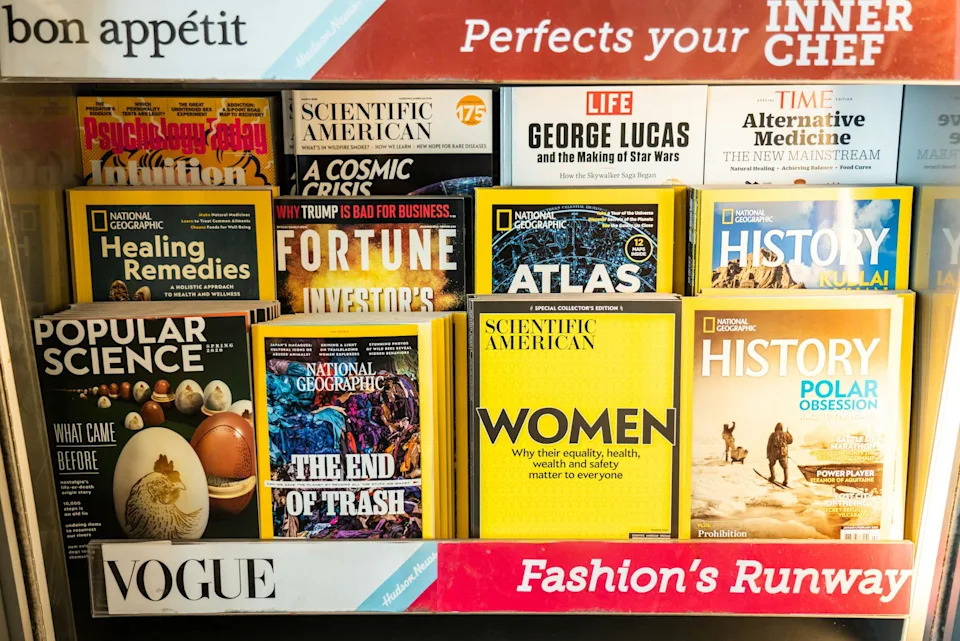
A big science section among periodicals on sale at an airport newsstand is a thing of the past.Alex Tai/SOPA Images/LightRocket via Getty Images
Notable Losses
Popular Science, with roots in the Popular Science Monthly (1872), illustrates the decline of legacy print. Once distributing more than one million copies per month (as recently as 2011), it moved to bimonthly, then quarterly, ended print in 2021 and — by the end of 2023 — produced no digital magazine, though it still publishes online articles and two podcasts. National Geographic, another storied brand, also faced layoffs and cut its monthly newsstand distribution, even while it remains in print.
Bigger Forces at Play
The challenges confronting science journalism mirror transformations across the entire journalism ecosystem. The rise of the internet has shifted advertising revenue and audience habits, hitting print journalism hard. From 2000 to 2025, U.S. Bureau of Labor Statistics data show roughly a 80% decline in U.S. newspaper employment versus about a 65% decline in periodical publishing jobs. Recent newsroom cuts at chains like hedge fund-controlled McClatchy — reportedly 30–50% of editorial staff at some papers — underline the scale of the crisis.
Economic pressures intersect with political forces: the emphasis on profits drives consolidation and disadvantages smaller outlets willing to prioritize civic missions such as recruiting future scientists, defending expert knowledge, or celebrating the natural world.
More Information, Different Quality
At the same time, science information is more plentiful than ever. The internet, web-only outlets, YouTube creators and newsletters (notably Substack) give audiences unprecedented access. According to National Science Foundation survey data, the internet surpassed television more than a decade ago as the public's main source for science information.
Quantity, however, is not the same as institutional journalism. Much online content favors quick takes and personalities and lacks the institutional investment needed for lengthy investigations, legal review and deep fact-checking. Promotional or unfiltered material produced by corporations or influencers rarely uncovers long-running errors, conflicts of interest, or systemic problems — the kinds of stories that established journalism is best positioned to pursue.
Conclusion
Are current alarms a moral panic? Partly. Is there cause for real worry? Also yes. The evidence points to a meaningful contraction in traditional, institutional science journalism — even as science communication flourishes in new formats. The path forward will require innovation: new business models, experimentation with digital platforms, and a recommitment to the investigative, public-interest functions of journalism.
Authors and Disclosures
This analysis was written by Bruce Lewenstein (Cornell University) and Chris Mooney (University of Tennessee). Bruce Lewenstein is a member of the National Association of Science Writers and in the 1980s and 1990s published research on Scientific American; the company that then owned the magazine provided limited travel and transcription support for that work. Chris Mooney is also a member of the National Association of Science Writers; his freelance work has appeared in publications discussed here, he served as Washington correspondent for Seed (2005–2007), and he worked at The Washington Post from 2014–2024. He currently publishes on Substack.
Help us improve.