Capt. Chesley "Sully" Sullenberger III, famed for the 2009 Hudson River landing that saved 155 lives, was inducted into the National Aviation Hall of Fame at age 75. He accepted the honor remotely and stressed that his career extended far beyond a single flight. In July he disclosed an Alzheimer's diagnosis and has encouraged openness about the disease; his wife urged more public conversation to reduce stigma. Alzheimer’s Association data show about 7.4 million Americans aged 65+ live with clinical Alzheimer’s dementia.
‘Sully’ Sullenberger Enshrined in National Aviation Hall of Fame — Urges Openness After Alzheimer’s Diagnosis
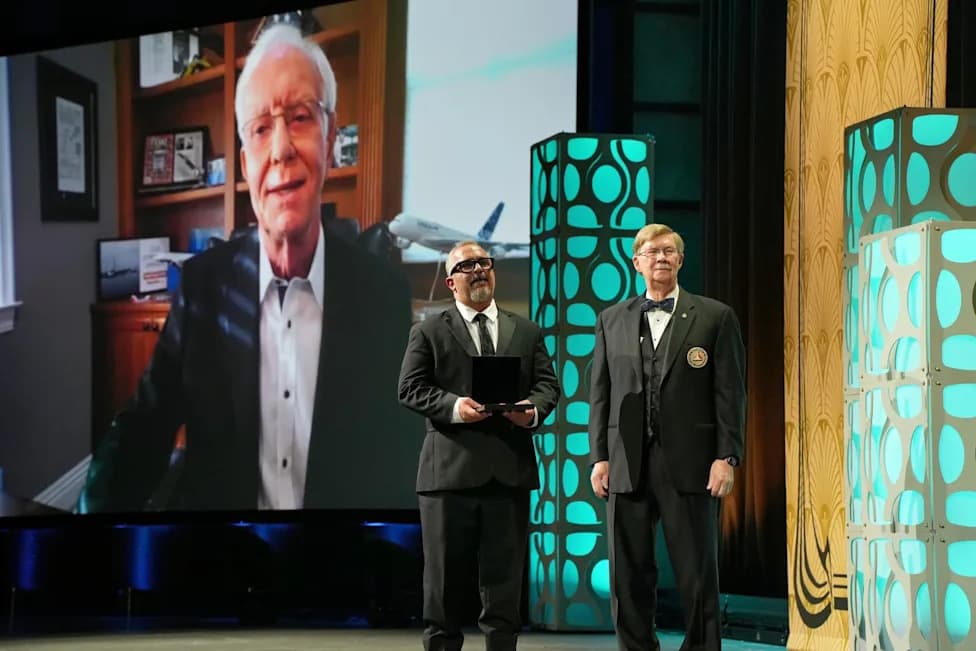
Chesley 'Sully' Sullenberger III attends his induction into the US National Aviation Hall of Fame by video on 24 September 2026 in Washington DC.Photograph: John Harrington Productions
Capt. Chesley "Sully" Sullenberger III, the pilot celebrated for the emergency landing of US Airways Flight 1549 on New York City's Hudson River in 2009, was inducted into the National Aviation Hall of Fame during a ceremony in Washington, D.C. The 75-year-old accepted the honor remotely, 17 years after the event that became known as the "Miracle on the Hudson."
Recognition and remarks
Sullenberger was enshrined as part of a six-member 2026 Hall of Fame class that included NASA astronauts and aviation researchers. Speaking by video, he congratulated his fellow inductees and expressed gratitude for the honor:
"I want to congratulate the other [inductees] on lifetimes of accomplishments. And I thank you for the honor of enshrinement in the National Aviation Hall of Fame."
While acknowledging that the 2009 ditching — later depicted in a film starring Tom Hanks — played a notable role in his selection, Sullenberger emphasized that his career was broader than one flight. "From a very young age, I knew I wanted to fly airplanes. That was the beginning of a lifetime following that dream," he said, adding that he felt fortunate to spend an entire working life doing what he loved.
The 2009 Hudson River Landing
A former U.S. Air Force pilot, Sullenberger was at the controls of US Airways Flight 1549 on Jan. 15, 2009. The Airbus A320 had departed LaGuardia Airport for Charlotte, North Carolina, carrying 150 passengers and five crew members when it struck a flock of birds and lost thrust in both engines. Determining the aircraft could not return to LaGuardia, Sullenberger executed a controlled ditching in the Hudson River; all 155 people on board survived.
Alzheimer's diagnosis and advocacy
In July, Sullenberger publicly revealed he had been diagnosed with Alzheimer's disease. He said the diagnosis gave him a new perspective on public service and encouraged others to speak up:
"This new phase of my life has challenged what it means to be of service. And the answer is to speak up. It is my hope that by sharing this, other families living in the shadows with this disease will feel they too can step forward."
In an interview on ABC's Good Morning America, he described the initial emotional impact: "All those emotions — the shock, the anger, why me?" His wife, Lorrie Sullenberger, urged more open conversation about Alzheimer's:
"This is a disease — not a character flaw. I think we need to talk about it more openly, and maybe other people can do the same."
Context and statistics
Data from the Alzheimer's Association indicate roughly 7.4 million Americans aged 65 or older are living with clinical Alzheimer's dementia, and about three out of four of those individuals are 75 or older. Sullenberger's public disclosure has been framed as part of a broader effort to reduce stigma and support families affected by the disease.
Legacy
Beyond the dramatic rescue on the Hudson, Sullenberger's long career in aviation and public life — from military service to airline captain and safety advocate — was central to his enshrinement. At 75, he remains a prominent voice on safety and, now, on destigmatizing Alzheimer's disease.
Help us improve.