Golden Dawn’s leaders were convicted as a criminal organisation in 2020 after years of violence and neo‑Nazi symbolism. Ilias Kasidiaris’s recent release and ongoing political activity — including backing the Spartans and helping to build new party structures — show how far‑right ideas have migrated into mainstream discourse. Private polls suggest a Kasidiaris‑linked force could win notable support, while legal changes restrict formal leadership but cannot fully stop clandestine influence. The article warns that dismantling parties is insufficient without broader civic and institutional vigilance.
Ilias Kasidiaris Walks Free — Can Greece’s Far‑Right Rebound?
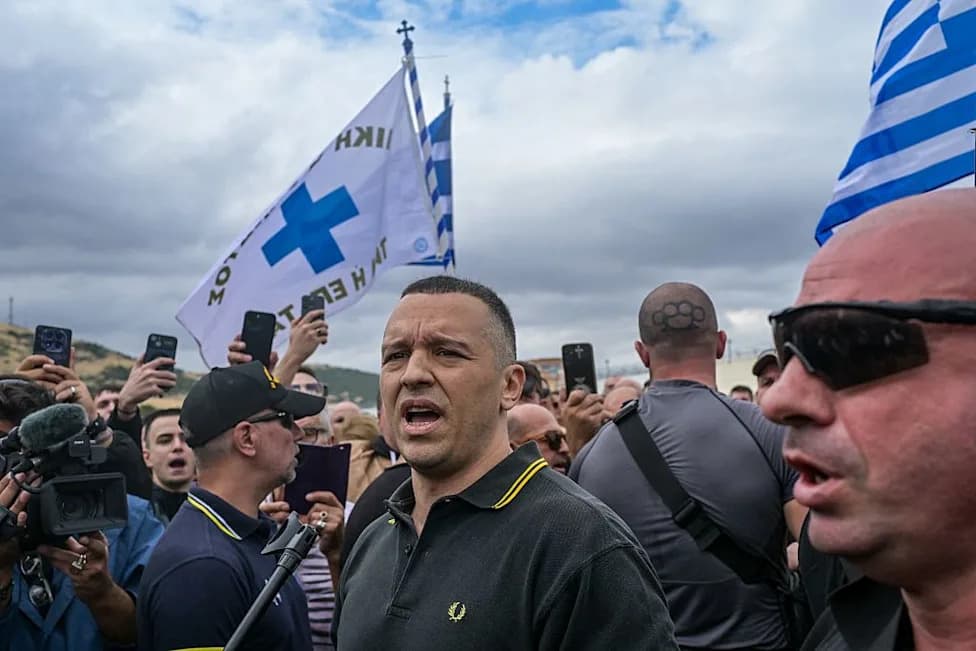
A court ruling in 2020 led to the jailing of most of Golden Dawn's leadership. But Greece's neo-Nazi subculture never went away — and with leading cadre Ilias Kasidiaris's release from jail, a new far-right party is taking form. (Aris Messinis / AFP via Getty Images)
For more than a decade, Golden Dawn’s rise, its street violence and its eventual criminal conviction marked one of the most disturbing chapters of modern Greek politics. With the recent release of Ilias Kasidiaris from Domokos Prison, those events are again centre stage — and the question is whether Greece has truly prevented a far‑right revival or merely driven it underground.
From Electoral Shock To Criminal Verdict
Golden Dawn entered parliament in May 2012 amid austerity and social turmoil. Its leaders mixed electoral politics with overt neo‑Nazi imagery and violent street squads that attacked migrants and political opponents. In October 2020, after a lengthy trial that began in April 2015, Greek courts ruled Golden Dawn operated as a criminal organisation; most senior figures received prison terms of roughly thirteen years.
Kasidiaris’s Release And Political Manoeuvres
Ilias Kasidiaris — convicted of directing a criminal organisation and sentenced to 13½ years — was released in September after serving under six years. His public reception at the prison gates, the selfies with supporters and his vow to return to the "front line" of politics underline a deliberate and highly visible comeback. Golden Dawn’s founder, Nikos Michaloliakos, was likewise moved to house arrest on health grounds last year.
From behind bars Kasidiaris remained politically active: after his own party Hellenes was barred from the 2023 ballot, he backed the previously unknown Spartans and helped propel them into parliament with viral social‑media activity. In 2025 Greece’s Special Highest Court found he had effectively acted as a concealed leader for that party — yet these activities were apparently not treated as disciplinary violations when he was considered for early release, raising questions about enforcement.
Repackaging, Networks And The Mainstreaming Of Far‑Right Rhetoric
Kasidiaris has largely abandoned explicit Nazi symbols in favour of an ultranationalist language: defenders of sovereignty, migration crackdowns and culture‑war rhetoric. That reframing mirrors a broader trend in Greek politics. Figures with far‑right pasts or sympathies — such as Adonis Georgiadis and Thanos Plevris, both linked to the old LAOS grouping — now hold senior government offices. Plevris’s harsh migration rhetoric, including past calls to make life unbearable for undocumented migrants, illustrates how ideas once associated with Golden Dawn have moved closer to the political mainstream.
Polls, Parties And Legal Limits
Private polling datasets reviewed for this article suggest a Kasidiaris‑linked list could currently attract roughly 6–8% support; a smaller published poll put the figure as high as 17%. The omission of such findings from headline published results risks underestimating the potential strength of a far‑right constituency.
New electoral rules introduced in 2023 bar Kasidiaris from formally leading a party until 2033. But legal restrictions have limits: he continued to coordinate politics from prison, his statements circulated widely on social media, and he helped bring other parties into parliament while outside formal leadership. The Supreme Court can disqualify parties judged to be controlled from the shadows, but enforcement remains challenging.
Why It Matters
Greece has a proud record of resisting fascism, but it also shows an alarming capacity to normalise extremist ideas when political space and social grievances allow. The Kasidiaris episode demonstrates that dismantling a party’s structure is not the same as uprooting the networks, rhetoric and constituency that produced it. Robust civic, political and legal responses are required if democratic norms are to hold.
Bottom line: Legal bans matter, but they are not sufficient on their own. The political soil that enabled Golden Dawn persists, and Kasidiaris’s return exposes how easily that soil can be cultivated again.
Help us improve.