James Marriott warns that algorithm-driven short-form media and rising screen time are eroding attention and undermining deep reading. He traces literacy's expansion from ancient Mesopotamia through Gutenberg and the Enlightenment, arguing that mass reading underpinned democratic engagement. Critics praise his diagnosis but fault him for underplaying structural drivers—class disparities and Big Tech's attention-extracting business model. Without democratic renewal and policy responses, the cultural loss could extend far beyond shorter attention spans.
How Digital Culture and Democratic Erosion Are Undermining Literacy

Mass literacy was ultimately a by-product of the struggles for mass democracy that defined the 20th century. With elites once again in control of the public sphere, people have naturally grown uninterested in the hollow culture money and power have produced. (Hulton Archive via Getty Images)
About two years ago a strange new breed of AI-created content began to populate social platforms: short videos starring hypersexualized, anthropomorphized fruit in increasingly absurd soap-opera plots. One clip shows a voluptuous strawberry cheating on her watermelon husband and later bearing two wolf cubs; another features an emasculated orange taking revenge on a womanizing banana; a darker variant depicts a tormented tangerine ultimately juicing his family. These lurid examples are easy to mock, but they also point to a broader cultural shift.
Attention, Algorithms and the Decline of Deep Reading
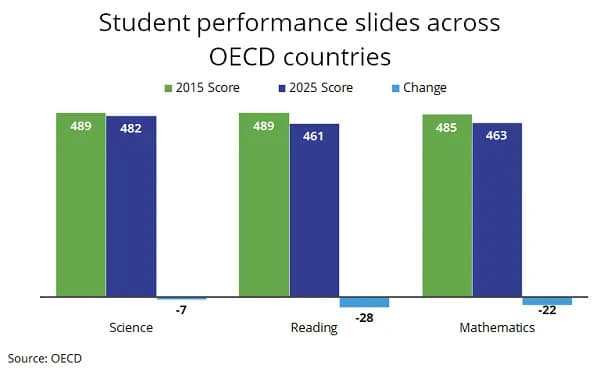
British journalist James Marriott argues that one casualty of this shift is human literacy. Framing his book as an "impassioned attack on the trivial and meaningless culture of the screen and a defence of the written word," Marriott marshals worrying statistics: in 2004 nearly 30% of Americans reported reading for pleasure; by 2023 that figure had fallen to about 16%. Books are shortening, comprehension of complex vocabulary is receding, and many young people now learn politics through TikTok, YouTube, and Instagram rather than extended printed argument.
Warnings about the corrosive effects of mass media are not new. Critics have lamented television since the 1950s. Marriott places the contemporary crisis in a long historical arc, asking whether the retreat from print signals a cultural evolution into a new "secondary literacy," or a deeper civilizational decline. While that historical framing is useful, the book often relies on aggregate statistics and rhetorical flourishes rather than detailed causal analysis.
From Cuneiform to Gutenberg to the Enlightenment
Marriott traces literacy's slow expansion from ancient Mesopotamia — when writing was the preserve of a narrow elite — through the Roman world, where perhaps 10–15% of people could read, and onto Gutenberg's movable-type press in the fifteenth century. The printing press, along with social forces such as Protestantism, helped make mass literacy conceivable. In the eighteenth century the spread of books, pamphlets and newspapers supported the rise of critical public debate and helped unsettle entrenched religious and political authorities.
"Reading was by no means inevitable," Marriott reminds readers, underscoring that literacy required a demanding cultural and neurological retraining.
Television, the Internet and the Fragmentation of Attention
Neil Postman's critique in the 1980s — that television's tilt toward spectacle and celebrity eroded the calmer, rational thought that reading fosters — feels even more apt today. The desktop computer and smartphone have made entertainment infinite and immediate. On TikTok, for example, users can skip roughly 260 videos in under 35 minutes. Phone features that enable "dual screening" (texting or browsing while watching) and streaming services that insert plot refreshers admit and reinforce distracted viewing.
Marriott is most persuasive when he describes how deep reading trains cognitive skills: drawing inferences, weighing evidence, holding competing ideas in mind, and following an argument to its conclusion. Short-form, algorithmically curated content tends to reward immediate emotional response and rapid consumption rather than sustained reflection.
Class, Business Models and Political Consequences
Where Marriott is weaker is in assessing structural causes. His book gives little space to class dynamics or to the business incentives that shape the attention economy. UK media regulator Ofcom has found that lower-income families watch about twice as much television and spend significantly more time on social media than wealthier households. Many parents treat screen time as an imperfect substitute for childcare. Meanwhile, the core business model of major tech platforms depends on capturing attention: more time on an app yields more ad impressions, richer user data and greater profit.
As whistleblowers and critics such as Tristan Harris have warned, designers and engineers deliberately optimize for engagement. "You can try having self-control, but there are a thousand engineers on the other side of the screen working against you," Harris observed, highlighting the imbalance between individual will and systemic design.
The cultural effects spill into politics. Data show parliamentary speeches in many Western democracies are becoming shorter and louder, favoring affective appeals over deliberative argument. Marriott points to figures like President Donald Trump — who famously eschews reading briefs — as emblematic of an attention-poor political style.
What’s At Stake
Marriott's defense of the written word is earnest and urgent, but it sometimes reads like a defense of elite culture rather than an analysis of democratic needs. He warns that canonical writers such as Shakespeare, Milton and Austen may fail to reach future audiences. That outcome is unlikely in absolute terms: elite spaces for the classics will persist. The real loss, critics argue, would be the erosion of mass literacy — the broad cultural formation of the last century that empowered working people, women and non-Western voices and underpinned democratic participation.
Without renewed commitments to democratic renewal, equitable education and regulatory scrutiny of attention-harvesting platforms, informed cultural participation may continue to decline. If that happens, the disappearance of literate habits could be only an early symptom of a far deeper civic unraveling.
Key Sources And Figures Mentioned: James Marriott (book under review), Neil Postman, Francis Bacon, Ofcom studies, Tristan Harris, TikTok usage statistics.
Help us improve.