Thomas Jefferson's handwritten 1787 letter to scientist David Rittenhouse, written from Paris, has been offered for sale alongside a major European scientific book for a guide price of $285,000 through the Raab Collection. In the note Jefferson urged peace, repayment of public debt, improvement of constitutions and expansion of agriculture. Dealers and commentators say the letter's themes still resonate amid modern debates over foreign policy, federal spending and constitutional norms.
Rare 1787 Thomas Jefferson Letter Up For Sale — A Warning That Resonates Today
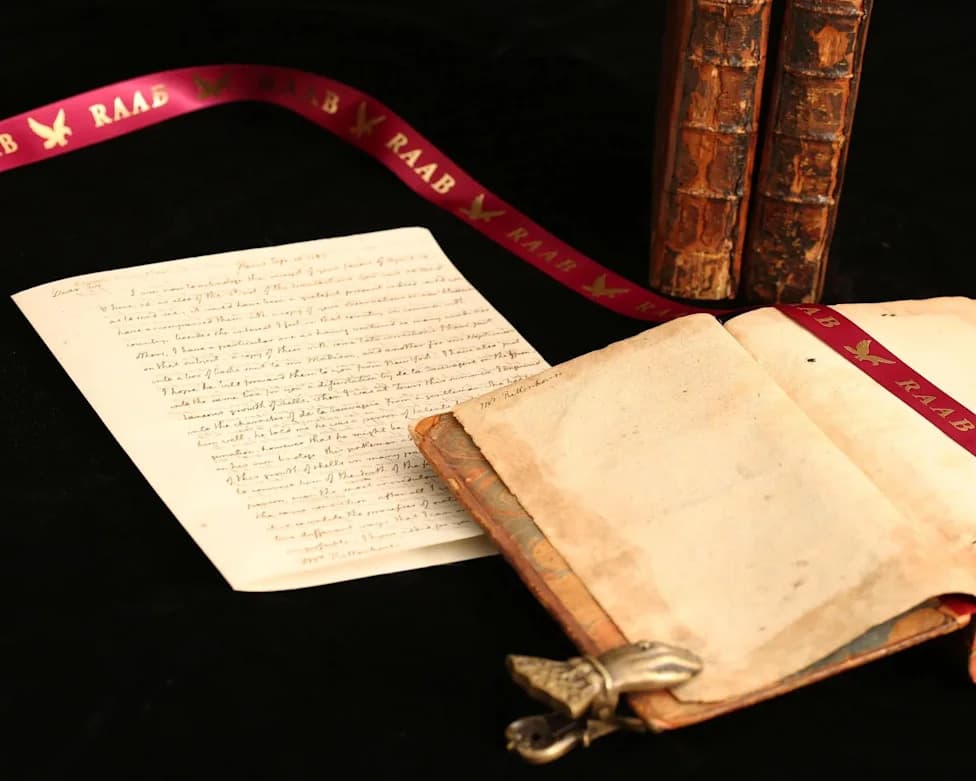
The 1787 letter from Thomas Jefferson to his friend and fellow member of the American Philosophical Society David Rittenhouse.Photograph: Raab Collection
A handwritten letter by Thomas Jefferson, dated 1787 and written while he served as the United States' minister in Paris, has been placed on the market by a private collector. Addressed to scientist and astronomer David Rittenhouse, the short but wide-ranging note outlines Jefferson's view of the priorities the young republic should pursue and includes a prescient warning that commentators say echoes in contemporary U.S. politics.
The Lot: The manuscript is being offered by the Raab Collection of Pennsylvania, paired with what dealers describe as "a major European scientific work." The pair carries a guide price of $285,000 and was previously exhibited at Texas A&M University.
What Jefferson Advised
Writing from Paris while the federal convention met in Philadelphia, Jefferson urged what he considered essential national goals. In the letter he wrote:
"Peace should be our plan, and the payment of our debts, improvement of our constitutions and extension of agriculture our principal objects."
Jefferson’s note emphasizes fiscal responsibility, constitutional refinement, agricultural development and a preference for peace — priorities he believed would help secure the nation's long-term prosperity.
Contemporary Resonance
Nearly 240 years after Jefferson penned those lines, some observers have contrasted his counsel with current political developments. The article links Jefferson’s recommendations to present-day debates over foreign policy, federal debt (reported to have topped $40 trillion), constitutional norms and agricultural policy. Those connections are presented as commentary rather than definitive conclusions.
Expert Context and Rarity
Nathan Raab, president of the Raab Collection, highlighted the letter’s continuing relevance and the rarity of the lot. He noted Jefferson wrote the note less than a decade after independence and that many of the subjects it addresses — war and peace, debt and constitutional structure — remain topics of public debate. Raab also pointed out the limits of Jefferson’s real-time knowledge: letters then traveled slowly, and, as he observed, the day Jefferson wrote the note the convention had in fact just concluded, a fact Jefferson would not have known for weeks.
The Raab Collection has handled other Jefferson material, including a 2024 sale of a 1802 letter about Jefferson’s finances and the discovery of a 1783 note to Virginia’s governor on citizens’ rights. But Raab called the Rittenhouse lot "at the very top" in terms of its intellectual breadth and the uncommon survival of both the letter and the gifted book together.
Why It Matters: Beyond market value, the document offers a compact window into Jefferson’s priorities at a formative moment in American history and invites reflection on which of those priorities endure or have evolved.
Help us improve.