Taxi drivers in Kabul are quietly playing Afghan and regional music inside their vehicles despite a Taliban ban enforced by the Propagation of Virtue and the Prevention of Vice (PVPV). Drivers lower the volume or switch off at checkpoints, and some have had USBs or memory cards seized or destroyed. For many, secretly playing music is a small act of cultural resistance and a source of comfort in a city where public entertainment has been curtailed since 2021.
Kabul Taxi Drivers Quietly Defy Taliban Music Ban, Turning Tunes Into Small Acts of Resistance
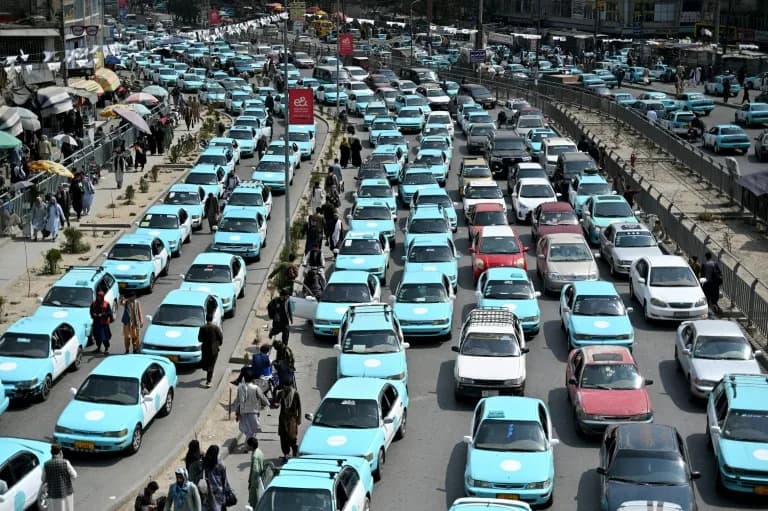
Some Afghan taxi drivers defy a ban on music in public places imposed by the Propagation of Virtue and the Prevention of Vice Ministry (Wakil KOHSAR)
Taxi drivers across Kabul have begun quietly playing Afghan and regional music inside their cars, a subtle but deliberate rebuke to the Taliban's ban on public music despite the risk of being stopped by the morality police.
For five years the city's usual soundtrack — from restaurants, cafes and shops — has been largely silenced, replaced by the religious and patriotic anthems approved by authorities who returned to power in 2021. Now some drivers are switching on folk and pop tracks when they feel it is safe, lowering the volume or turning the music off entirely whenever checkpoints or PVPV officers are nearby.
The ban is enforced by the Propagation of Virtue and the Prevention of Vice (PVPV) Ministry. PVPV regulations state that 'since music is forbidden and causes annoyance to passengers, drivers must refrain from playing or listening to it.' The ministry did not respond to requests for details about penalties for playing music, though people who breach other PVPV rules can face imprisonment.
'At every checkpoint we pass, we lower the volume of the music or even turn it off completely... so I don't get into trouble with them,'said Roeen, a 28-year-old taxi driver who gave only his first name for security reasons. He told AFP from his sky blue-and-white taxi that PVPV officials 'have a lot of authority' and that drivers are 'definitely too afraid of them to be able to listen to music at a higher volume.'
Driving through Kabul's congested, noisy streets has made Roeen more drawn to music since the ban: 'I have to make sure that even if I can't listen in the early morning, by eight o'clock my music is on,' he said. For him and others, playing music quietly has become a personal form of cultural protest in a country where many forms of public entertainment, including cinema, are restricted.
'Stress' And The Risk Of Confiscation
Another driver, who asked to remain anonymous, said he only plays music when he is alone and surrounding traffic noise can mask it. The 32-year-old said the pleasure of listening has been replaced by anxiety: 'Before, whenever a person wanted, they could listen without any worry or stress. But now... personally I listen — but with some stress.'
He reported being stopped twice at checkpoints for carrying a USB stick and a memory card containing songs; when he admitted they held music, officers reportedly broke the devices. Provincial branches of the PVPV have at times reported burning musical instruments as part of their enforcement, according to ministry spokesman Saiful Islam Khyber, though the ministry does not publish comprehensive figures on seized items.
Passengers also try to avoid attracting attention. Master's student Shamsullah Ahmad, 29, said he checks whether a taxi has a music player before getting in. 'I prefer music in the car because wearing headphones would be noticed; even at low volume, it is better than silence,' he said. The morality police have reportedly removed headphones from people's ears to check whether they were listening to music.
Shared taxis remain a common and affordable way to navigate Kabul, where a formal public-transport system is lacking. Vehicles frequently carry multiple passengers in tightly packed seats, making the presence of music — even softly played — a small but meaningful assertion of cultural life amid growing restrictions.
Help us improve.