The South Carolina State Museum removed a 1956 Ku Klux Klan pamphlet from its "America's 250th" exhibit after visitors said its placement implied Senator Strom Thurmond had spoken at the rally referenced in the flyer. Museum officials said the removal corrects confusing context while preserving the exhibit's broader coverage of racial history. Critics, including Rep. JA Moore, argue the decision risks minimizing painful but real elements of the state's past. The dispute underscores tensions over how museums should display racist artifacts and provide historical context.
S.C. State Museum Removes 1956 KKK Pamphlet From America's 250th Exhibit Amid Context Concerns
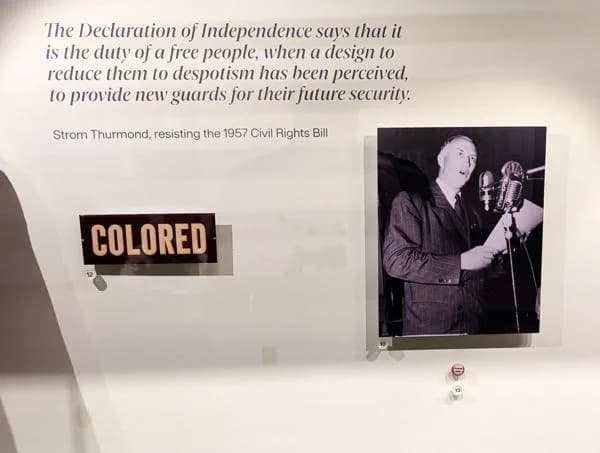
An exhibit at the South Carolina State Museum in Columbia shows a void where a 1956 Ku Klux Klan pamphlet was once displayed. Museum officials said the artifact was removed in efforts to present a "clearer and more historically accurate" portrait of the state during the Civil Rights era. Nick Reynolds/Staff
The South Carolina State Museum in Columbia has removed a 1956 pamphlet produced by the Ku Klux Klan from its "America's 250th" exhibit after museum staff concluded the item's placement risked creating a misleading historical impression, officials said.
The flyer had been displayed in a section that traces South Carolina's history from the Revolutionary era to the present and invites visitors to consider how Revolutionary-era ideals have shaped the nation. That section also features Civil Rights–era artifacts such as a stool from a segregated Woolworths lunch counter used during a 1960 sit-in by Black college students, a 1940s segregation sign labeled "colored," and a campaign pin from Sen. Strom Thurmond's 1948 States' Rights Party presidential run.
Museum spokesperson Chandler Mack said staff removed the Klan pamphlet after multiple visitors said its proximity to a portrait and items associated with Thurmond left the mistaken impression that Thurmond had spoken at the specific rally cited in the flyer. "Museum staff recently determined that the arrangement of some objects created confusion about their historical context," Mack said. "To avoid any unintended misunderstanding, we removed the flyer. This change does not alter the overall content of the section; it simply allows us to present the materials in a clearer and more historically accurate way."
Photographs of exhibit signage show the reference to the pamphlet crossed out in black marker; a collections code for the item remains visible on the label. Museum officials say the adjustment was meant to correct context and reduce the potential for visitors to draw inaccurate conclusions from the display layout.
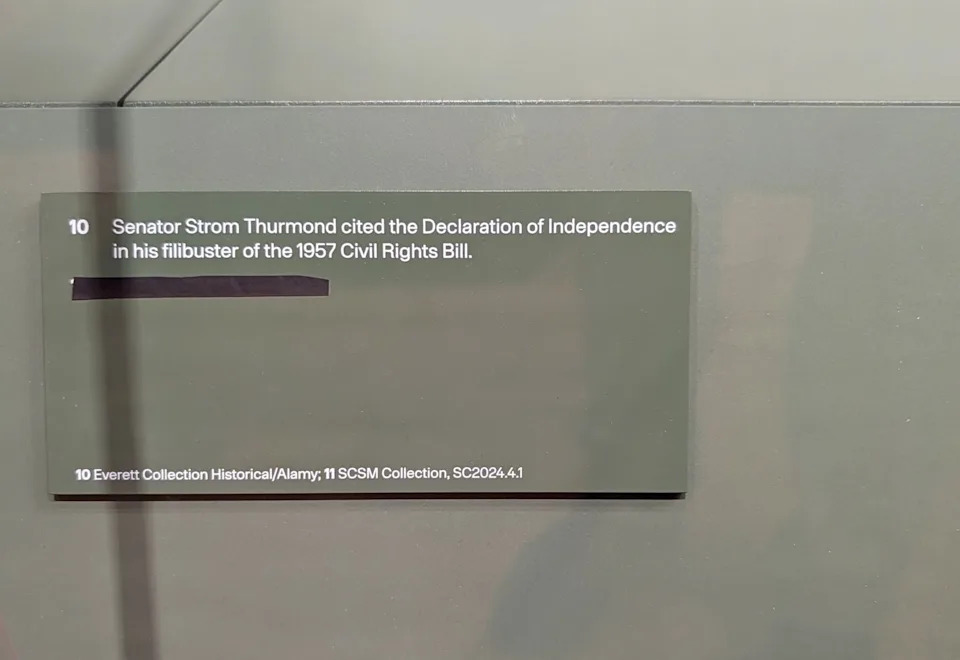
A reference to a former Ku Klux Klan artifact on signage in the South Carolina State Museum had been deleted, but a reference to the item's code in the museum's collections can still be seen. Nick Reynolds/Staff
Debate Over Historical Presentation
Not everyone agreed with the museum's decision. North Charleston Democratic state Rep. JA Moore, a member of the Legislative Black Caucus, said removing the pamphlet risks softening or erasing painful elements of South Carolina's past. Moore cited personal family trauma — including a cross-burning at his father's home in the 1960s and the 2015 racially motivated shooting at Emanuel AME Church in Charleston that took his sister's life — to underscore why confronting these histories matters.
"These people terrorized my forefathers. But the truth of the matter is that they existed. They were here. They were very present in South Carolina," Moore said. "We can try to pretend that these evils did not happen. It doesn't change the fact that they do."
The museum maintains other exhibits that document Black South Carolinians' experiences across eras — from slavery in the Antebellum period to the expanding civic influence of Black communities in the 20th century and beyond.
Context On Strom Thurmond And The Klan
The controversy also highlights the complicated historical record of Sen. Strom Thurmond. Though Thurmond was a well-known segregationist and Dixiecrat presidential candidate in 1948, his interactions with the Klan were mixed: his 2003 New York Times obituary cites an episode in 1940 when he urged a grand jury in Greenville to act against what he called "the most abominable type of lawlessness." At other times he sought protections or favorable treatment linked to Klan activities, including pushing for police protection for a 1949 Klan rally in Denmark and pressing for tax exemptions for Klan-held property. Thurmond also called for investigations into a 1950 attack on a Black-owned nightclub in Myrtle Beach; although charges were filed against several alleged assailants, none were prosecuted.
The museum's choice to remove the flyer underscores ongoing tensions about how museums should display racist or extremist artifacts: whether to include every primary document and risk misinterpretation, or to curate displays selectively to ensure accurate context and avoid inadvertently promoting hateful ideology.
Help us improve.