Rep. Brendan Boyle
How Democrats Could Team Up With Trump to End the Debt Ceiling — Permanently
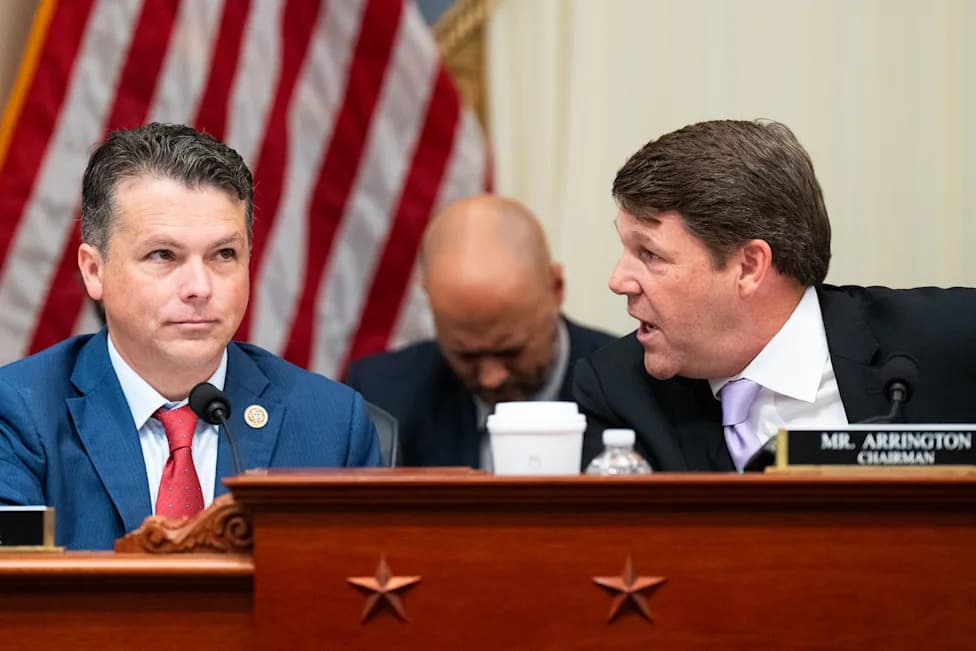
Rep. Brendan Boyle, the ranking Democrat on the House Budget Committee, listens as Republican Chairman Jodey Arrington speaks during a markup hearing in the Cannon House Office Building on July 16, 2026. —Bill Clark–CQ-Roll Call, Inc via Getty Images
Sometime next year the U.S. government is expected to reach its statutory debt limit again, a recurring moment that frequently turns into a high-stakes partisan showdown — and a risk of market turmoil — as lawmakers use the threat of default to press the White House for concessions.
If Democrats reclaim one or both chambers of Congress, that showdown could either produce another impasse or, unexpectedly, a bipartisan opportunity. President Donald Trump has publicly advocated eliminating the debt ceiling, a position that clashes with many Republicans but aligns with a notable segment of congressional Democrats. That alignment has prompted Rep. Brendan Boyle (D-Pa.), the top Democrat on the House Budget Committee, to push for a lasting fix.
"I will not vote to simply kick the can down the road again and just raise the debt ceiling for another 18 months," Boyle told TIME. "My next vote on the debt ceiling will only be to permanently reform it to end the dysfunction around it once and for all."
What Boyle Proposes
Boyle's plan, introduced as the Debt Ceiling Reform Act in 2023, would stop routine congressional votes to raise the statutory cap and largely transfer authority to suspend the limit to the Treasury secretary. Under the proposal, the Treasury secretary could suspend the debt ceiling for periods of up to two years at a time. Congress would retain a check: lawmakers could block a suspension through a joint resolution, subject to the president's signature.
Boyle says the approach has drawn quiet bipartisan interest from members tired of repeated votes on the same issue. He argues it would remove the periodic political brinkmanship that has forced last-minute deals, rattled markets and produced credit-rating headaches.
Why This Matters
Raising the debt ceiling does not authorize new spending; it merely allows the Treasury to borrow to pay obligations Congress has already approved. Still, past standoffs — most notably in 2011 and again in 2023 — have contributed to credit downgrades, short-term borrowing turbulence and big market swings.
Congress most recently raised the limit in July 2025, adding $5 trillion and setting the cap at $41.1 trillion. The Treasury is projected to hit that limit sometime in 2027, though estimates vary. Once the cap is reached, the department can use cash balances and "extraordinary measures" for a limited period before arriving at the so-called X-date, when it could no longer meet all obligations on time.
History, Politics and the Path Forward
The U.S. did not have a debt ceiling for much of its history; the mechanism was adopted in 1917 and has become an increasingly contentious political tool in recent decades. In 2011, Republicans used the approaching limit to extract spending caps and a deficit-reduction process from President Barack Obama, a showdown that nearly triggered default and preceded the first U.S. credit downgrade. Twelve years later, the 2023 agreement between Speaker Kevin McCarthy and President Joe Biden likewise traded spending and policy changes for a suspension of the limit through the end of 2024.
Boyle sees a strategic opening if Democrats control the House and Trump occupies the White House: with Trump publicly open to scrapping the ceiling, Democrats could press for a structural change rather than another temporary raise. That calculus is political as well as policy-driven: Boyle is likely to chair the House Budget Committee if Democrats win the House, and he says reforming the ceiling would be a signature accomplishment.
Trump on Truth Social: "The Debt Limit should be entirely scrapped to prevent an Economic catastrophe. It is too devastating to be put in the hands of political people that may want to use it despite the horrendous effect it could have on our Country and, indirectly, even the World."
Boyle also plans to use the Budget Committee to tackle broader budget process reforms and to reassert Congress's constitutional power over spending. He has signaled he will call senior administration officials to testify about tactics that shifted or withheld funds in prior years.
For now, the prospect of permanently resolving the debt-ceiling cycle remains politically uncertain. But if parties align — a Democratic Congress and a Republican president who favors abolition — the long-running mechanism that has triggered repeated fiscal fights might finally be on the table for permanent reform.
Help us improve.