The first global map of arbuscular mycorrhizal fungi estimates about 10 metres of fungal filaments in a teaspoon of healthy soil, adding up to roughly 110 quadrillion kilometres worldwide—enough to reach the Sun on the order of hundreds of millions of times. Using data from over 16,000 soil cores and machine learning, researchers found grasslands hold about 40% of the network. These fungi sequester an estimated 4 billion tonnes of CO2-equivalent per year, yet most dense hotspots remain unprotected and agriculture has significantly reduced fungal biomass.
Earth's Hidden Fungal Network Could Stretch to the Sun About 700 Million Times
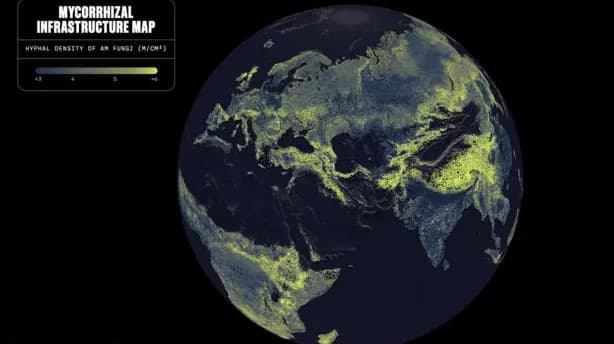
The first global map of Earth’s arbuscular mycorrhizal fungal networks, revealing an underground living web estimated to stretch 110 quadrillion kilometers | Image Credit: Truth & Beauty / Moritz Stefaner, Justin Stewart – SPUN
Scientists have mapped a vast, living network of microscopic fungal threads in Earth's topsoil—so extensive that, by one estimate, those filaments could be stretched end to end to reach the Sun on the order of hundreds of millions of times.
What the Map Shows
The first global map of arbuscular mycorrhizal fungi, published in the journal Science by researchers at the Society for the Protection of Underground Networks (SPUN), draws on more than 16,000 soil cores and machine-learning models to estimate fungal distributions worldwide. The team calculates roughly 10 metres of living fungal filaments in a teaspoon of healthy soil and—when extrapolated across global topsoil—about 110 quadrillion kilometres in total.
How These Fungi Work
These fungi do not typically form visible mushrooms. Instead, they make microscopic tubes that weave through soil and connect directly into plant roots. In exchange for carbon from plants, they deliver water and essential minerals. About 70% of terrestrial plants rely on this symbiosis, a partnership that has persisted for roughly 475 million years.
Key Findings and Impacts
The global model finds grasslands store the largest share of this network, holding around 40% of the estimated filaments. Together, arbuscular mycorrhizal fungi draw down an estimated 4 billion tonnes of CO2-equivalent into soils each year—about 11% of typical annual human emissions. Some of the densest hotspots appear beneath the Everglades and across the Tibetan Plateau, but most of those areas lack formal protection.
How Farming Disrupts the Network
Agricultural practices substantially reduce fungal biomass. Croplands contain roughly half the fungal biomass of the wild soils they replaced—largely because tillage severs fungal threads. Fertilizer use also has a quieter but profound effect: when plants receive phosphorus from fertilizer, they reduce or stop trading with the fungi that previously supplied much of their phosphorus, leaving fungi sidelined even as crops continue to grow.
Limits of the Map
The new map focuses only on arbuscular mycorrhizal fungi. Other mycorrhizal systems that support trees like pines and oaks, plus decomposer fungi, are not included because comparable global estimates do not yet exist. The 110-quadrillion-kilometre figure is an extrapolation based on sampled data plus machine-learning estimates, not a literal measurement of every filament.
Toby Kiers, SPUN's executive director, called the work "one of the most exciting studies" of her career; the dataset is intended to help governments and conservation groups identify dense, unprotected underground networks.
Why It Matters
These networks play a major role in plant nutrition and soil carbon storage. Protecting and promoting healthy mycorrhizal communities could support biodiversity, improve soil resilience, and help climate mitigation efforts. The new map highlights where protections are most needed and where agricultural practices could be altered to restore underground connectivity.
Help us improve.