The indri (Indri indri), Madagascar’s only singing lemur, times mouth opening with pitch much like trained human vocalists, a new study finds. Using 83 videos of 19 wild indris and markerless motion tracking, researchers show indris open their mouths wider for higher notes—likely boosting resonance and helping calls carry through dense rainforest. The similarity to human vocal technique may reflect convergent evolution over roughly 74 million years.
How Indri Lemurs ‘Sing’ Like Opera Vocalists: Mouth Shape, Pitch and Long-Distance Calls
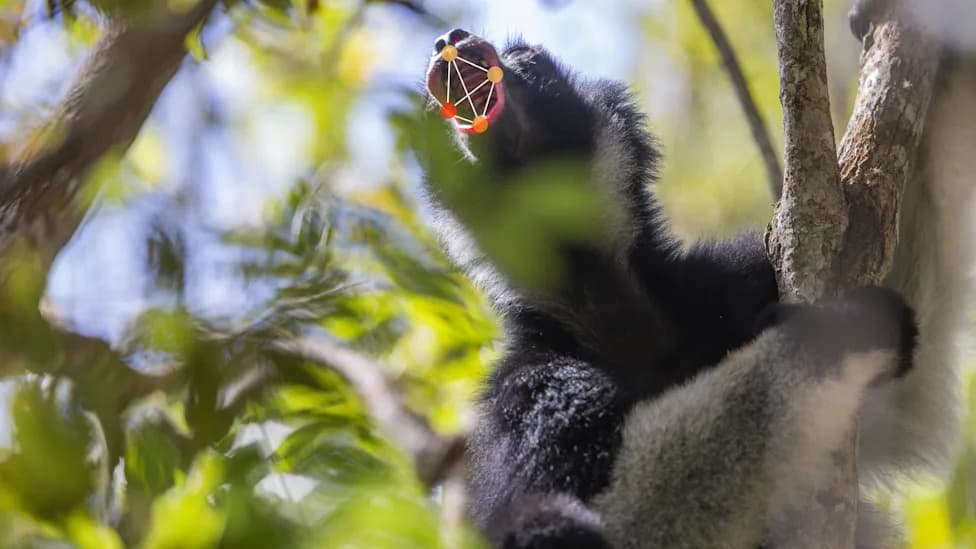
How the points of the mouth are tracked during singing.
With piercing, siren-like calls, the indri (Indri indri) is Madagascar’s only known singing lemur. These canopy-dwelling primates produce long, haunting vocalizations that can carry across large distances—and a new study shows they shape their mouths to help those sounds travel.
A paper published in PLOS Computational Biology reports that indris coordinate mouth opening with pitch in a way comparable to trained human singers. The higher the note, the wider an indri opens its mouth, suggesting a form of "formant tuning" that may boost resonance and help high-pitched notes propagate through dense rainforest.
Researchers analyzed 83 video recordings of 19 wild indris, merging field audio with markerless motion-tracking (pose-estimation) to follow upper and lower lip positions frame by frame. The team found a consistent correlation: as vocal frequency rose, mouth opening increased.
Why this matters: Widening the mouth at higher pitches changes the vocal tract's resonant properties and can amplify harmonics—exactly what opera singers do to project sound without amplification. For indris, this likely improves the reach and clarity of calls used to reinforce group bonds and to warn neighboring groups.
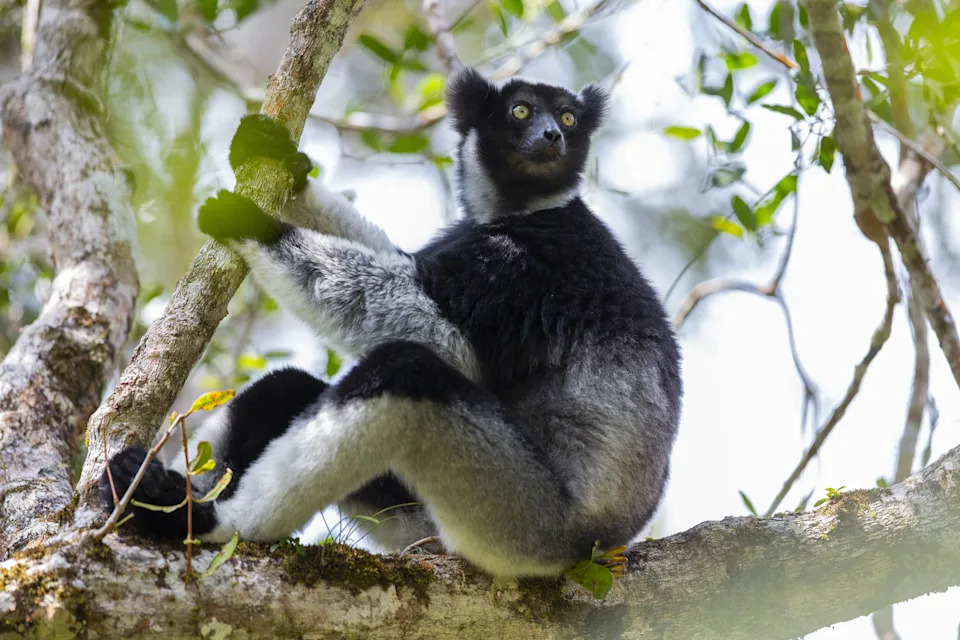
An indri in the Maromizaha forest.Image: Filippo Carugati.
"Every time the pitch of an indri's song rose, we could see its mouth opening wider, frame by frame," said primatologist Chiara De Gregorio, a study co-author and research fellow at the University of Warwick. "It's the kind of fine-tuned coordination between voice and body that we usually associate with trained human singers, not with a lemur singing from the forest canopy."
Co-author Filippo Carugati of the University of Turin added that applying markerless pose estimation to footage recorded in the wild allowed researchers to link visible facial movements directly to acoustic changes—insights that audio alone cannot provide.
Image: Filippo Carugati (Maromizaha forest)
Humans and indris last shared a common ancestor roughly 74 million years ago. The authors argue these parallels in vocal production are best explained by convergent evolution: distinct lineages arriving at similar solutions to the problem of transmitting signals through cluttered, absorptive habitats.
Study details: PLOS Computational Biology; 83 videos of 19 wild indris; markerless motion-tracking; frame-by-frame lip-position analysis correlated with vocal frequency; results consistent with possible formant tuning to enhance long-distance communication.
Help us improve.