Preservation Is An Act Of Resistance. The Stonewall National Monument Visitor Center uses its authentic location at 51 Christopher Street to connect the 1969 uprising to contemporary queer life and to center the voices who lived it. Since opening in June 2024 the center has hosted 135,000+ visitors, collected 17,000+ journal entries, and delivered 100+ educational programs. The authors argue that preserving memory — not just objects or buildings — is a collective responsibility that requires active, year‑round engagement.
Preserving Memory Is an Act of Resistance — Inside the Stonewall Visitor Center
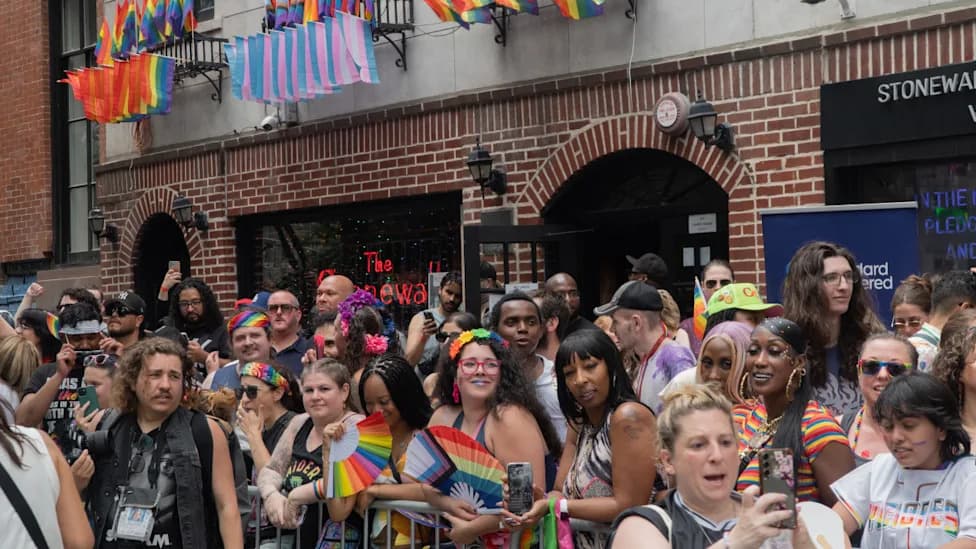
More than 35 people crowd the sidewalk outside the Stonewall Inn and Stonewall National Monument Visitor Center, on Christopher Street in Manhattan, watching NYC Pride March 2026. Dozens of small pride-themed flags hang on ironwork located below windows above the inn. This location in Greenwich Village is known as Stonewall.
Preservation is not passive. It is a deliberate act: to say plainly that this happened, that these people lived and loved and fought, and that their lives mattered. At a time when history itself is being contested, safeguarding the full, often uncomfortable truth of LGBTQIA+ struggles is an act of resistance.
Preservation as a Choice
At WorldPride in Amsterdam, leaders from around the globe convened to talk about protecting queer museums, memorials, and historic sites. Though their contexts differed, the central challenge was the same: LGBTQIA+ communities have survived generations of persecution and deliberate erasure and repeatedly transformed that oppression into living heritage. That transformation requires intentional preservation — not of objects alone, but of memory and meaning.
The Stonewall National Monument Visitor Center
When President Barack Obama designated Stonewall a national monument in 2016 — the first in the United States honoring LGBTQIA+ rights — the next question was clear: how do we ensure visitors understand what happened here? The answer led to the creation of the Stonewall National Monument Visitor Center at 51 Christopher Street, located within the original footprint of the Stonewall Inn.
The Visitor Center was designed to do more than display artifacts. It uses the authenticity of place to link the 1969 uprising to contemporary experiences, centering LGBTQIA+ designers and working directly with Stonewall pioneer Mark Segal to ensure historical accuracy and to elevate the voices at the heart of the story.
Preservation Beyond Bricks And Plaques
When people imagine endangered historic sites, they often picture threatened buildings. But an equally dangerous threat is the gradual sanitizing or erasure of the history a place represents. Stonewall’s inclusion on the National Trust’s 2026 list of America’s Most Endangered Historic Places highlights that risk: it is not only the physical site that can be lost, but the meaning and memory attached to it.
"Preservation is not simply about saving something. It is about who gets to tell the story of what was saved."
How Everyone Can Preserve Memory
Most people will never build a museum or run a national monument — but everyone can preserve memory. Preservation happens when a parent tells a story once deemed too uncomfortable, when an educator refuses to reduce LGBTQIA+ history to a footnote, or when a community refuses to let its history be rewritten. Teaching, documenting, donating, creating art, and sharing personal stories all make preservation possible.
Since opening in June 2024, the Stonewall National Monument Visitor Center has welcomed more than 135,000 visitors from all 50 states and 95 countries, collected over 17,000 visitor journal entries, and delivered more than 100 educational programs for schools, employee groups, Gender and Sexuality Alliances, and community organizations worldwide. These numbers reflect not only attendance, but people encountering history and recognizing themselves as participants in its next chapter.
Make Memory a Responsibility
Preservation turns memory into responsibility. Progress is neither inevitable nor self-sustaining: institutions endure because people sustain them, stories live because people keep telling them, and rights persist because people defend them. A rainbow flag in June is meaningful, but symbolism alone cannot carry the work. Institutions, histories, and communities require active support year-round.
What will you carry home from WorldPride? Maybe you will teach. Maybe you will document, donate, create, or share your story. There is no single correct way to participate — only a call for all of us to do the work of remembering and protecting what matters.
Anne Marie Gothard and Diana Rodriguez are co‑founders of the Stonewall National Monument Visitor Center in New York City.
Help us improve.