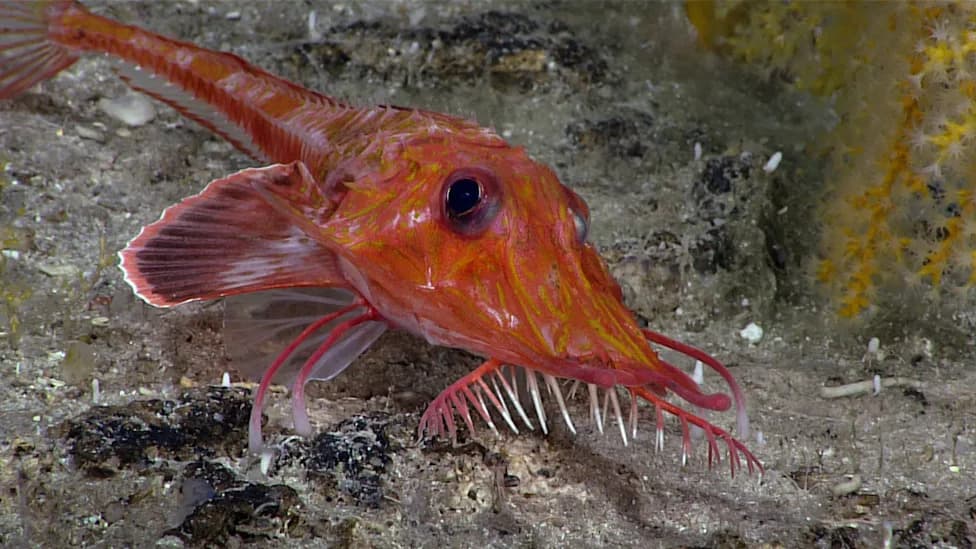
Researchers recorded the first known video of the armored searobin Scalicus engyceros appearing to walk backward along the seafloor using detached, leg‑like pectoral‑fin rays. The footage, captured by an ROV in the northern South China Sea and reported in Ocean‑Land‑Atmosphere Research, also shows a rake‑like barbel that may help the fish probe sediment for prey. The animal reacted to the vehicle's lights before swimming away, suggesting some light sensitivity. Live deep‑sea observation links morphology to behavior and highlights growing threats to these poorly known habitats.
Rare Footage Shows Deep‑Sea Fish 'Walking' Backwards Along Seafloor
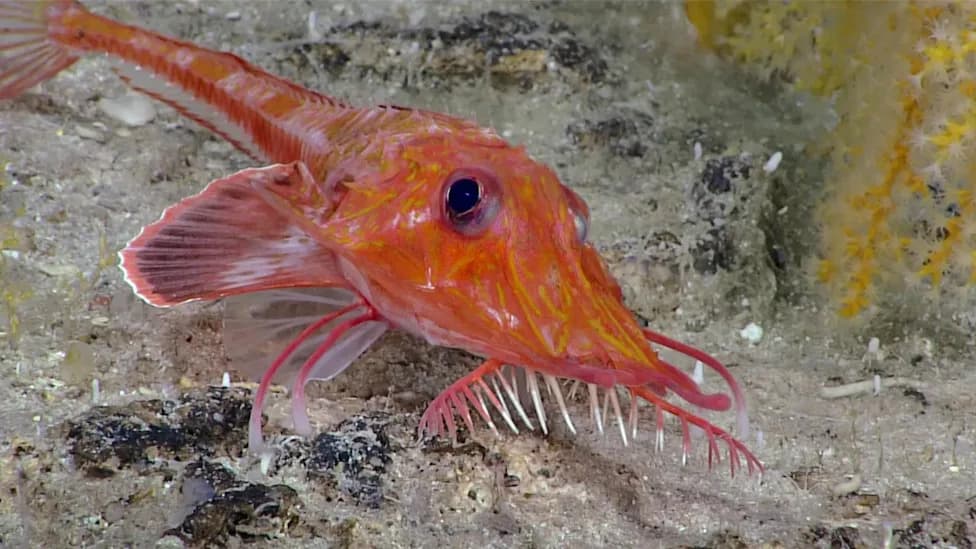
Photo Credit: NOAA Ocean Exploration, 2025 Beyond the Blue
Scientists have captured rare deep‑sea footage of a fish appearing to 'walk' backward across the seabed, revealing a surprising behavior that links an odd preserved specimen to its living counterpart.
The animal, identified as Scalicus engyceros — an armored searobin — was recorded by a remotely operated vehicle (ROV) in the northern South China Sea. Armored searobins are notable for bony plates and detached pectoral‑fin rays that function like leg‑like appendages. The new video, published in Ocean‑Land‑Atmosphere Research, appears to show the fish deliberately using those free fin rays to move in reverse along the sediment, which the authors describe as the first documented case of backward 'walking' using leg‑like fins.
“Our study delivers a paradigm‑shifting revelation: the deep‑sea fish Scalicus engyceros...is among the few fish species known to walk,” said Han Tian, a postdoctoral researcher at Sun Yat‑sen University in Guangzhou.
The footage also highlights a prominent rake‑like barbel projecting from the fish's underside. Researchers suggest that, while the barbel may make locomotion awkward, it likely provides an advantage for probing, digging or detecting prey buried in sediment. The searobin's relatively large eyes are another adaptation to dim, deep habitats and may help it detect bioluminescence or faint light.
Observers noted the fish seemed largely unbothered by the ROV's approach but did react to the vehicle's lights before swimming away, indicating some retained light sensitivity. This behavior underscores the value of in situ observation: preserved specimens in museums reveal morphology, but live footage reveals function and behavior.
Why This Matters
Deep‑sea ecosystems remain poorly documented and are increasingly threatened by industrial activity, pollution and warming oceans. Recording animals in their natural environment helps scientists understand how morphology relates to movement, feeding and other behaviors — and can produce unexpected discoveries like this one.
Other Recent Rare Ocean Observations
- Drifting oarfish sighted near Taiwan.
- Female angel sharks gathering in cooler water pockets as seas warm.
- Unusual attacks on vessels by killer whales near Spain.
- A giant octopus approaching a filmmaker in British Columbia.
- A round stingray lashing out after being handled on a California beach.
Each video reminds researchers that many behaviors remain unseen until cameras reach these dark habitats. Continued deep‑sea exploration and careful protection of these environments are essential to preserve both known and yet‑to‑be‑discovered species and behaviors.
Help us improve.