Scientists captured video of Scalicus engyceros, an armored searobin, walking backward along the seafloor — the first recorded instance of backward locomotion in a fish. The species uses stiff, free pectoral-fin rays like legs and bears rake-like barbels for probing sediment. Filmed in the northern South China Sea, the fish showed some sensitivity to light before swimming away. Researchers say in situ deep-sea observations are revealing new behavioral and evolutionary adaptations.
First-Ever Backwards-Walking Fish Filmed in the South China Sea
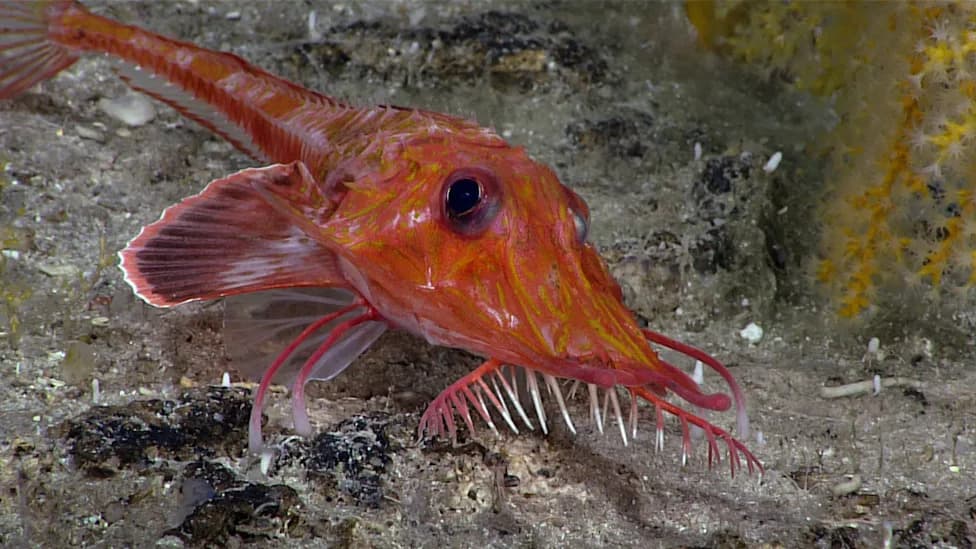
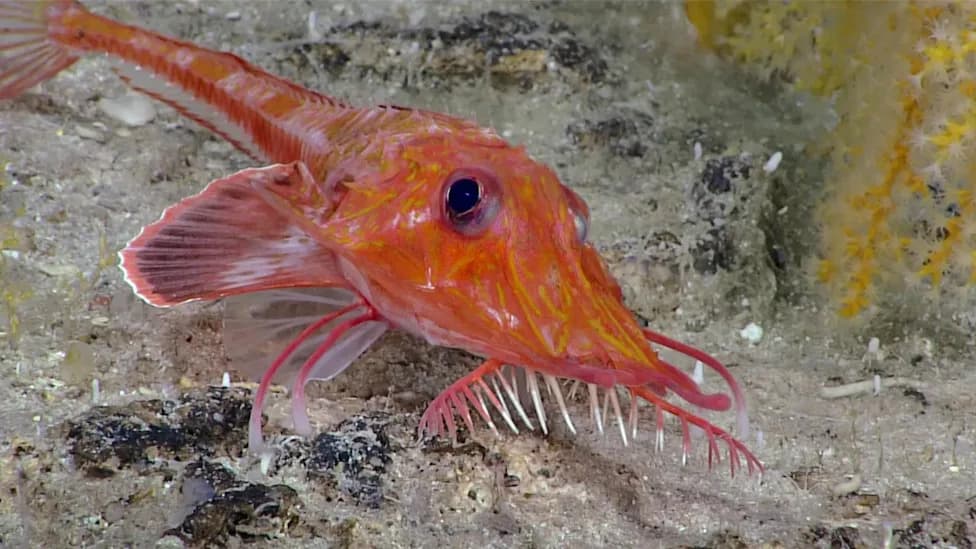
An armored searobin spotted during Dive 11 of NOAA's Papahānaumokuākea ROV and Mapping expedition in 2025. This was one of the team's "fishier" dives thus far, with numerous fish sightings, including this armored sea robin, seen at a depth of approximately 493 meters (1,6,17 feet). Armored sea robins use modified fins to move across the seafloor and branched "whiskers" in front of their mouths to help them sense food.
Chinese scientists have recorded the first known case of a fish walking backward along the seafloor. The footage, captured by a deep-sea submersible in the northern South China Sea, shows Scalicus engyceros, an armored searobin, using its stiff pectoral-fin rays to move in reverse across sediment.
Armored searobins are notable for their unusual anatomy: bodies partly covered in bony plates and long, rigid free pectoral-fin rays that protrude like tiny legs. In Scalicus engyceros these fin rays appear to function as supports for locomotion, allowing the fish to “walk” along the ocean bottom rather than swim continuously.
The research, published in Ocean-Land-Atmosphere Research, provides both video documentation of this behavior and the first scientific description of backward locomotion in a fish species. The team also observed rake-like barbels extending from the fish’s head. Although these barbels seem to make walking a bit awkward, they likely help the fish probe, dig, and locate prey buried in sediment.
Researchers noted that Scalicus engyceros had large eyes typical of many deep-sea dwellers. The animal did not react strongly to the approaching submersible, but it did respond to the vehicle’s light beam before swimming away, suggesting at least some sensitivity to light and possibly indicating it had not been long resident in that depth zone.
“[Our] study delivers a paradigm-shifting revelation: the deep-sea fish Scalicus engyceros... is among the few fish species known to walk,” said Han Tian, a postdoctoral researcher at Sun Yat-sen University in Guangzhou.
Beyond the novelty of backward walking, the observation underscores how in situ deep-sea exploration — using modern submersibles and cameras — can reveal behaviors that preserved specimens alone cannot. Seeing animals alive in their environment offers new clues about their feeding strategies, sensory abilities, and evolutionary adaptations.
The researchers emphasize that much remains unknown about this species and its ecology. Continued deep-sea observations and targeted studies will help clarify how widespread walking behavior is among searobins and what ecological roles these behaviors serve on the ocean floor.
Help us improve.