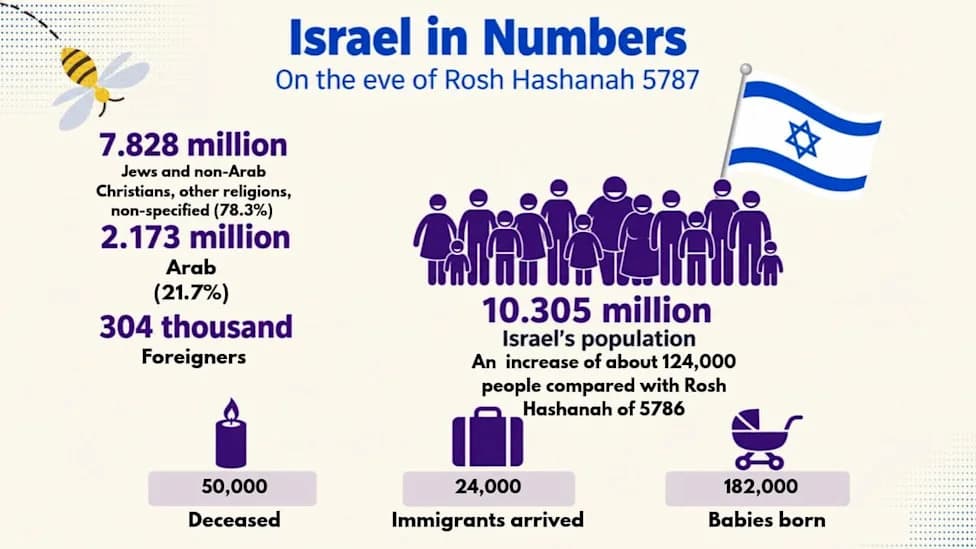
The Central Bureau of Statistics estimates Israel's population at 10.305 million ahead of Rosh Hashanah, a net rise of about 124,000 (1.2% growth). High births (around 183,678) and a total fertility rate of 2.88 are boosting natural growth, even as international migration produced a negative balance of roughly 8,000. The report also highlights a sharp increase in emigration since 2023, strong life expectancy, a tight labor market and mixed housing trends.
Israel Reaches 10.305 Million Ahead Of Rosh Hashanah — Strong Birth Rate, Rising Emigration
Israel
The Central Bureau of Statistics (CBS) reports that Israel's population is estimated at 10.305 million on the eve of Rosh Hashanah, an increase of about 124,000 people over the past year. The annual growth rate stands at 1.2%, driven primarily by a high birth rate that has kept the population rising despite a recent uptick in emigration.
Key Figures
Population Breakdown: Of the total, roughly 7.828 million are classified as Jews and others (78.3%), about 2.173 million are Arabs (21.7%), and approximately 304,000 are foreign nationals.
Natural Change: The year recorded roughly 183,678 live births and about 50,000 deaths, with a total fertility rate (TFR) of 2.88 children per woman — well above the OECD average of 1.41.
Migration: CBS reports a negative international migration balance of roughly 8,000 people over the past year. During the period, around 24,000 new immigrants arrived, about 4,000 came through family reunification, roughly 21,000 previously emigrated Israelis returned, and approximately 57,000 Israelis were recorded as having emigrated abroad under CBS methodology.
Trends And Context
The CBS highlighted a sharp rise in emigration since 2023. A Tel Aviv University study using CBS data found that 268,930 Israelis left in 2023–2025 (86,509 in 2023; 91,499 in 2024; 90,922 in 2025) — a major increase compared with 83,219 departures across 2013–2015. CBS cautioned that its population totals are provisional and based on the 2022 census, and that it updated its methods for estimating Israelis living abroad and for including the foreign population.
End-of-2025 Snapshot: At the end of 2025 the bureau estimated the population at 10.203 million (9.916 million Israelis plus about 286,700 foreign residents). Under the CBS annual migration methodology, 2025 saw 20,900 newly recorded immigrants (down from 31,100 in 2024), 69,500 recorded departures and 18,800 recorded returnees.

People enjoy the beach in the northern Israeli city of Haifa, August 28, 2026. (credit: Rachel Alroey/Flash90)
Society, Economy And Living Conditions
Israel remains home to nearly half of the world's Jewish population: of an estimated 15.9 million Jews worldwide as of January 1, 2026, about 46% live in Israel.
Households & Family Life: There are more than three million private households, with an average household size of 3.17 people (compared with roughly 2.5 across OECD countries). In 2024, some 53,025 couples married while 16,499 couples divorced.
Health & Longevity: Life expectancy is high by international standards: 81.4 years for men and 85.9 years for women. CBS places Israeli men seventh and women eighth among OECD countries based on comparable 2024 data.
Labor Market: Labor force participation stands at 4.577 million people, with an unemployment rate of 2.9%. The employment rate for those aged 15 and over is 60.9% (63.6% for men and 58.2% for women).
Housing: Housing indicators were mixed: the housing price index fell 1% and the new-home price index declined 2.8%, while average rent rose 4.3%. The average home price is approximately NIS 2.33 million and the average monthly rent about NIS 4,919.
What To Watch
Demographers and policymakers will be watching how sustained high fertility interacts with rising emigration. Continued methodological updates from CBS around the measurement of Israelis abroad mean year-to-year comparisons should be read with care.
Note: CBS data are provisional and reflect changes in methodology following the 2022 census, including updated measures of Israelis living overseas and the inclusion of the foreign resident population.
Help us improve.