The Max Planck Institute study shows that women's faces are rated more attractive than men's on average, but male attractiveness exhibits a skewed distribution with a small subgroup rated exceptionally high. This "upper tail" helps explain why male beauty is often celebrated despite lower male averages. The paper argues attractiveness ratings reflect broader cultural and aesthetic judgments — not only sexual or partner preference — and calls for clearer distinctions in future research.
Women Rated More Attractive Than Men — With One Intriguing Twist

Left: Jonathan Bailey who won "People's" 2025 Sexiest Man Alive title in London, England on September 22, 2025. Right: Margot Robbie who is widely considered one of the most attractive stars in Hollywood, is pictured in London on September 11, 2025.
A cross-cultural analysis led by the Max Planck Institute for Empirical Aesthetics (MPIEA) in Frankfurt finds that women's faces are rated as more attractive than men's on average — but a careful look at the data reveals an important nuance in male attractiveness.
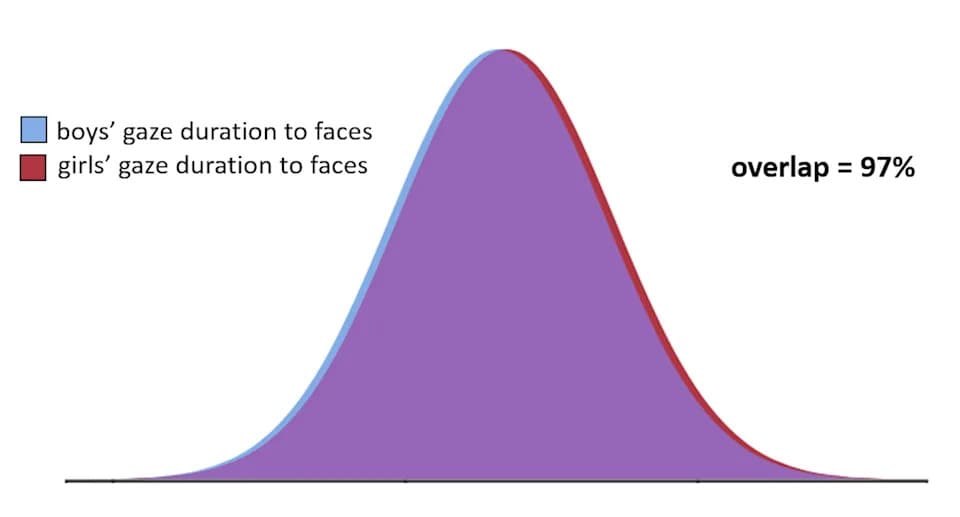
The single-author study by Eugen Wassiliwizky, published in Current Opinion in Psychology, examines what the author calls the "Gender Attractiveness Gap" (GAP). When raters scored female faces, the ratings formed an approximately normal (bell-shaped) distribution: most scores clustered around a central average. Male ratings, however, deviated from that pattern. Rather than a symmetrical curve, men's attractiveness scores display a pronounced upper tail: a small subgroup of men are rated exceptionally attractive even though the male mean score is lower overall.
What This Means
This distribution helps explain a cultural paradox: male beauty has been celebrated across history — from classical sculpture to modern pop culture — despite men scoring lower on average. The study suggests that celebrated images of male attractiveness disproportionately reflect that exceptional upper tier rather than the typical male face.
Implications for Research and Social Perception
Researchers often use attractiveness ratings as proxies for partner preference, sexual attraction or "mate value." Wassiliwizky's findings suggest those ratings also capture broader aesthetic and social judgments. The Gender Attractiveness Gap is particularly pronounced when heterosexual women rate other women’s faces, indicating that attractiveness evaluations are not driven solely by sexual interest.
Eugen Wassiliwizky: "I hope this research shifts the focus from 'who is more attractive?' to 'why does the human mind evaluate beauty the way it does?'"
Alli Spotts-De Lazzer, Licensed Psychotherapist: "These findings challenge the assumption that attractiveness ratings reflect sexual or romantic interest alone. Ratings appear shaped by cultural ideals, perceived social status, and learned standards — dynamics amplified by social media."
The study encourages scientists to distinguish more clearly between aesthetic appreciation shaped by cultural and social factors and genuine sexual attraction when using attractiveness ratings in research. That distinction could change how studies measure mate preferences and interpret the social meaning of attractiveness scores.
Illustrations: The original article referenced contemporary public figures to illustrate cultural attention to attractive faces — for example, Jonathan Bailey (People's 2025 Sexiest Man Alive) and Margot Robbie (widely regarded as one of Hollywood's most attractive stars).
Citation: Wassiliwizky, E. (2026). What Are We Measuring When We Measure Attractiveness? Current Opinion in Psychology. https://doi.org/10.1016/j.copsyc.2026.102416.
Help us improve.