Three experiments in PLOS One found that women near ovulation showed stronger preferences for conspicuous luxury items—particularly when those items would be visible to others. One experiment used urine tests to verify ovulation, while the others estimated fertility from cycle timing. The fertility-linked increase in luxury preference disappeared when choices were private or when participants were told men do not notice brands, suggesting a socially strategic signaling explanation rather than a simple causal effect of hormones. The authors note important limitations, including nonrepresentative samples and the inability to randomize fertility.
Study: Women Near Ovulation Prefer More Visible Luxury—But Only When Others Can See

Women near ovulation showed more interest in visible luxury goods, but the effect depended on whether others could notice them. (CREDIT: Shutterstock)
Three experiments published in PLOS One report that women near ovulation showed stronger preferences for conspicuous luxury items—especially when those items would be visible to others. The pattern appeared for larger, more recognizable logos and for brands displayed publicly, but it weakened or disappeared when luxury consumption would be private or when participants were told that men tend not to notice designer clothing.

Aekyoung Kim of Jeonbuk National University in South Korea. (CREDIT: Jeonbuk National University)
What the Researchers Did
The research team, led by Aekyoung Kim of Jeonbuk National University (South Korea), tested whether fertility-related changes across the menstrual cycle relate to preferences for conspicuous luxury. The authors interpret their findings as consistent with a hypothesis that reproductive biology can influence social signaling, but they emphasize that the experiments do not establish a direct causal link between ovulation and real-world shopping behavior.
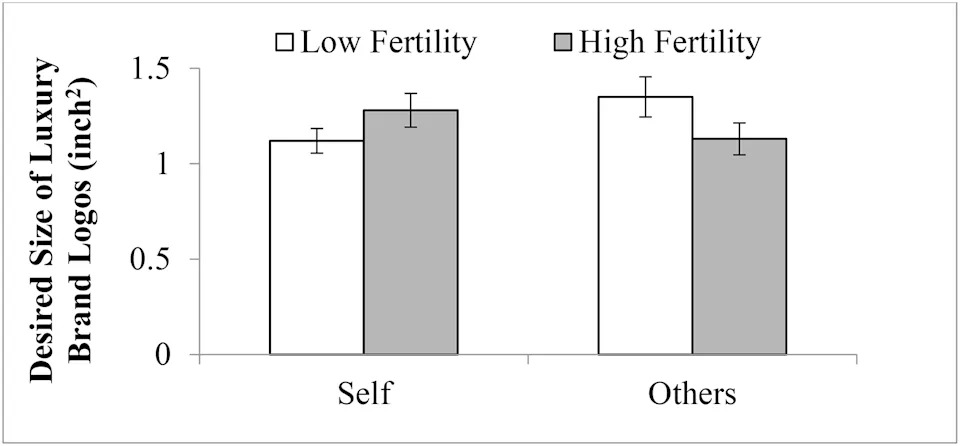
Study 1 Results. (CREDIT: Aekyoung Kim et al, PLOS One)
Experiment 1 — Hormone-Verified Fertility
Seventy university students not using hormonal contraception completed sessions at both high- and low-fertility points. The study used urine tests to detect the luteinizing hormone surge that precedes ovulation, so each woman served as her own comparison. Participants were shown logos (Gucci, Chanel, Louis Vuitton) and asked to draw the size they would want displayed on handbags or shoes. Near ovulation, the average self-chosen logo area was 1.28 square inches versus 1.12 square inches during the lower-fertility session; the difference reached statistical significance. The effect did not appear when participants selected logos for another woman.
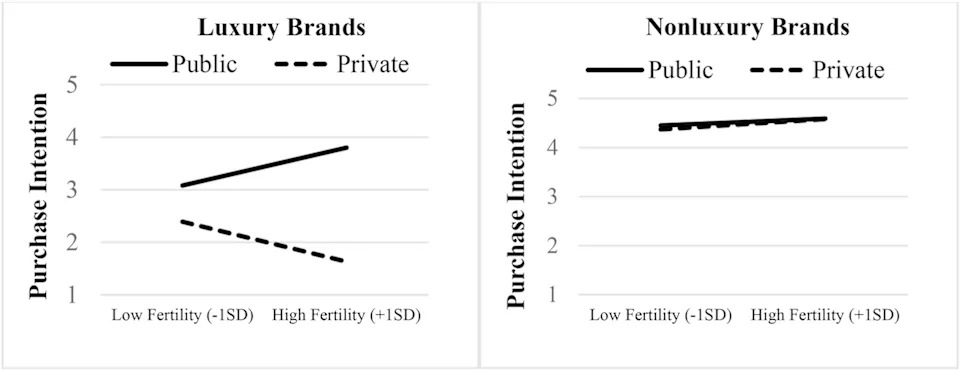
Study 2 Results. (CREDIT: Aekyoung Kim et al, PLOS One)
Experiment 2 — Visibility Manipulated
The second study began with 1,486 recruits and—after applying health, medication, cycle-length and menstrual-date screening—analyzed 332 women whose fertility could be reasonably estimated from cycle timing. Participants rated their willingness to buy T-shirts from luxury brands (e.g., Chanel, Prada, Gucci, Louis Vuitton) or nonluxury brands (e.g., Gap, Old Navy, H&M). Some imagined wearing the shirt publicly; others imagined wearing it only at home. In the public condition, estimated fertility was associated with higher interest in luxury brands: average purchase intention rose from 3.08 at lower estimated fertility to 3.80 at higher estimated fertility on a seven-point scale. No comparable effect appeared for nonluxury brands.
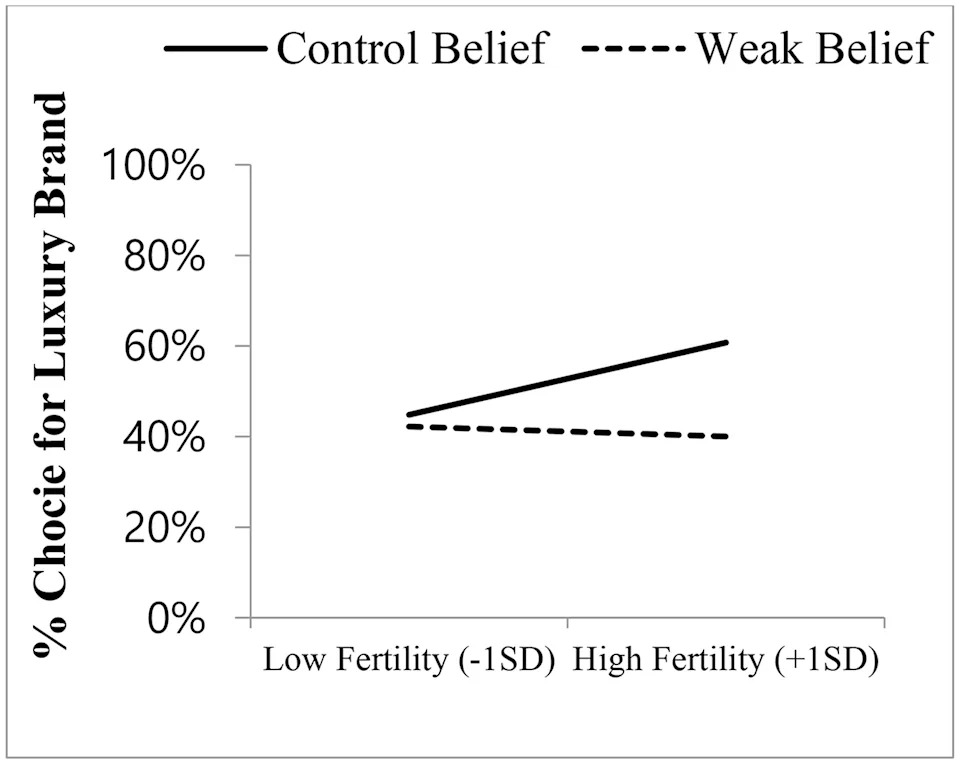
Study 3 Results. (CREDIT: Aekyoung Kim et al, PLOS One)
Experiment 3 — Beliefs About Men's Attention
For the third experiment, researchers recruited 966 women and analyzed a screened group of 358 participants who had recently purchased luxury items. Some read a fabricated news story claiming men tend not to notice brand labels; others read an unrelated control article. Participants chose between a chance to receive a $100 gift card from a luxury retailer (Polo Ralph Lauren) or a nonluxury retailer (Old Navy). In the control group, the estimated share choosing the luxury option rose from about 44.8% at low fertility to 60.8% at high fertility. When participants were told men did not notice brands, the fertility-linked increase in luxury preference disappeared. A secondary analysis using a larger sample produced a statistically significant fertility-by-belief interaction, but the authors note differences in significance across samples.
Interpretation and Limitations
The authors argue the pattern is specific: fertility-related shifts appear to increase interest in visible status signals rather than produce a general boost in liking for expensive goods. Visible logos and brand prominence can function as social signals that make status easier for others to read.
However, the study has important limitations. Samples were convenience-based and heavily screened, many participants were excluded for menstrual- and health-related criteria, and only the first experiment used direct hormone assays—so fertility could not be randomly assigned. The broader literature on ovulatory shifts remains contested, with recent reviews calling for careful measurement and replication. The authors caution that these findings may not generalize to communities where luxury has different social meaning or to real-world purchasing behavior.
Bottom Line
Under controlled conditions, women near ovulation preferred more conspicuous luxury displays when those displays were publicly visible and personally relevant. The results are consistent with a socially strategic signaling interpretation but do not prove that ovulation directly causes changes in everyday shopping choices.
Further Reading
Key related works include reviews and empirical studies on ovulatory shifts, hormonal predictors of sexual motivation, and the role of brand prominence in status signaling (Trends in Cognitive Sciences, Journal of Consumer Research, Hormones and Behavior, Journal of Marketing, and others). Full study details are available in PLOS One.
Help us improve.