The 2026 Radford/FGCU report finds the United States accounts for 3,803 documented serial killers since 1900, about 62.9% of the dataset, far more than any other country. England (188) and Russia (172) follow at a distance. Experts warn these are identified cases shaped by differences in detection, reporting and record access, not absolute prevalence. U.S. identified serial killing peaked in the 1970s (~300 active offenders) and fell to under 50 in the 2010s, likely due to forensics, surveillance and social changes.
Ranked: Countries With The Most Documented Serial Killers — Why The U.S. Dominates The List
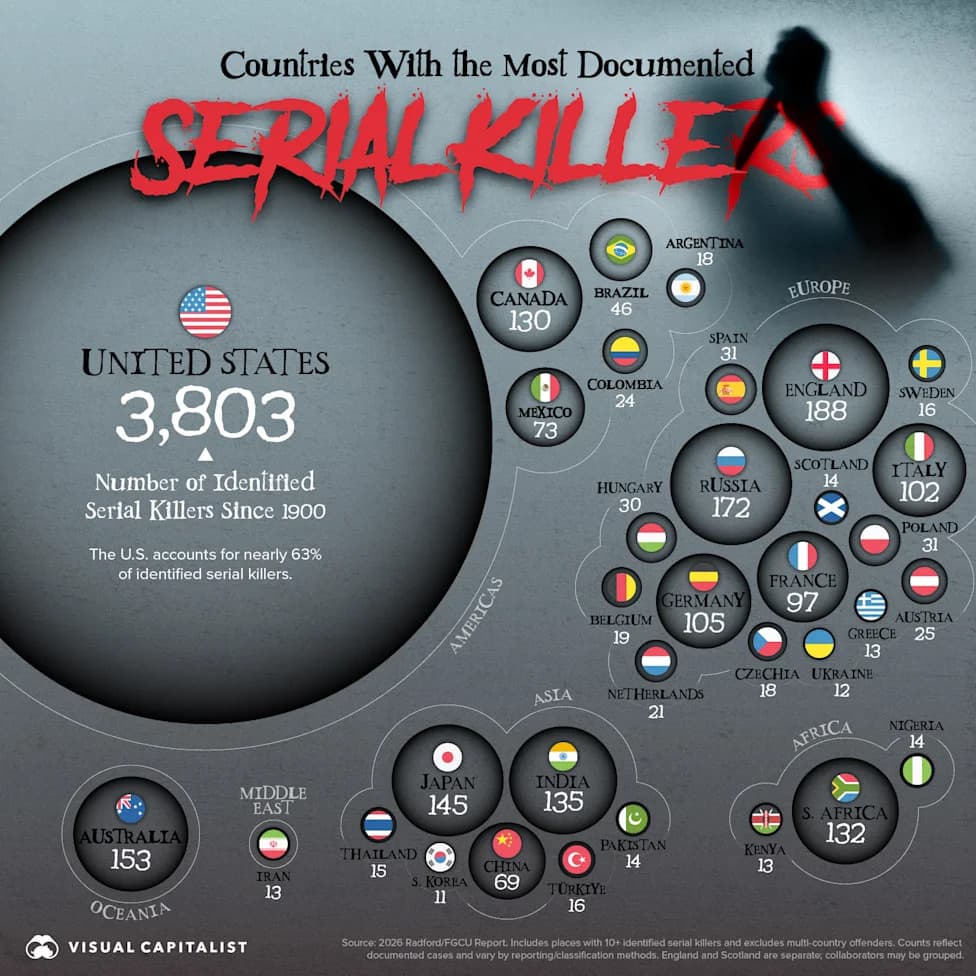
Countries with the most documented serial killers since 1900, led by the United States with 3,803 identified cases.
The 2026 Radford/FGCU report on serial killer statistics shows the United States far outpaces other countries in documented serial killers since 1900: 3,803 identified offenders, about 62.9% of the dataset. These totals reflect identified and documented cases in the Radford dataset, not a definitive measure of true prevalence.
Top Findings
No other country exceeds 200 documented cases. England ranks second with 188 identified serial killers, followed by Russia (172), Australia (153), and Japan (145). The dataset lists countries with at least 10 identified offenders and excludes perpetrators whose crimes spanned multiple countries.
Radford Definition: A serial killer is an offender who unlawfully kills two or more victims in separate events.
Why the U.S. Appears So Prominent
The large U.S. total does not necessarily mean Americans are inherently more likely to become serial killers. Radford University researcher Mike Aamodt and others note that U.S. cases are easier to identify and document because police, prison and public records are comparatively accessible. Differences in law enforcement practices, case classification, and public access to records can strongly influence country totals.
Historical Trends
Research cited by Northeastern University estimates nearly 300 known serial killers were active in the U.S. during the 1970s, compared with fewer than 50 in the 2010s — a decline of more than 80% in identified active offenders. Experts attribute the long-term decline to multiple factors: advances in DNA forensics, wider surveillance and improved information-sharing between law enforcement agencies, and shifts in social behavior that reduced opportunities for predators (for example, reduced hitchhiking and more public awareness).
Ongoing Debates
Other explanations remain debated. Author Caroline Fraser has examined environmental lead exposure as a possible contributor to earlier increases in violent behavior, while criminologist James Alan Fox highlights demographic shifts, better policing and forensic advances. No single theory fully explains historical rises and falls in identified serial killing.
Selected Country Counts (Identified Serial Killers)
United States: 3,803 (62.91%) • England: 188 (3.11%) • Russia: 172 (2.85%) • Australia: 153 (2.53%) • Japan: 145 (2.40%) • India: 135 (2.23%) • South Africa: 132 (2.18%) • Canada: 130 (2.15%) • Germany: 105 • Italy: 102 • France: 97 • Mexico: 73 • China: 69 • Brazil: 46 • (Full list includes countries with 10+ identified cases.)
Read With Caution: The Radford/FGCU ranking provides a consistent way to compare documented, identified cases across countries, but it is shaped by differences in detection, reporting and record availability. These counts are best understood as a ranking of identified cases rather than a literal measure of where serial murder is most or least prevalent.
Help us improve.