Lebanon Could Seek Abraham Accords Membership If Hezbollah Is Disarmed — Sunni MP Fouad Makhzoumi says Lebanon can establish diplomatic and trade ties with Israel once militias are disarmed and the state regains control of its borders. He argues that disarming Hezbollah, reforming the judiciary, and strengthening banking compliance are prerequisites for restoring investor confidence and attracting regional investment, particularly from the UAE. The country’s prolonged economic crisis has driven a dramatic emigration surge, worsening shortages in key sectors such as healthcare.
Lebanon Could Seek Abraham Accords Membership If Hezbollah Is Disarmed, MP Says
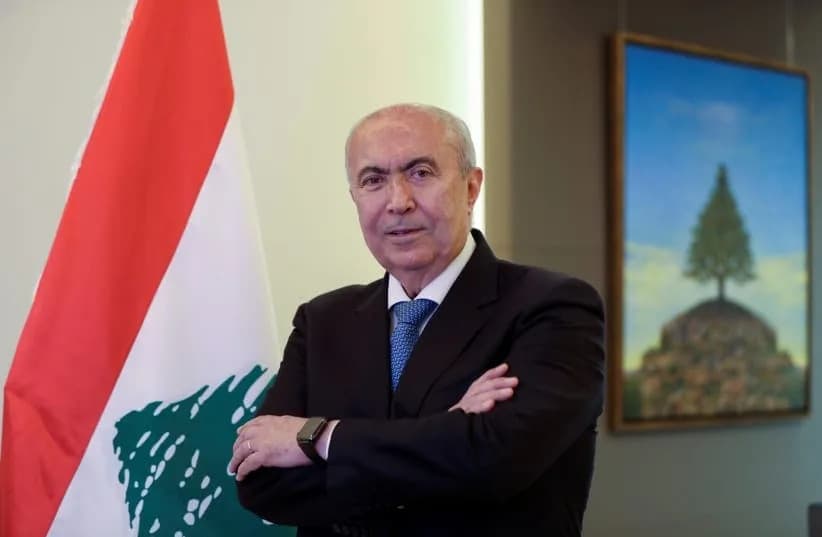
Fouad Makhzoumi, a Sunni billionaire philanthropist and current member of parliament who is running again, poses during an interview with Reuters in Beirut, Lebanon April 28, 2022. (photo credit: REUTERS/MOHAMED AZAKIR)
Beirut — Lebanon could pursue formal ties with Israel and even seek membership in the Abraham Accords if Hezbollah is disarmed and can no longer use Lebanese territory as a "launching pad" for attacks, Lebanese Sunni MP Fouad Makhzoumi told Middle East 24 last week.
Makhzoumi — a businessman who serves as CEO and executive chairman of Future Pipe Industries and leads Lebanon's National Dialogue Party — said the prospect of diplomatic relations and trade with Israel depends on restoring the state's monopoly on force and eliminating armed militias.
Security and State Authority
"Our side, as Lebanese, disarms the militias," he said, arguing that the border remains effectively outside state control and allows arms to be smuggled into and out of the country. Makhzoumi has previously urged the Lebanese Armed Forces to demonstrate their readiness to confront arms trafficking, including by mounting a checkpoint in Beirut's Dahieh neighborhood.
"I don't see any reason why we cannot sign peace with Israel," he said, adding that Lebanon could realistically "achieve" Abraham Accords membership once security conditions are met.
Economic and Institutional Reforms
Makhzoumi framed Lebanon's economic recovery around three political prerequisites: disarming Hezbollah, tackling judicial corruption, and creating a banking system that complies with international regulations. He argued that investor confidence requires a fair regulatory framework applied equally to all, one unified military authority, and equal enforcement of the law.
Lebanon ranked poorly on Transparency International's 2025 Corruption Perceptions Index, scoring 23 out of 100 and placing 153rd out of 182 countries. This week, Lebanon's central bank announced that France-based consulting firm Alvarez & Marsal will audit transactions from October 1, 2019, through December 31, 2023 — a step Makhzoumi and others see as necessary but not sufficient to restore confidence.
Regional Investment And Diaspora Return
Makhzoumi said changes in security and governance could unlock greater regional investment, especially from the United Arab Emirates — an Abraham Accords signatory that has already emerged as a significant investor in Lebanon. Last month, UAE Foreign Trade Minister Thani bin Ahmed Al Zeyoudi led a delegation of more than 80 business and government figures to Beirut, where the two countries signed an intergovernmental memorandum of understanding to deepen ties.
Regional analysts told The Jerusalem Post that rising UAE investment could help Beirut distance itself from Iran and reduce Hezbollah's influence. Makhzoumi said he is in talks with potential investors interested in southern Lebanon, where Hezbollah has long filled gaps in employment, healthcare and education.
Brain Drain And The Human Cost
Makhzoumi warned that political instability and insecurity have driven many young Lebanese to emigrate. Figures from the American University of Beirut show emigration surged by about 450% across 2021–22, with roughly 79,134 Lebanese leaving in 2021 alone. The outflow has created significant gaps in critical sectors, particularly healthcare.
"I operate in 50 countries," Makhzoumi said. "Wherever you go, you find successful Lebanese. They would return if there were a state worth returning to — a place where they can bring their children back and live under the law without threats from militias."
Whether Lebanon can translate those proposals into reality will depend on complex domestic politics, the balance of power with Hezbollah, and whether international and regional partners back reforms with sustained investment and political support.
Help us improve.