Researchers modeled a hypothetical moon orbiting Venus and found Venus’s very slow rotation could cause tidal forces that drive a satellite inward instead of away. Simulations tested moon masses from 0.5 to 10 times Earth’s Moon and showed larger moons tend to fall faster. While the work does not prove Venus had a moon, it highlights how tidal evolution on slowly rotating planets can eliminate satellites and may affect rotation, geology and climate.
Study: Venus’s Slow Spin Could Have Dragged a Former Moon Into a Catastrophic Crash
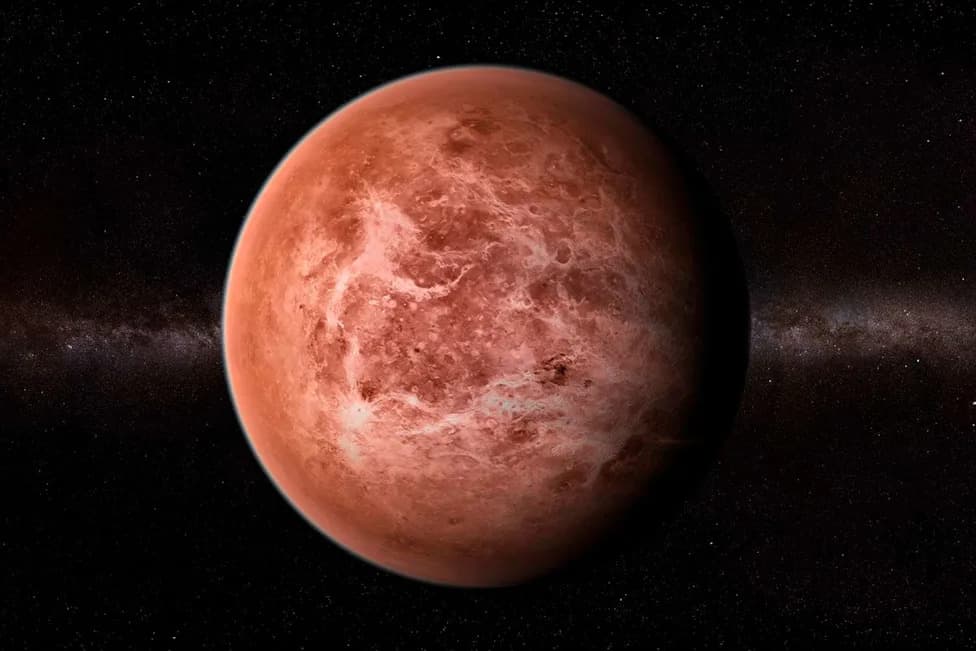
VenusCredit: Science Photo Library RF/Getty
New computer models suggest Venus may once have hosted a moon that slowly spiraled inward and eventually collided with the planet. The study, titled Tidal Demise: The Evolution and Fate of a Hypothetical Venus Moon, was led in part by planetary astrophysicist Stephen Kane at the University of California, Riverside. The authors emphasize that their work explores possibilities rather than proving Venus actually had a moon.
How the models were built
The team validated their methods by reproducing known behavior of Earth’s Moon, then ran simulations for a Venus–moon system while varying two key parameters: Venus’s rotation rate and the moon’s mass. Simulated moon masses ranged from 0.5 to 10 times the mass of Earth’s Moon. In many scenarios the satellite remained stable for billions of years, but in numerous others the moon lost orbital energy and migrated inward until it struck Venus. Larger moons generally fell sooner in the models.
Why a moon could fall toward Venus
The inward migration is driven by tidal torques and Venus’s extremely slow rotation. Earth rotates roughly once every 24 hours, which produces tidal interactions that steadily push our Moon outward at about four centimeters per year. Venus, by contrast, rotates once every ~243 Earth days; that slow spin can reverse the sign of the tidal torque so an orbiting moon is driven inward instead of away.
When I made this discovery, I was shocked. I thought surely the broad range of scenarios I was exploring would lead to a variety of results. But it all went pretty much in the same direction. — Stephen Kane
Possible consequences of a moon impact
If a moon did plunge into Venus, the collision would deliver large amounts of energy and angular momentum to the planet. That could alter Venus’s rotation rate, affect its internal heat and geology, and potentially influence its climate history. Depending on impact energy, fragments might be re-accreted or destroyed and mixed into the atmosphere and surface.
Broader implications
The study also highlights a general point for rocky planets: slowly rotating worlds may be unable to retain moons over long timescales because of tidal evolution. This has implications for exoplanet systems and for debates about whether a moon is important for habitability. As Kane notes, a moon can influence a planet’s evolution, but it is not necessarily required for habitability.
What the study does and does not show
The models demonstrate a plausible pathway by which a hypothetical Venusian moon could have been lost without invoking a singular catastrophic event. However, the study does not confirm that Venus actually had a moon; it only shows that if one existed, Venus’s slow rotation makes an inward tidal demise a likely outcome under many reasonable assumptions.
Help us improve.