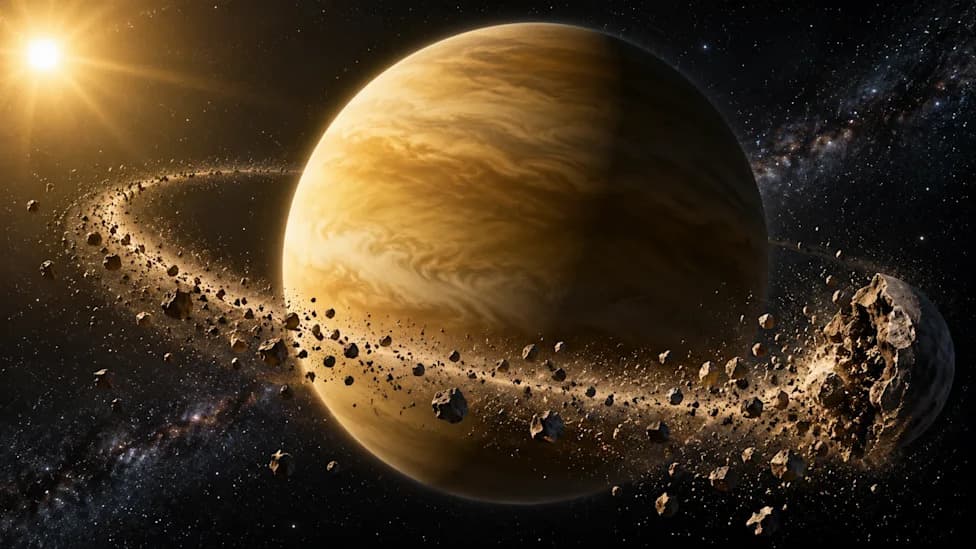
New simulations that include internal temperature and material strength show the Moon could have formed extremely quickly after the giant impact between Earth and a Mars-sized protoplanet, Theia. If Theia was still hot (<~60 million years after formation), the collision would have produced a massive debris disk that could assemble into a Moon in roughly five hours; a cooler Theia (100–150 million years after formation) favors slower accretion. Most lunar material in the models comes from Theia's mantle, though isotopic similarities with Earth remain a puzzle.
New Simulations Suggest Earth’s Moon Could Have Assembled in About Five Hours After Giant Impact
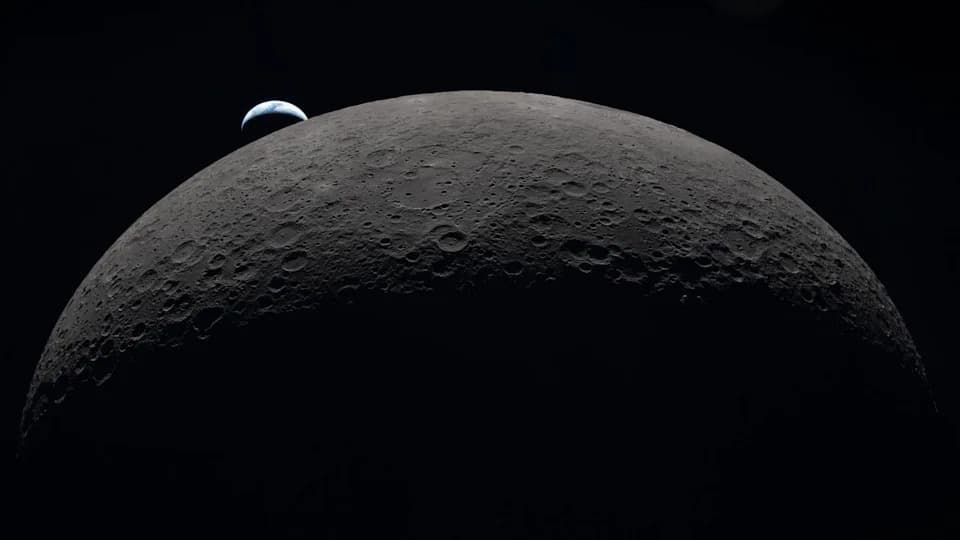
Earth sets at 5:41 p.m. CDT, April 6, 2026, over the moon's curved limb in this photo captured by the Artemis II crew during their journey around the far side of the moon. | Credit: NASA
New models show the Moon may have formed extremely rapidly after the giant impact that shaped the early Earth.
Recent high-resolution computer simulations that include internal temperature profiles and material strength of young protoplanets indicate the Moon could have assembled in as little as five hours after a collision between the proto-Earth and a Mars-sized body commonly called Theia.
The research, led by Adeene Denton of the Southwest Research Institute, expands on the long-standing giant-impact hypothesis—most notably developed by planetary scientist Robin Canup—by incorporating how heat retained inside newborn planets changes their mechanical behavior during catastrophic collisions.
"Models have evolved to include material strength, something that's really important when you're studying collisions between smaller bodies like asteroids or for my previous paper about the formation of the Pluto–Charon system," Denton said. "We weren't sure it would matter for the Moon or not. When we did the simulations, we found it actually matters quite a bit."
The key finding is simple but powerful: hotter planetary material is mechanically weaker than colder material. If Theia struck the proto-Earth while still very hot (for example, less than ~60 million years after planetary formation), it would have been more readily vaporized and shredded. That produces a massive, dynamically active disk of silicate debris that can collapse into a single intact Moon on timescales of hours.
By contrast, a cooler, stronger Theia (perhaps 100–150 million years after formation) would survive the impact better, leaving more intact material and creating a debris configuration that favors slower, gradual accretion of a satellite.
"Depending on how hot the Earth and Theia are prior to the collision, the impact can destroy Theia and produce this massive disk of debris that eventually forms the Moon," Denton said. "But when I used the same parameters as original impact modeling — down to the equal temperature structures inside both bodies — within around five hours, an intact Moon emerged."
Across the scenarios modeled, most of the Moon's material originates from Theia's silicate mantle, with a smaller contribution from Earth's mantle. That outcome helps explain some compositional clues but does not fully resolve lingering puzzles: isotopic similarities between Earth and Moon remain difficult for current models to reproduce in full.
The findings also affect how astronomers think about detecting moon formation beyond the Solar System. If terrestrial moons can assemble in hours, transient moon-forming disks around rocky exoplanets would be extremely short-lived and therefore hard to observe, unlike longer-lived disks associated with gas-giant formation.
The study was published Sept. 1 in The Astrophysical Journal Letters. Scientists including Robin Canup—who was not involved in this study—have suggested these results may help constrain the timing and thermal state of the giant impact by linking present lunar properties (such as volatile content) to the collision conditions.
Image note: An Artemis II photograph shows Earth setting over the Moon’s limb; it illustrates the long-term outcome of the dramatic early event that these simulations explore.
Help us improve.