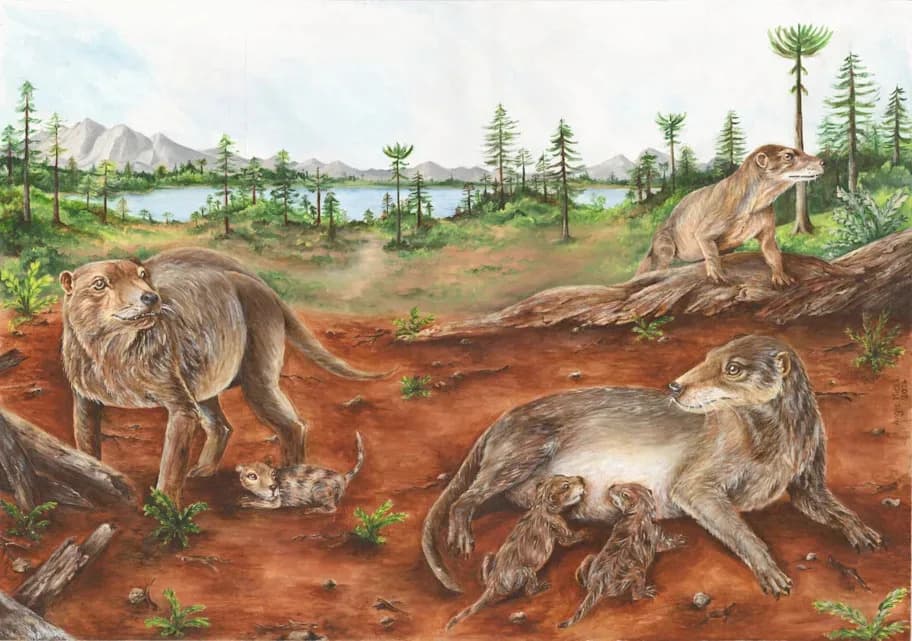
A partially preserved cynodont fossil from northwestern Argentina provides new evidence that an ancestor of mammals may have given birth to live young rather than laying eggs. The specimen, identified as Chiniquodon theotonicus (catalogue CRILAR-PV109) from the Chañares Formation, preserves unusually well-preserved bone microstructure that the authors interpret as a neonatal growth line paired with embryonic-like tissue.
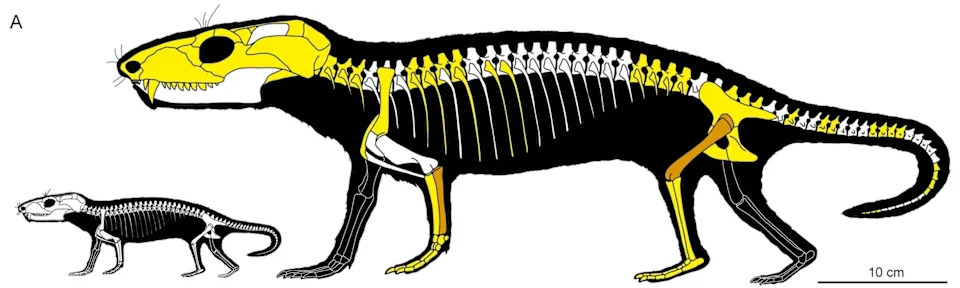
Representation of neonate and adult Chiniquodon theotonicus. Recovered (yellow) and histologically analyzed (orange) bones of specimen CRILAR-PV109. (CREDIT: Dr Leandro Gaetano et al, Frontiers in Mammal Science)
Key Findings
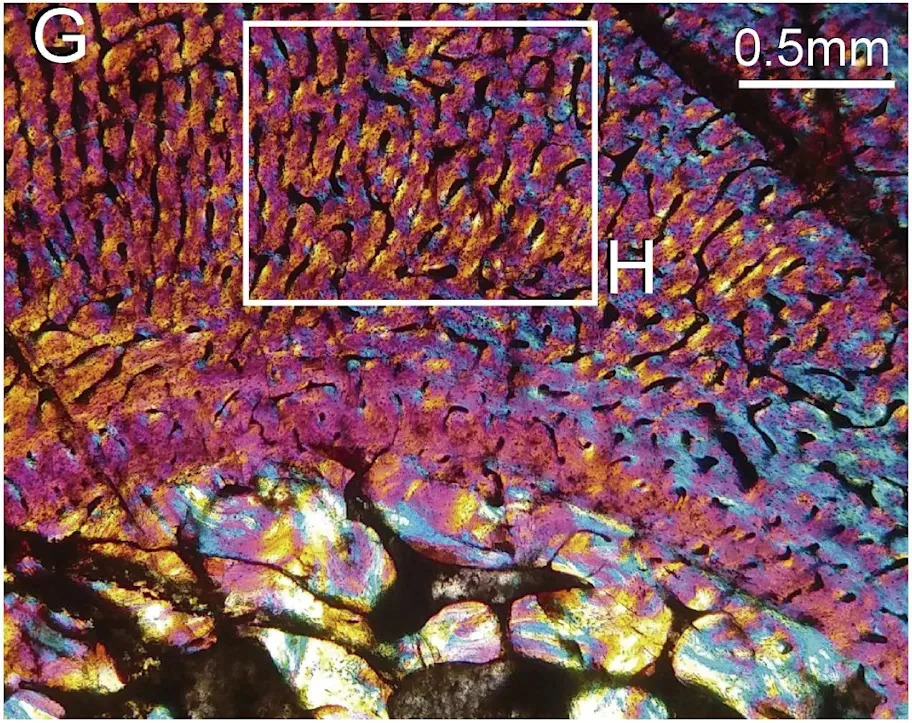
Thin sections of the femur and ulna reveal exceptionally small medullary cavities and minimal secondary remodeling, preserving microscopic embryonic bone tissue normally lost during growth. Within both bones the researchers observed an abrupt change in tissue structure—vascular canals and matrix organization shift sharply in a pattern similar to a neonatal line, a histological marker associated with the physiological change at birth.
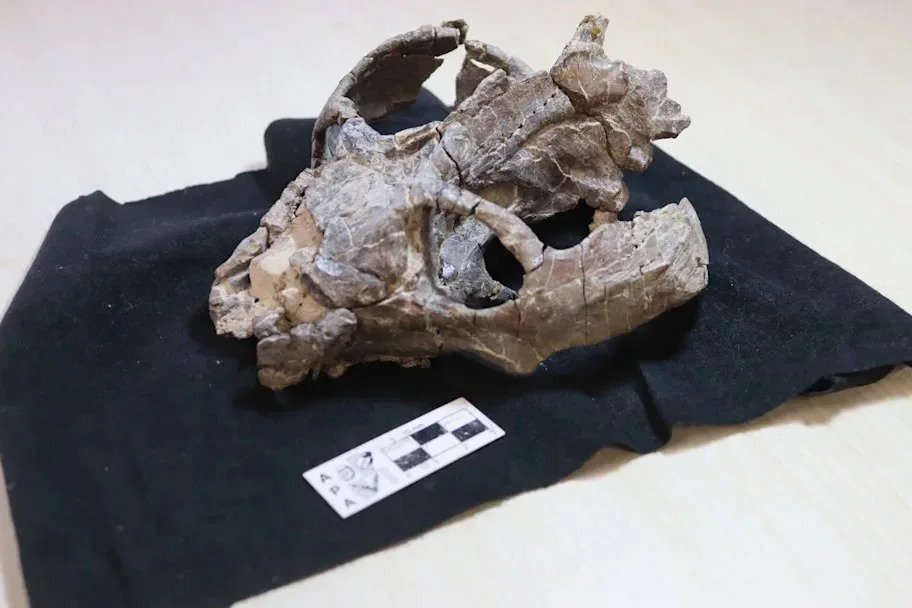
Skull of the Chiniquodon theotonicus individual that was used for this study. (CREDIT: Dr Leandro Gaetano)
"We show for the first time that live birth was present in at least one mammalian ancestor, Chiniquodon theotonicus, which lived approximately 236 million years ago," said lead author Dr. Leandro Gaetano (CONICET).
Body-Size Evidence
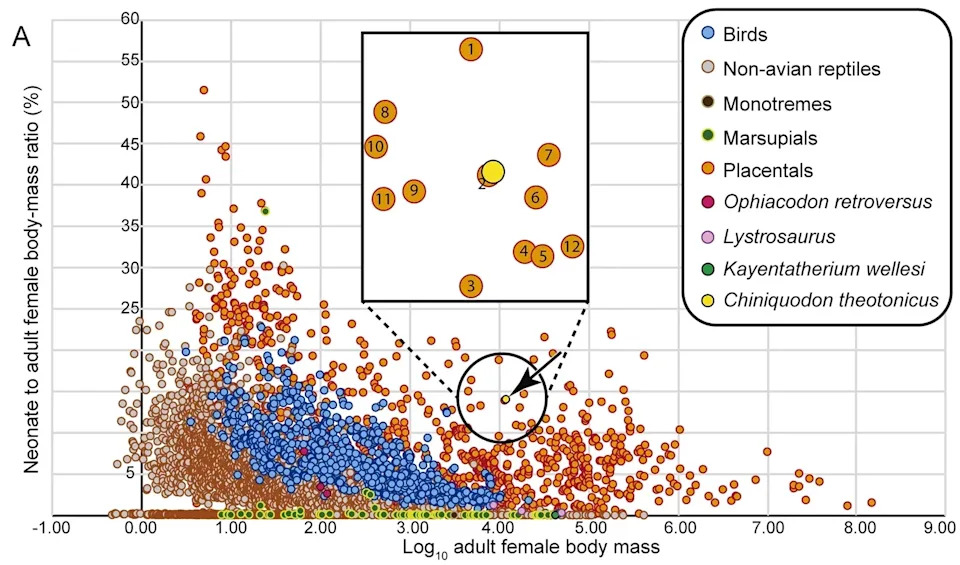
The team estimated adult body mass using femoral circumference, placing the individual at about 11.99 kg at death and estimating the size at the putative birth-related line as ~1.68 kg. That makes the newborn roughly 14% of adult mass—far larger, proportionally, than hatchlings of reptiles or birds of similar adult size and more comparable to newborns of extant placental mammals. Statistical comparisons with large datasets of modern mammals (1,869 species), non-avian reptiles (2,619) and birds (782) repeatedly grouped C. theotonicus with placental mammals in neonate-to-adult mass ratio analyses.
The neonatal line in Chiniquodon. (CREDIT: Dr Leandro Gaetano et al, Frontiers in Mammal Science)
Implications
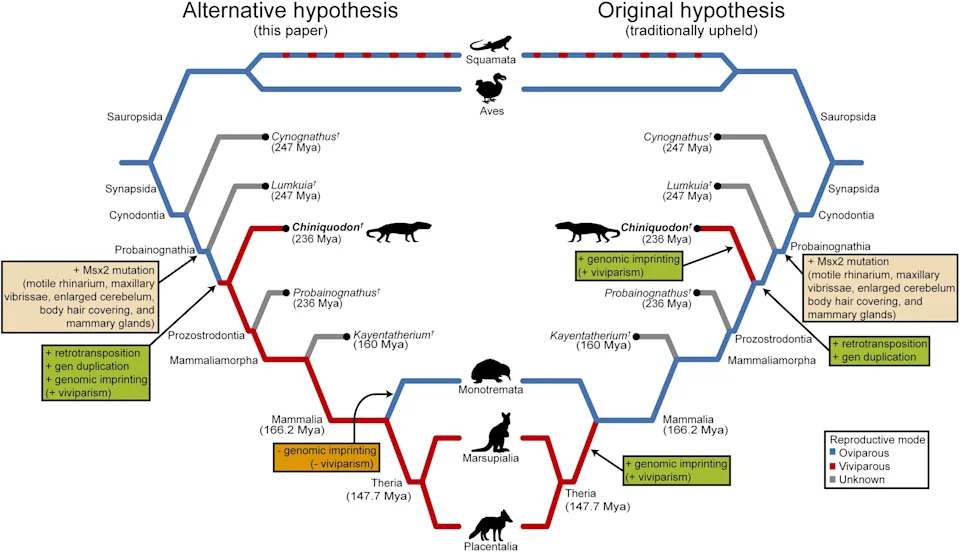
If the interpretation is correct, viviparity (live birth) may have appeared in the mammal lineage roughly 90–95 million years earlier than some previous estimates, suggesting reproductive changes associated with mammals began deep in the Triassic. The result challenges the conventional view that non-therian cynodonts were obligatorily egg-laying and that live birth evolved only near the origin of therian mammals.
Simplified cladograms showing the two equally parsimonious, alternative scenarios for the evolution of viviparity and other features as discussed herein. (CREDIT: Dr Leandro Gaetano et al, Frontiers in Mammal Science)
Limitations and Caution
The authors emphasize important caveats. The body-mass equations were derived from living mammals and may not perfectly fit Triassic cynodont body proportions, particularly at very small sizes. Pelvic anatomy for C. theotonicus is incompletely known, limiting direct inference about birthing mechanics. Bone microstructure can be difficult to distinguish between a neonatal line and a hatching line from oviparous species, which is why the team combined histology with size estimates to support their interpretation.
Neonate to adult body-mass ratio (%) plotted against the decimal logarithm of the adult female body mass, with magnified circled area. (CREDIT: Dr Leandro Gaetano et al, Frontiers in Mammal Science)
Evolutionary Scenarios
The study outlines two equally parsimonious possibilities: (1) egg-laying remained ancestral and viviparity evolved independently in C. theotonicus and later in therians; or (2) viviparity arose earlier among Triassic probainognathian cynodonts, and monotremes later represent a return to egg-laying. The current evidence cannot distinguish between these scenarios.
Context and Next Steps
The work provides a practical approach for inferring reproductive mode in fossil synapsids by combining bone microstructure with newborn-to-adult size estimates. Additional specimens showing similar neonatal lines or preserved perinates will be required to test whether live birth was widespread among early cynodonts and to refine the timing and frequency of this major reproductive transition.
Publication: Frontiers in Mammal Science. Specimen: CRILAR-PV109, Chañares Formation, Argentina. Authors include Dr. Leandro Gaetano and María Miceli Baro (University of Buenos Aires).