The limb bone of the Triassic cynodont Chiniquodon theotonicus (≈236 million years old) shows a neonatal growth line interpreted as evidence of rapid postnatal growth. Estimates place the newborn at ~1.7 kg (~3.7 lb), about 14% of an estimated 12 kg adult mass — a ratio more typical of mammals than of reptiles or birds of similar size. Comparative data from thousands of living species support the interpretation, but researchers stress further fossils and analysis are needed to confirm an early origin of viviparity in mammal ancestors.
Fossil Suggests Live Birth May Have Evolved 90–95 Million Years Earlier in Mammal Ancestors
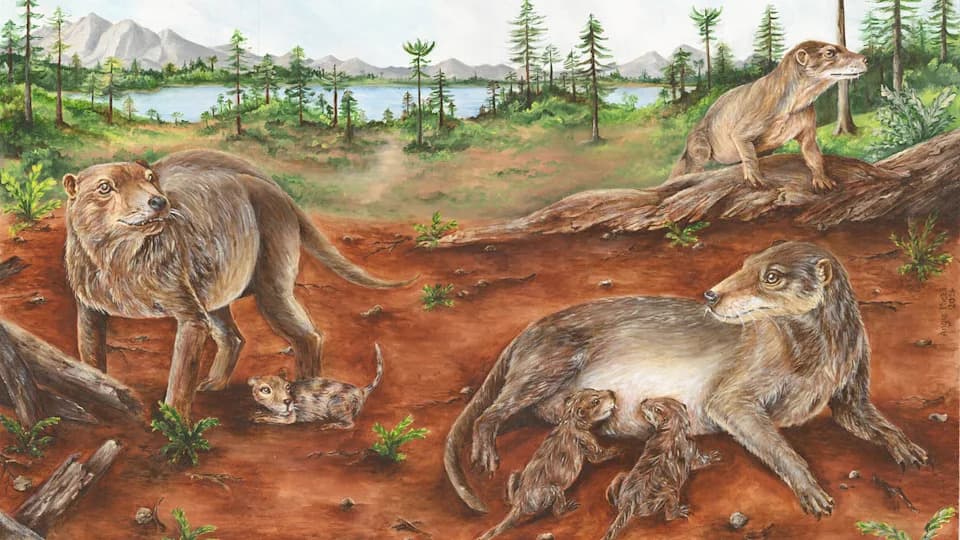
A reconstruction of a group ofChiniquodon theotonicusindividuals, a pregnant female (left) as well as a female (right) breastfeeding few, relatively large young. | Credit: María de los Ángeles Miceli Baro.
A dog-sized, carnivorous cynodont that lived about 236 million years ago may have given birth to live young, a new study reports. If confirmed, the finding pushes back the likely origin of viviparity — retaining embryos inside the mother until birth — in the mammalian lineage by roughly 90–95 million years.
Study and specimen
Lead author Leandro Gaetano, a paleontologist at Argentina's National Scientific and Technical Research Council, and colleagues described growth markings in a limb bone of Chiniquodon theotonicus, a Triassic cynodont from northwestern Argentina. The team published their results on August 13 in Frontiers in Mammal Science.
What the bone shows
The researchers identified a distinct band of disorganized bone tissue interpreted as a neonatal line, a feature associated in living animals with an abrupt increase in growth immediately after birth or hatching. By measuring that line and overall limb proportions, they estimated the specimen weighed about 12 kg (26 lb) at death and roughly 1.7 kg (3.7 lb) at birth — approximately 14% of adult mass.
When you are in an egg or in your mom's belly, you have a small space and you grow very slowly. When you hatch or are born, you have a lot of space and you start growing very, very quickly. — Leandro Gaetano
Comparative evidence
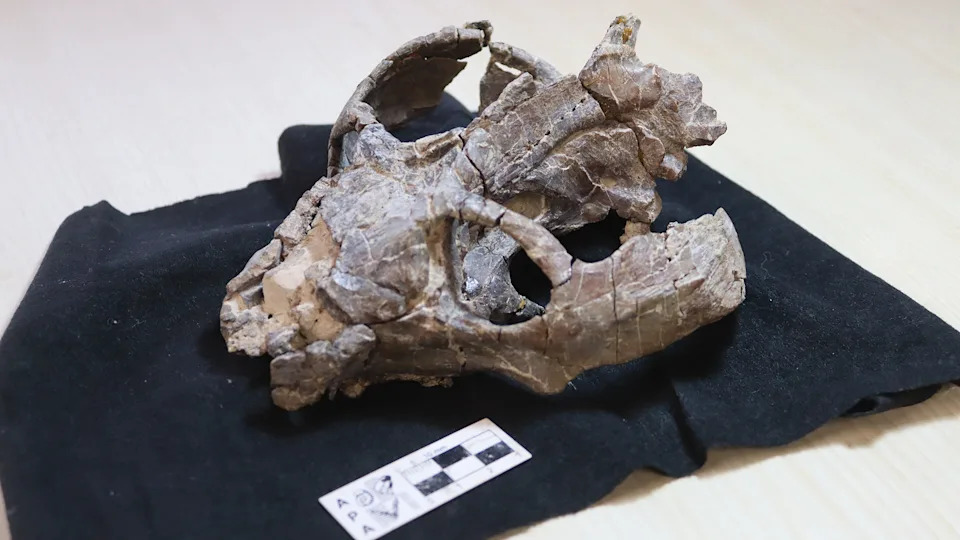
The skull of theChiniquodon theotonicusindividual that was used for this study. | Credit: Leandro Gaetano
To evaluate whether the newborn:adult mass ratio fits an egg-laying or live-bearing life history, the team compared their estimates to a dataset covering 1,869 mammals, 2,619 nonavian reptiles and 782 birds. For animals with similar adult mass (about 8–15 kg), reptiles and birds typically hatch at a far smaller proportion of adult mass (often well under 5%), whereas many mammals produce relatively large newborns (in some species up to ~20% of adult mass). The 14% estimate for C. theotonicus aligns more closely with mammalian patterns.
Implications and caution
If further evidence confirms viviparity in early cynodonts, it would indicate that live birth evolved much earlier on the mammal stem than previously believed. The Triassic was a challenging environment after the end-Permian extinction, and gestating embryos internally could have protected offspring from predators and harsh conditions. Still, authors and independent experts emphasize that this result is suggestive rather than definitive and that additional fossils and analyses are needed to establish a broad evolutionary shift.
Context in other discoveries
This study joins other recent findings that push mammal-like traits deeper into pre-mammalian history, including proposed whiskers in the cynodont Probainognathus and evidence for hair and lactation-related features in other Triassic cynodonts. Together these lines of evidence suggest a mosaic of mammal-like characteristics emerging well before true mammals.
Conclusion
The neonatal line and size estimates from Chiniquodon theotonicus provide a compelling hint that viviparity may have existed among early mammal relatives far earlier than previously thought, but corroborating fossils and additional studies will be required to confirm this major evolutionary shift.
Help us improve.