Rebecca Cooke, a 38-year-old Democrat and former waitress, is campaigning to flip Wisconsin's competitive 3rd Congressional District, citing rural economic pain from high fuel and fertilizer costs and cuts to food and health programs. Incumbent Derrick Van Orden defends his support for Trump-era policies on tariffs, tax cuts and the administration's stance on Iran. Farmers interviewed describe mixed views but widespread financial stress, making this a closely watched midterm contest.
Rural Backlash Over Trump-Era Policies Fuels Tight House Race In Wisconsin's 3rd District
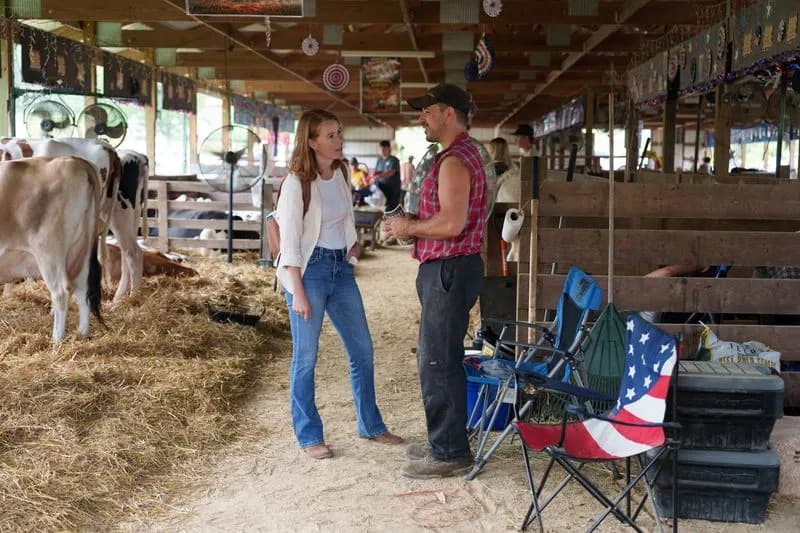
Rebecca Cooke, who is running for the democratic nomination in Wisconsin's 3rd congressional district, talks to a local resident while campaigning in Elroy, Wisconsin, U.S., June 28, 2026. REUTERS/Tim Evans
Rebecca Cooke spends her days alternating between knocking on doors across Wisconsin's 3rd Congressional District and waiting tables at two restaurants in Eau Claire, a city of roughly 73,000 surrounded by farmland. At 38, the dairy farmer's daughter and Democratic front-runner is trying to flip a competitive House seat this November that could help determine control of Congress.
Cooke says conversations she has while serving customers often surface the issues voters care about most — from high fuel and fertilizer prices to cuts in food and health programs. She keeps supportive notes patrons sometimes leave on receipts on her phone as reminders of what is at stake.
Why the Race Matters
The 3rd District mixes farmland with larger towns that host universities and employers such as Menards. It has been closely contested: the last three elections were decided by about three to four percentage points, including incumbent Derrick Van Orden's narrow victory over Cooke in 2024.
“Any district that is mathematically competitive is going to get a significant amount of attention,” said Anthony Chergosky, political science professor at the University of Wisconsin–La Crosse.
Policy Fractures In Rural Communities
Van Orden, a retired Navy SEAL and Republican incumbent, has campaigned alongside former President Donald Trump this summer. He supports multiple Trump-era priorities — including tariffs, a 2025 tax-cut package that reduced funding for Medicaid and SNAP, and the administration's approach to Iran — positions that Republicans say defend national security and economic interests.
Democrats and some farmers counter that those policies have strained rural households and farms. Tariffs and trade tensions have slowed purchases of U.S. agricultural exports, particularly to China, while cuts to food-purchase programs removed a steady buyer of locally grown food that supported farmers and food banks. Meanwhile, the conflict with Iran has been cited as a factor in higher fuel and fertilizer prices that squeeze farm margins.
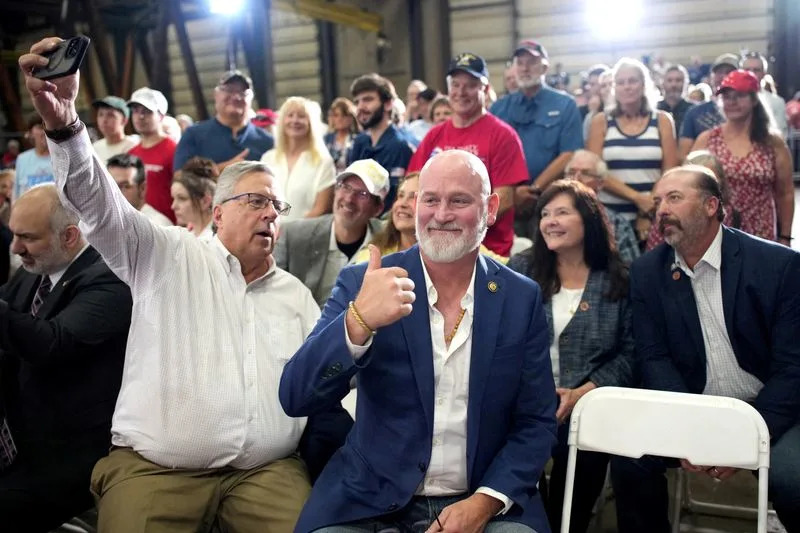
FILE PHOTO: Rep. Derrick Van Orden (R-WI) attends an event at Mid-City Steel where U.S. Vice President JD Vance is expected to promote is expected to promote The One, Big, Beautiful Bill Act of 2025 passed earlier this summer, the Trump administration's signature piece of legislation, in La Crosse, Wisconsin, U.S., August 28, 2025. Andrew Harnik/Pool via REUTERS/File Photo
Voices From The Field
From his Ferryville farm near the Mississippi River, 33-year-old grower Dylan Bruce described what he called a combined fuel-and-farm crisis. An April American Farm Bureau survey found 70% of members could not afford fertilizer; diesel averaged about $5.05 a gallon in Wisconsin as of late summer, well above last year’s average, according to AAA.
Corn and soybean farmer Dean Rosenbrook, who appeared at a Chippewa Falls rally where Trump spoke, said he would likely back Van Orden but also wants the Iran war to end. "Fuel and fertilizer prices are killing us," Rosenbrook said.
Cooke’s Message And The Path Ahead
Cooke portrays herself as a moderate Democrat rooted in rural experience. She cites her family's loss of its dairy herd when she was in high school as formative and proposes expanding federal support for rural hospitals, slowing farm consolidation, and strengthening labor unions in Wisconsin.
Van Orden defends his positions as necessary for long-term security and economic strength, noting measures such as House-passed legislation to allow year-round sales of higher-ethanol gasoline as part of efforts to ease fuel costs.
Recent polling shows Trump remains relatively popular among rural voters — 51% approval in a late-July to early-August Reuters/Ipsos poll — though that is down from earlier in 2025. Strategists say that drop, combined with local economic strains, could make this race especially competitive.
Reporting by Renee Hickman in Eau Claire, Wisconsin. Editing by Emily Schmall and David Gaffen.
Help us improve.