The tobacco hawkmoth Manduca sexta has porous, hair-like wing scales and genes for odor receptors, indicating its wings can detect odors. Electrowingography showed wing tissue responds selectively to two amines, pyrrolidine and piperidine, which occur in nightshade leaves. AI structural models predicted two candidate wing receptors that can bind these molecules. The behavioral role of wing-based olfaction, such as guiding egg-laying, remains to be tested.
Moth Wings That Smell: Tobacco Hawkmoth Detects Nightshade Chemicals
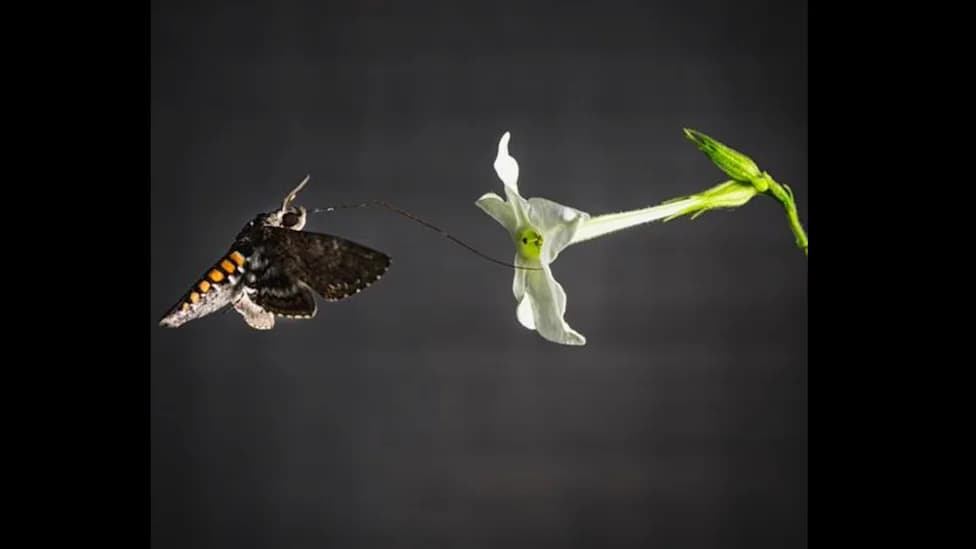
A tobacco hawkmoth ('Manduca sexta') feeding from a tobacco flower.
Moth wings do far more than enable flight. A new study in the Journal of Experimental Biology shows that the tobacco hawkmoth, Manduca sexta, has wing structures capable of detecting specific odor molecules — a surprising example of sensory biology beyond the antennae.
What the Researchers Found
A German research team examined the wings using multiple complementary approaches. Scanning electron microscopy (SEM) of gold-coated wing tissue revealed porous, hair-like scales — a classic hallmark of chemosensory structures. Genetic analyses of wing tissue identified genes that encode odor receptor proteins, suggesting the molecular machinery for smell exists in the wings.
How They Tested Smell Detection
To measure physiological responses, investigators used a technique called electrowingography: excised wings were placed between electrodes while researchers presented a panel of odor molecules. The wing recordings responded selectively to two amines, pyrrolidine and piperidine — pungent compounds commonly found in the leaves of nightshade plants.
Trimming the wing edges did not abolish the responses, indicating that sensory, porous hairs capable of detecting these chemicals are distributed across the wing surface rather than confined to the margins.
Structural Evidence From AI Modeling
As a final line of evidence, the team used artificial intelligence to predict 3D structures for ten candidate odor receptors found in wing tissue. Molecular docking showed that pyrrolidine and piperidine fit snugly into the binding pockets of two candidate receptors, supporting the electrophysiological and genetic findings.
Why It Matters
These results reveal a previously underappreciated sensory role for moth wings. Because tobacco hawkmoths frequently lay eggs on nightshade plants, wing-based detection of nightshade-associated amines could help females locate suitable host plants for oviposition. However, the behavioral consequences of wing olfaction remain untested and are an important next step.
Sonja Bisch-Knaden, co-author from the Max Planck Institute for Chemical Ecology, commented that this work builds on earlier discoveries of receptor proteins in wing tissue and provides multiple lines of evidence that wings can serve as olfactory sensors.
Overall, the study combines anatomy, genetics, electrophysiology, and structural modeling to make a strong case that Manduca sexta wings can detect specific plant-derived chemicals — expanding our view of how insects sample chemical cues in their environment.
Help us improve.