Researchers report that early-life stress in mice leaves a lasting epigenetic "scar" in dopamine-producing neurons of the ventral tegmental area. Elevated SETD7 increases H3K4me1 marks, loosening chromatin and leaving genes primed to respond more strongly to later stress. Experimental manipulation of SETD7 altered adult anxiety-like behaviour, suggesting a concrete molecular mechanism that may point to future interventions—pending confirmation in humans.
Physical Scar: Early Trauma Leaves an Epigenetic "Genetic Slinky" in Dopamine Neurons, Mouse Study Finds

(Elva Etienne/Moment/Getty Images)
Childhood adversity can leave enduring marks on health, but the biological steps that link early trauma to later mental-health vulnerability remain incompletely understood. A new study in Neuron (Kim et al., 2026) reports that early-life stress in mice produces a lasting molecular change inside dopamine-producing neurons of the ventral tegmental area (VTA), effectively leaving a cellular "physical scar" that primes these cells to overreact to stress later in life.
What the Researchers Did
The team examined VTA neurons in mice exposed to stress during early development. They measured chromatin marks, gene expression, enzyme levels and adult behaviour, and then tested causality by experimentally increasing or blocking the enzyme they identified.

The researchers compared coiled DNA in brain neurons to a slinky toy – which can be affected by stress. (Debbie Harris/Unsplash)
Key Findings
Early stress raised levels of the enzyme SETD7 in VTA neurons. SETD7 promotes placement of the chromatin mark H3K4me1, which labels stretches of chromatin as more ready to uncoil. The authors liken this state to a child's slinky: chromatin becomes slightly loosened so certain gene "dials" are easier to access.
Crucially, this altered chromatin state did not immediately change behaviour. Instead, it left dopamine-producing cells primed so that later stressors provoked an exaggerated molecular and behavioural response. In adult animals, this heightened reactivity correlated with disrupted dopamine balance and increased anxiety-like behaviours.
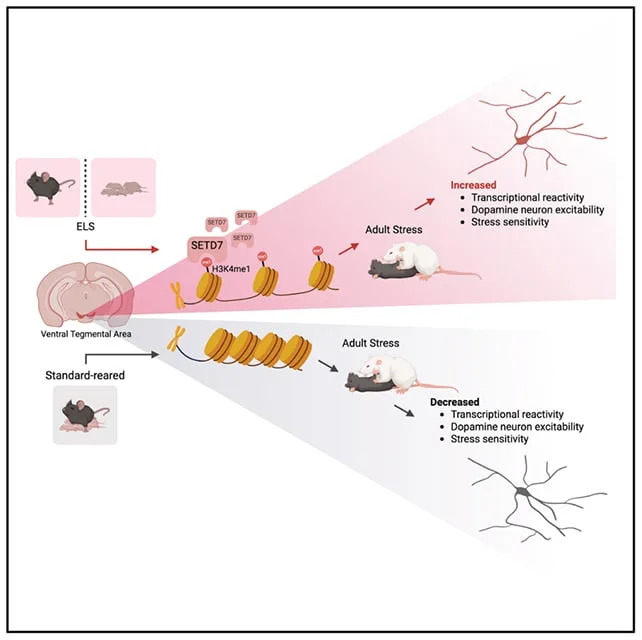
Early stress exposure left mice more vulnerable to stress later on. (Kim et al.,Neuron, 2026)
Experimental Tests of Causality
To test whether SETD7 was sufficient and necessary for the effect, investigators artificially increased SETD7 in unstressed mice and blocked it in mice that experienced early stress. Raising SETD7 produced adult behaviours consistent with lower stress tolerance and more anxiety-like responses, while blocking SETD7 made previously stressed mice more resilient than controls.
"We have uncovered a new biological process linking experience of early-life adversity to this long-term vulnerability to mental illness," said Meaghan Creed, one of the study's senior authors. "This finding reveals a physical scar left by trauma experienced during development inside brain cells, providing scientists with a concrete biological target to develop new treatments and interventions."
Why This Matters
The study identifies a clear epigenetic mechanism—SETD7-driven H3K4me1 marks in VTA neurons—that helps explain why early stress can produce latent and broad effects on mental health. Because the experiments used mice, the findings must be confirmed in humans; however, conserved aspects of mammalian brain biology and epidemiological links between childhood adversity and later illness make a related process plausible in people.

Subscribe to ScienceAlert's free fact-checked newsletter
Next Steps and Implications
Knowing these stress-related chemical bookmarks now opens avenues for interventions that might prevent or reverse the primed state. Future research will explore whether positive early experiences (for example, improved social interaction or nutrition) can produce protective epigenetic changes in the same neurons, and whether pharmacological or other interventions can safely target SETD7 or its downstream effects.
"If we can step in with supportive care, therapy or social resources during sensitive windows of development, we may be able to protect the epigenome—preventing the genetic slinky from locking into an open position and perhaps giving the developing brain a chance to build natural resilience," said Catherine Jensen Peña of Princeton Neuroscience Institute.
Limitations: Results are from mouse models and require human confirmation. Targeting epigenetic mechanisms in people involves high safety and specificity hurdles and will take time to develop.
Study citation: Kim et al., Neuron, 2026.
Help us improve.