An 80-million-year-old articulated snake fossil from São Paulo, named Tametara mirim, suggests early snakes followed multiple evolutionary paths rather than a single route to slithering. Skull anatomy and micro-CT scans indicate adaptations for headfirst burrowing, while comparisons with other early snakes like Dinilysia point to distinct ecological specializations. Published in Nature, the study highlights the rarity of articulated Mesozoic snake fossils and the value of advanced imaging and fossil preservation for understanding evolution.
80-Million-Year-Old Brazilian Fossil Reveals Multiple Routes To Snake Slithering
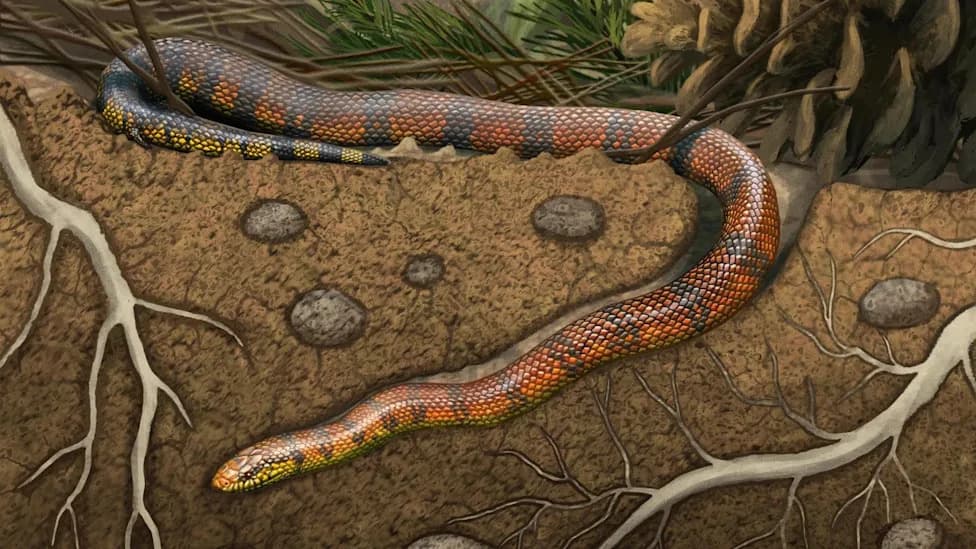
Photo Credit: Gabriel Ugueto
A remarkably well-preserved snake fossil from São Paulo state, Brazil, is offering new evidence that early snakes did not follow a single, uniform path to limbless locomotion. The specimen, dated to about 80 million years ago and described as a new species, Tametara mirim, sheds light on how different snake lineages adapted to distinct environments.
The research, published in Nature, emphasizes how rare articulated Mesozoic snake remains are—fewer than 10 such fossils are currently known. Unlike many fragmentary finds, the bones of this specimen remain articulated in life position, allowing unusually detailed anatomical study.
Evidence for a Burrowing Lifestyle
Detailed examination of the skull revealed thick, compact bone consistent with animals that move headfirst through soil. Micro-CT scans of the brain cavity further show reduced visual centers and a relatively small forebrain—traits commonly associated with subterranean, low-light habitats.
Contrasts With Other Early Snakes
Comparisons with another early snake, Dinilysia, reveal contrasting anatomies. Dinilysia's skull and brain anatomy are more consistent with above-ground life, suggesting it occupied a different ecological niche. Together, these differences indicate that early snakes were diversifying into multiple habitats—burrowing, surface-dwelling, and some later moving into marine environments—rather than evolving along a single linear trajectory.
Broader Significance
This discovery highlights the importance of advanced, non-destructive imaging techniques such as micro-CT scanning for studying delicate fossils. It also underscores the scientific value of protecting fossil sites and natural history collections, which preserve the material needed to reconstruct evolutionary history.
By revealing how early snakes adapted to varied ecological pressures, the find helps explain the group's modern diversity and distribution, from subterranean burrows to coastal waters. More broadly, each well-preserved specimen fills critical gaps in the fossil record and improves our understanding of resilience, adaptation, and biodiversity through deep time.
Help us improve.