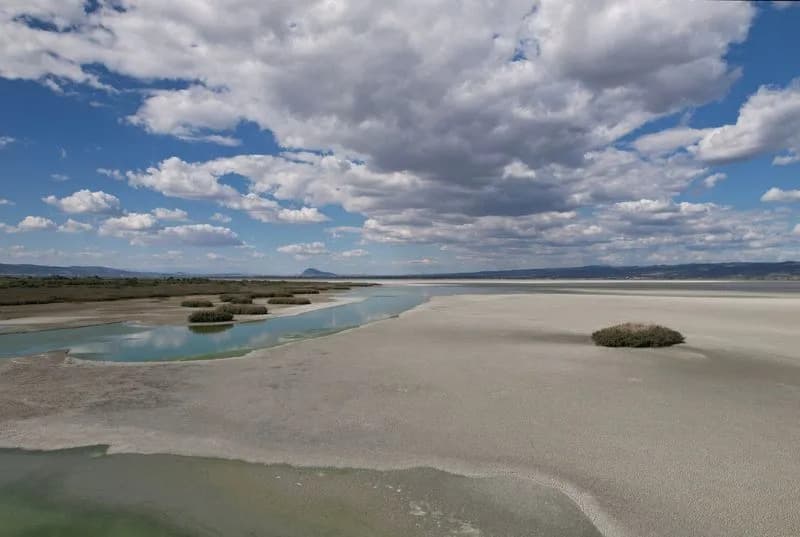
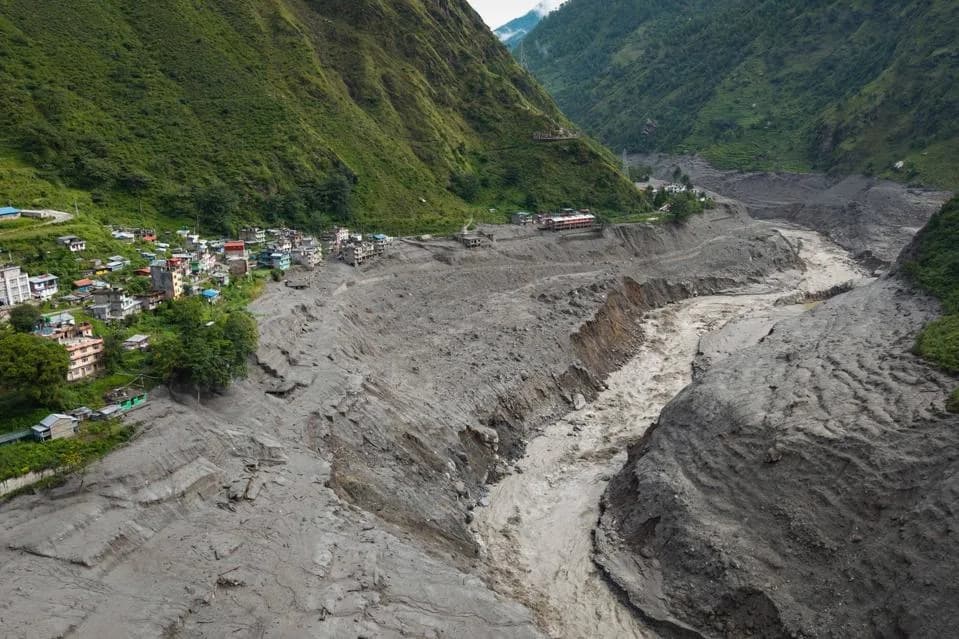
Rising waters in Kenya's Rift Valley have caused Lake Baringo to expand by roughly 70% and Lake Bogoria by about 21% since 2010, narrowing the gap between them and forcing tens of thousands to higher ground. The surge has increased dangerous encounters with crocodiles and hippos, submerged resorts and schools, and slashed tourism income. Scientists warn that overflow and potential mixing of the lakes could trigger severe ecological damage and further displace communities.
Rising Rift Valley Lakes Drive Crocodiles and Hippos Into Kenyan Communities
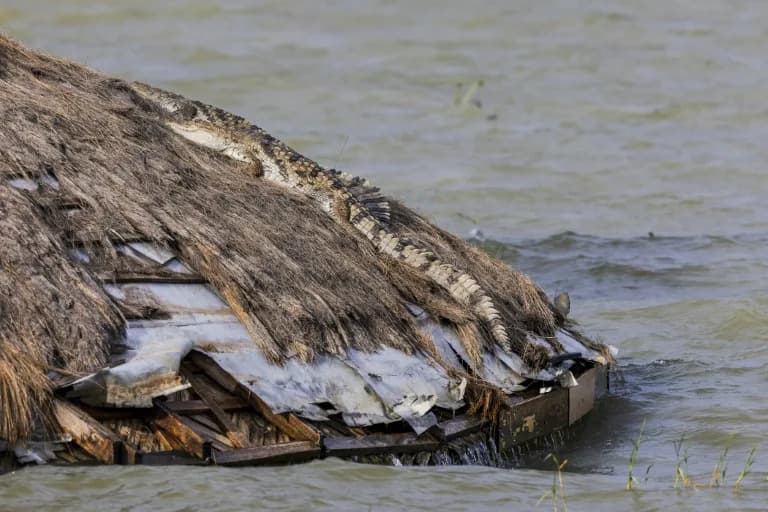
Crocodiles and hippos are moving closer to homes as lake water expands in Kenya's Rift Valley (Tony KARUMBA)
A crocodile basks on the roof of a submerged conference hall at a holiday resort in central Kenya — a stark image of how rapidly rising lake waters are threatening thousands of families, farms and local businesses.
Lake Baringo and neighbouring Rift Valley lakes have swelled to levels not seen in decades. Scientists link the surge to unusually heavy rains tied to climate change, and satellite imagery confirms dramatic growth that has already displaced communities and strained local ecosystems.
Lives Lost and Communities Displaced
Official figures show tens of thousands of people have been forced to move to higher ground, but many say the waters continue to encroach on newly occupied land. Residents report more encounters with dangerous wildlife as the lakes edge closer to homesteads.
When Lake Baringo first rose significantly in 2011, Mary Milka Tiren, 40, lost her husband after a hippo attacked him walking home from work at a now-submerged tourist resort. A decade later her nine-year-old son spent three months in hospital after a crocodile attack that left a permanent scar.
"It wanted to rip off his whole arm from the shoulder... but he was rescued by his peers after a long struggle," Tiren said.
"We have seen more crocodile incidents not because numbers of crocodiles have risen, but because the lake is now much closer to homesteads," said Kenya Wildlife Service (KWS) Senior Warden Jackson Komen. He also warned that hippo attacks have risen because expansion of the lakes has erased riparian grazing lands.
What Satellite Data Shows
An AFP analysis of Copernicus Sentinel and NASA Landsat imagery shows Lake Baringo's surface area expanded by about 70% since 2010 — from roughly 138 square kilometres to around 234 square kilometres. Nearby Lake Bogoria, an alkaline lake noted for its high sodium content and flamingo populations, has grown by about 21%, from approximately 34 to 41 square kilometres.
The rising waters have narrowed the gap between the two lakes to an estimated 10 kilometres. Scientists warn that if the freshwater of Baringo and the alkaline waters of Bogoria mix, fish and other wildlife may not survive.
"If the two lakes mix, fish, crocodiles and hippos could fail to survive... we may face an ecological disaster we do not yet know how to manage," Komen said.
Mathew Herrnegger, a scientist at Austria's University of Natural Resources and Life Sciences, noted that satellite altimetry indicates Bogoria is high enough to overflow toward Baringo, though the volume and full impact remain uncertain.
Economic and Social Impacts
The lakes' expansion has severely damaged tourism and local livelihoods. Komen said community wildlife conservancies have lost about 80% of their usable land, forcing wildlife relocations. AFP observed at least four holiday resorts submerged by Baringo, with another stranded on an island.
Lake Bogoria's flamingo numbers have declined and some hot springs are now underwater. Michael Baimet, director of the local disaster department, estimated tourism revenues fell from roughly $1 million a year to about $200,000.
Schools and Families at Risk
Official records indicate about a dozen schools around Lakes Baringo and Bogoria have been affected, with several partially or fully submerged. At Kokwa Island Primary and Junior School in Marigat, roughly 240 pupils and staff must cross crocodile-infested waters to reach classes; a single ferry makes repeated trips, cutting into learning time. The girls' dormitory sits inches from the lapping waves, prompting additional security measures.
Many families lack the funds to relocate. Faith Mpayei, 40, has moved the fence around her former two-acre farm twice since 2016 as the water advanced; her fence now lies underwater and water reaches roughly a third of the way up her house. "It has reduced me to zero," she said. "We are helpless... I have to relocate... there’s nothing left to do here."
Looking Ahead
Local authorities and scientists warn that further heavy rains — including seasonal El Niño events — could worsen flooding and force more relocations. The situation poses urgent questions about long-term adaptation, disaster response and how to protect both people and fragile ecosystems as climate-driven extremes increase.
Help us improve.