Global wildfires, persistent heat waves and record-warm oceans mark a worrying 2026 summer, but the year has not yet become the hottest on record. Scientists say a likely exceptionally strong El Niño — combined with ongoing human-driven warming and very high ocean heat content — raises the chance that 2026 could surpass 2024 before year’s end. Current extremes are primarily driven by long-term greenhouse gas warming; El Niño is expected to add a short-term boost in the coming months.
Not The Hottest — Yet: A Supercharged El Niño Could Make 2026 The Warmest Year On Record

FILE - A baseball fan cools off before a game between the San Diego Padres and the Chicago Cubs in Chicago, July 1, 2026. (AP Photo/Nam Y. Huh, File)(AP Photo/Nam Y. Huh)
Wildfires have scorched parts of North America and Europe, deadly heat waves have stalled over cities, and the world’s oceans are the hottest on record for this time of year. Climate scientists warn a rapidly strengthening El Niño could push global temperatures higher and reshape weather patterns worldwide.
Where 2026 Stands Now
Despite the intense heat and extremes, 2026 has not yet become the hottest year on record. So far it ranks as the third-warmest year, behind 2024 and 2025. But researchers say there is still time for that to change before the year ends.

FILE - People in Lake Country, British Columbia, watch as the Quilpituk Creek wildfire burns on the mountainside across Okanagan Lake, near Fintry, Aug. 3, 2026. (Darryl Dyck/The Canadian Press via AP, File)(DARRYL DYCK/The Canadian Press via AP)
Why 2026 Could Spike
Scientists point to a one-two combination: steadily rising human-caused warming plus projections for an unusually strong El Niño. Together, these raise the odds that 2026 could surpass 2024 as the warmest year — or at least come very close.
“With wars around the globe in recent years people paid less attention to climate change because the world was on fire in different ways. Now the world is on fire again with climate change in a way that’s increasingly difficult to ignore,” said Zeke Hausfather of Berkeley Earth. “It's going to keep getting worse.”
Hausfather estimates a 35% chance that 2026 will overtake 2024, up from about 7% in March. Former NASA climate scientist James Hansen has also predicted 2026 may edge out 2024 by year’s end.

FILE - Usually submerged areas of the Danube River are exposed amid a drought in Rasova, Romania, Monday, Aug. 3 2026. (AP Photo/ Vadim Ghirda, File)(AP Photo/Vadim Ghirda)
Oceans, Lag Effects, And El Niño
Daily global sea surface temperatures matched 2024 beginning in May and have been at record highs on most days since June. Because oceans cover more than 70% of Earth’s surface, there is typically roughly a month-and-a-half lag between ocean heat anomalies and their appearance in the global average temperature. That lag increases the likelihood of new global records in the months that follow.
Europe’s Copernicus climate service reports that about 82% of the world’s ocean surface has experienced marine heat waves this year. Most forecast models now predict an exceptionally strong El Niño — perhaps the strongest on record. El Niño is a natural warming of parts of the equatorial Pacific that tends to raise the global average temperature and alter weather extremes worldwide.

FILE - Tourists take shelter as they walk in front of the Rome'a ancient Colosseum, Aug. 1, 2026. (AP Photo/Alessandra Tarantino, File)(AP Photo/Alessandra Tarantino)
“El Niño releases heat stored in the ocean, and because greenhouse gases trap more heat — with about 90% of the extra energy going into the seas — there is even more heat to be released,” said Zachary Labe of Climate Central. Ocean heat content, a key measure of human-driven warming, continues to set new records.
What Role Is El Niño Playing Right Now?
Scientists emphasize that the extreme heat, fires and other disruptions already visible this summer are not primarily caused by El Niño, because El Niño’s strongest effects usually appear later in the year. The season’s early extremes are the result of long-term warming driven by burning coal, oil and gas.
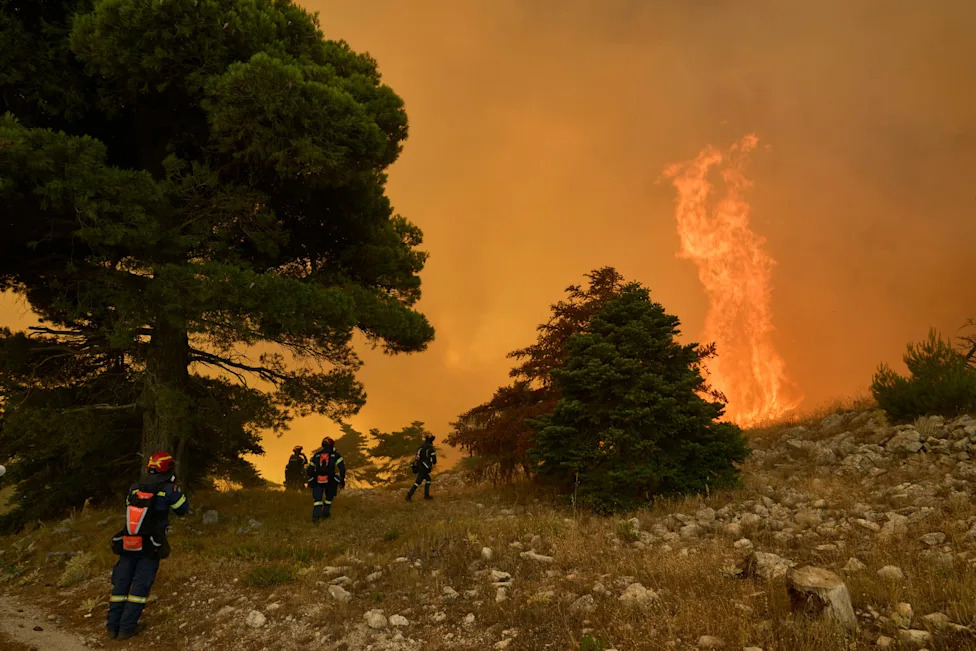
FILE - Firefighters approach towering flames on Mount Kithairon near Porto Germeno, northwest of Athens, Greece, Aug. 3, 2026. (AP Photo/Petros Giannakouris, File)(AP Photo/Petros Giannakouris)
“The driver of the record warmth is climate change in the background. It’s a much, much larger contribution than El Niño, which is just a tenth to two-tenths of a degree on top of that long-term trend,” Labe said.
James Hansen and others have noted that warming appears to be accelerating for two reasons: declines in industrial aerosol pollution that previously masked some warming, and indications the climate might be responding more strongly to greenhouse gases than many models anticipated.
Impacts This Summer
Heat waves this summer have been especially severe in regions unaccustomed to extreme heat, with unusually warm nights that make sleep difficult and worsen health and productivity outcomes. Samantha Burgess of Copernicus described Europe’s pattern this year as exceptional, with multiple heat waves from May through July. North America, South America, India and other regions have also experienced shocking or devastating heat.
Princeton climate scientist Michael Oppenheimer said these events are the vivid realization of long-standing warnings: climate change has increased wildfire risk and the probability of unprecedented, extremely hot summers around the world.
What To Watch For
NOAA previously gave a lower probability that 2026 would finish as the warmest year, but monitoring officials have said those odds may rise as updated analyses are completed. With strong El Niño forecasts and continued high ocean heat content, the next several months will be critical in determining whether 2026 becomes the warmest year on record.
Note: The Associated Press funds climate coverage through multiple foundations but retains full editorial control.
Help us improve.