Three physicists from the University of Oslo studied what happens when an optical shutter truncates a single-photon wavepacket and published their calculations in Physical Review Letters. Using a one-dimensional toy model with a single polarization, they find that truncation can produce a complex quantum state that includes photon-number components up to arbitrarily large values. In the model, one region after the cut can register as vacuum while the other registers as a full photon, a consequence of the photon’s asymmetric, extended amplitude. The result is theoretical but has implications for how time- and space-dependent operations transform photonic states.
Physicists Attempted to 'Cut' a Photon — The Result Upends Intuition
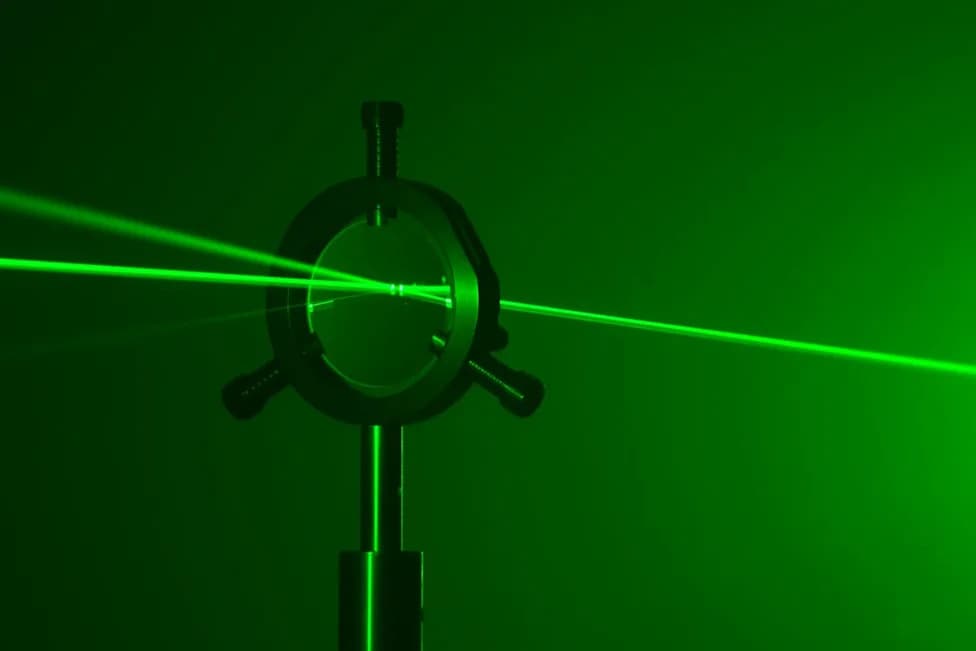
Scientists Broke Physics Cutting a Photon in HalfChris Rogers - Getty Images
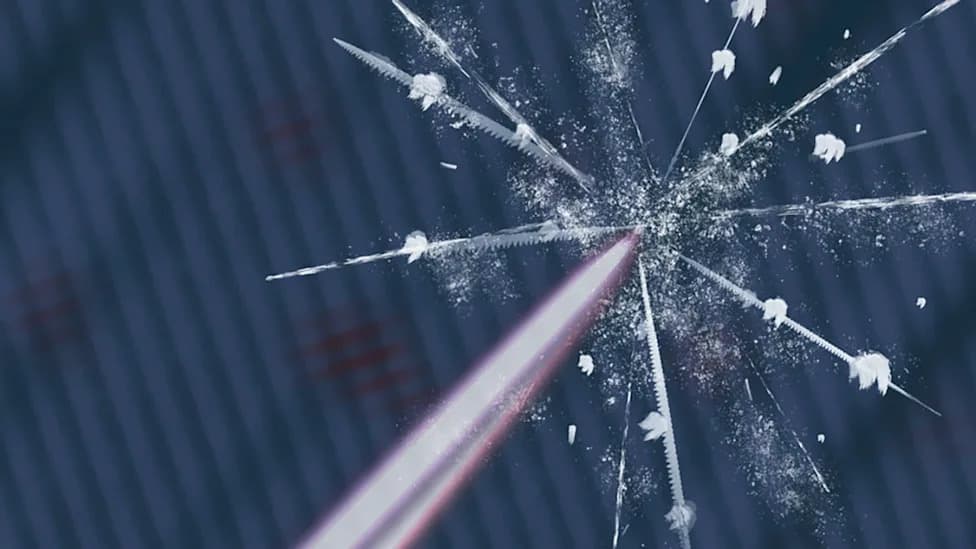
Researchers from the University of Oslo report surprising theoretical results showing that clipping a single-photon pulse with an optical shutter can produce an unexpectedly complex quantum state.
The work, published in Physical Review Letters, asks a deceptively simple question: what happens when you truncate a photon-carrying optical pulse? Although a photon is an elementary particle and cannot be physically split like a composite object, the quantum wavepacket that describes a photon can be modified by time- and space-dependent operations such as shutters or mirrors.
Optical pulses are extremely short bursts of light that can contain just a few photons. The Oslo team stresses that single-photon wavepackets often have asymmetric quantum amplitudes with a long, effectively unbounded tail in one direction. That extended amplitude — sometimes described informally as an "infinite tail" — means that where and when you cut the pulse matters for the resulting quantum state.
Model and Methods
To make the problem tractable, the authors built a deliberately simple, idealized ("toy") model: one spatial dimension, a single polarization, and a single-photon wavepacket sent toward a mirror-like shutter that truncates the pulse mid-flight. The analysis is theoretical and based on exact calculations of how the truncated field evolves under these constraints.
Key Findings
Contrary to everyday intuition, truncating the wavepacket does not produce two smaller partial photons. Instead, the truncated state can be expressed as a superposition that includes components with arbitrarily many photons (photon-number components up to arbitrarily large values). In the particular toy model the authors studied, the post-shutter state can resolve into two well-defined regions: one region that registers as vacuum (no photon) and the other that registers as a single photon. More generally, the truncation operation converts the original single-photon wavepacket into a complicated mixture or superposition of photon-number states.
The underlying reason is the directional, asymmetric structure of the photon’s quantum amplitude: because the amplitude extends in one direction, abruptly removing part of the wavepacket injects frequency and temporal components that change the photon-number decomposition. Even slowly operating shutters can give rise to high photon-number components in principle.
Caveats and Significance
The authors are careful to note the limits of their result: it applies to a highly idealized model and is a theoretical calculation, not an experimental demonstration. Nevertheless, the analysis clarifies how localized, time-dependent operations affect photonic quantum states and may be useful to theorists and experimentalists working on quantum optics, quantum information, and the manipulation of light with fast shutters, modulators or mirrors.
In short, the study reframes a simple dinner-table question into a concrete theoretical finding: trying to "clip" a photon-like wavepacket can produce an unexpectedly rich quantum outcome rather than a smaller, partial photon.
Help us improve.