New experiments show that brains can persist for millennia because wet, low-oxygen burial conditions steer protein decay toward crosslinking and insoluble aggregation rather than complete destruction. Researchers led by Alexandra Seviour mapped over 1.26 million protein decay trajectories from mouse burial experiments sampled over six months, finding that oxygen availability determines whether free-radical chemistry fragments proteins or produces decay-resistant aggregates. The brain’s metal content, membrane density, redox-active amino acids and the skull’s barrier effect make it especially likely to follow this preservation pathway, which may also connect to molecular patterns seen in neurodegenerative disease.
Why Some Human Brains Survive Millennia: A New Chemical Explanation
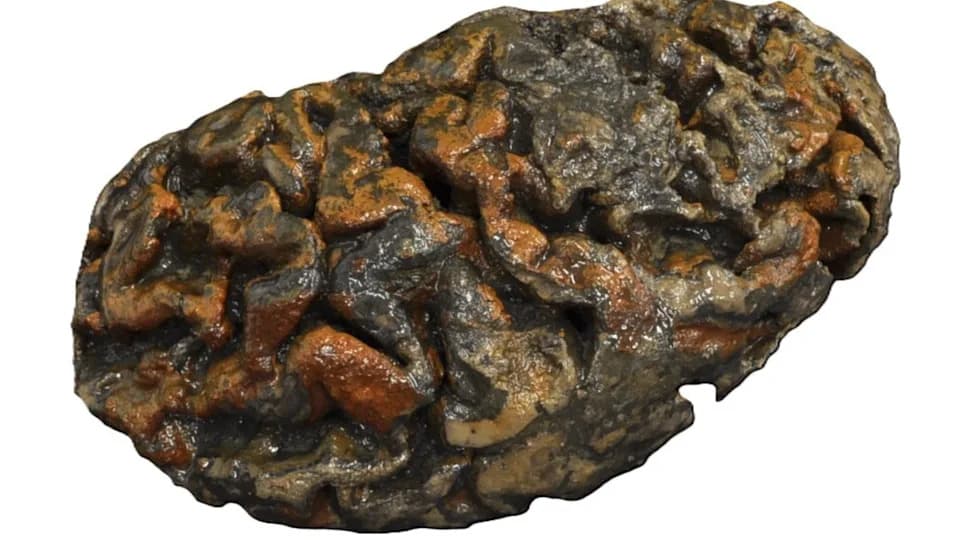
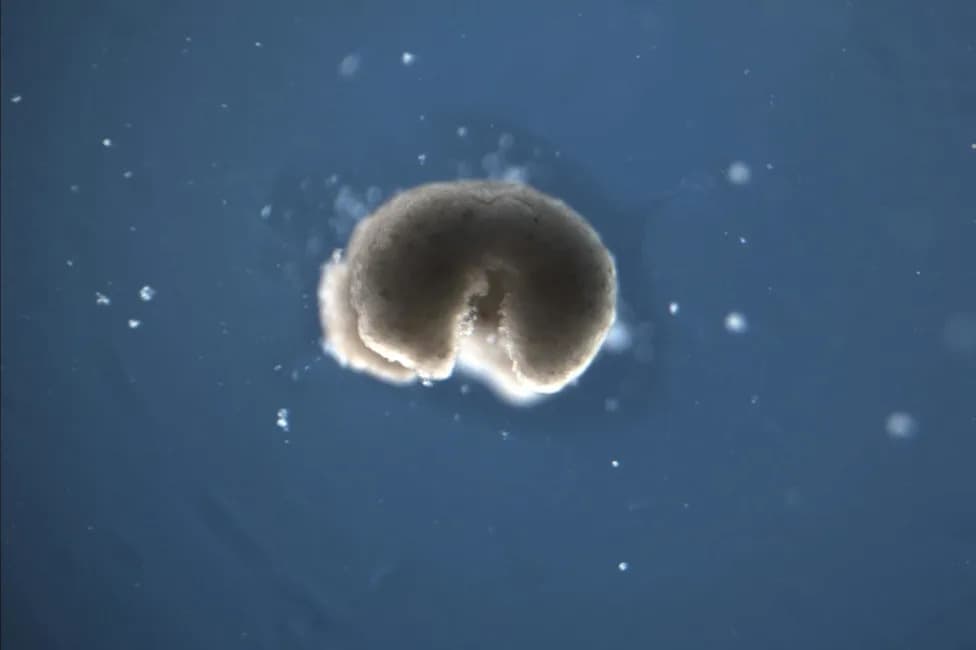
The left cerebral hemisphere of a man who was buried in Bristol, U.K. Part of the preserved brain is stained red with iron oxides. . | Credit: Alexandra Morton-Hayward
For decades archaeologists and pathologists have been puzzled by a striking phenomenon: in certain burials the brain persists long after the rest of the body has decayed. New research led by Alexandra Seviour (University of Oxford) and published June 19 in the Journal of Proteome Research reveals a chemical pathway that explains how brains can resist decomposition for thousands of years under specific burial conditions.
Controlled experiments reveal a preservation pathway
Seviour and colleagues tested their idea by burying mouse carcasses in four combinations of water and oxygen availability and sampling brains at 24 hours, 72 hours, one week, six weeks, three months, and six months. Using high-resolution mass spectrometry, the team tracked more than 1.26 million protein decay trajectories to identify which peptides survived and what chemical modifications they carried.
Oxygen shapes the fate of brain proteins
The experiments showed that early decomposition steps were similar across environments, but after several weeks oxygen availability became the dominant factor. In oxygen-rich settings, abundant oxygen fuels chain reactions of free radicals that rapidly fragment proteins and accelerate decay. In contrast, wet, low-oxygen (hypoxic) environments — such as riverbeds, lake shores, flooded caves, and shipwrecks — stall the radical cascade. Intermediate products instead form crosslinks with neighboring protein fragments, producing insoluble, tightly bound aggregates that resist enzymatic and microbial breakdown.
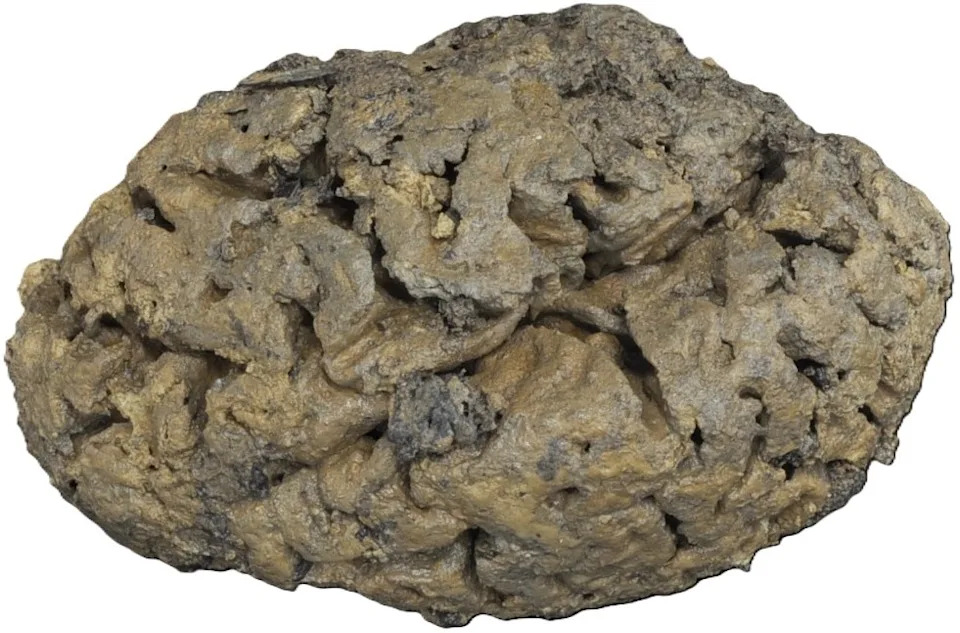
The preserved brain of an adult whose burial was found in Bristol. The brain is coated with clay from a waterlogged grave. | Credit: Alexandra Morton-Hayward
Why the brain is especially prone to this outcome
The brain’s biology makes it particularly likely to follow this self-limiting pathway: it is rich in metal ions that catalyze free-radical reactions, packed with membranes that concentrate radicals, and contains many redox-active amino acids that readily form crosslinks. The skull also creates a physical microenvironment that limits oxygen and fluid exchange compared with other body regions, favoring the chemistry that yields toughened protein residues.
"We found that brain preservation isn't a rare anomaly, it's a novel chemical pathway," Seviour told Live Science. "Under the right conditions, preservation actually arises from decay itself: the same reactions that degrade tissue can also weld the breakdown products together into something far tougher."
Broader implications
More than 4,400 preserved human brains have been recorded in the archaeological record spanning the last 12,000 years, and roughly one-third of these cases are not explained by classic preservation processes such as mummification or saponification. Richard Evershed (University of Bristol), who was not involved in the study, praised the comprehensive proteomic approach and suggested applying similar methods to other tissues and to proteins preserved in other archaeological matrices (for example, pottery residues or dental calculus) to test how unique the brain’s pathway is.
Beyond archaeology, the study has potential biomedical relevance: Seviour notes that the molecular signature of the decay-resistant peptides resembles protein fingerprints seen in some neurodegenerative diseases such as Alzheimer’s. Exploring that overlap could offer new molecular insights into disease-related protein aggregation.
Overall, the work reframes brain preservation not as a paranormal oddity but as a reproducible chemical outcome driven by burial microenvironments and intrinsic brain chemistry.
Help us improve.