The Supreme Court's use of the metaphor 'a law trapped in amber'—revived in United States v. Rahimi—has spread across multiple opinions this term, appearing in six Supreme Court cases and hundreds of lower-court rulings. Originating with 1970s liberal jurists, the phrase is now used broadly, by justices across the ideological spectrum, to reject overly rigid historicism. By saying what the law is not, the metaphor subtly nudges the Court toward a more adaptable, principle-driven approach, even as it deliberately leaves the precise doctrine unsettled.
A Court No Longer 'Trapped in Amber': How a Vivid Metaphor Is Reshaping Constitutional Interpretation
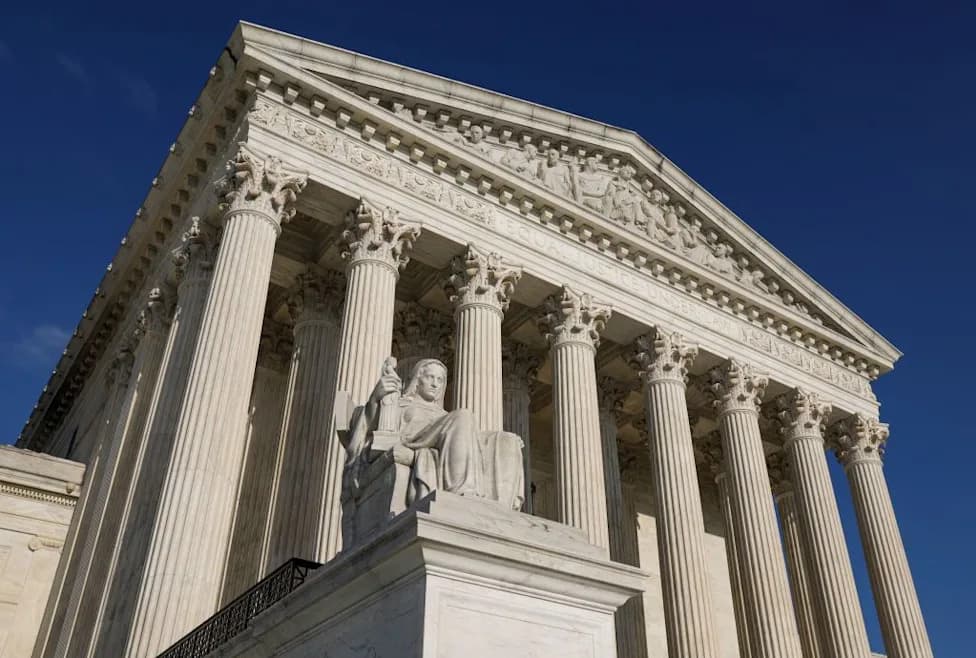
(Kevin Dietsch/Getty Images)
The Supreme Court's invocation of the image of a law 'trapped in amber'—first prominently featured in United States v. Rahimi—has rapidly spread across this term's opinions and hundreds of lower-court rulings. What began as a phrase used by 1970s liberal jurists to criticize frozen legal doctrines has been repurposed, paradoxically, by a modern Court often associated with conservative originalism. The metaphor is doing important rhetorical work: by saying what the law is not, it nudges the Court toward a more flexible, principle-driven approach without spelling out a single doctrinal theory.
Early history
The idea that constitutional principles should not be 'frozen' in time predates Rahimi. A prominent early use appears in Richardson v. Ramirez (1974), in which the Court upheld felony disenfranchisement rules using an analysis often characterized as originalist. In dissent, Justice Thurgood Marshall (joined by Justice William Brennan) wrote that 'constitutional concepts of equal protection are not immutably frozen like insects trapped in Devonian amber.' That passage echoed Judge Shirley Hufstedler's 1972 Ninth Circuit opinion in Dillenburg v. Kramer, which argued that the Equal Protection Clause encodes a living principle whose implications can evolve, especially in voting-rights contexts.
Over subsequent decades the 'amber' image surfaced intermittently in scholarship and litigation. Law professor Akhil Amar used the metaphor to critique some of Justice Antonin Scalia's stringent Fourth Amendment originalist arguments, and originalist scholar Stephen Sachs later used it to describe how general-law rules (like personal jurisdiction) might be updated by nonjudicial actors. For much of that time, however, the image was relatively rare in judicial opinions; the metaphor itself might be said to have been 'frozen in amber.'
Amber escaping: Rahimi and the ripple effect
United States v. Rahimi marked a turning point. There, the Court upheld a gun restriction for individuals subject to domestic-violence restraining orders while signaling a move away from a rigid historical test for Second Amendment claims. Chief Justice John Roberts wrote: '[S]ome courts have misunderstood the methodology of our recent Second Amendment cases. These precedents were not meant to suggest a law trapped in amber.' That line—appearing without citation to its provenance—helped popularize the image on the modern Court.
Several justices echoed or contested the phrase in concurrences and dissents. Justices Sonia Sotomayor, Ketanji Brown Jackson, and Amy Coney Barrett treated a law 'trapped in amber' as an undesirable state; Justice Neil Gorsuch observed that some constitutional provisions might indeed reflect the people's directions 'trapped in amber.' Lower courts and scholars quickly adopted the language: references rose from dozens to hundreds, and the image reappeared across doctrinal contexts, including equity, statutory interpretation, and administrative law.
Wide application this term
By the author's count, this term the amber metaphor appeared in six separate Supreme Court cases, including two majority opinions. Notable examples include:
- Trump v. Cook (Federal Reserve): The Court asked why the central bank should be 'trapped in amber' any more than other aspects of constitutional governance, using the metaphor to resist a sweeping unitary-executive claim.
- Watson v. Republican National Committee (mail-in ballots): Justice Amy Coney Barrett wrote that historical practice 'detached from statutory text' does not 'trap in amber' every contemporary statutory practice—applying the image in statutory interpretation.
- Trump v. Barbara (birthright citizenship): Justice Brett Kavanaugh observed that exceptions recognized in 1791 or 1868 are not necessarily a closed set 'trapped in amber,' echoing Richardson-era dissenting themes.
Several dissents also invoked the image—Justice Sotomayor asked when law is or is not 'trapped in amber,' and Justices Sotomayor and Jackson used the metaphor to critique the Court's approaches in statutory and Second Amendment disputes. The result is a remarkable cross-ideological embrace of a single evocative phrase.
What the metaphor does—and what it leaves unsaid
The amber metaphor is rhetorically potent because it is both vivid and ambiguous. Amber suggests beauty and preservation; 'trapped in amber' conjures immobilized insects, fossilized and forever on display. Used negatively, the phrase tells readers what the law should not be—static and fossilized—without fully specifying the alternative. That indirectness resembles litotes: an understated way to steer interpretation without committing to a comprehensive doctrinal framework.
Read one way, the image signals a 'living' quality to law and constitutional meaning. That interpretation aligns with the phrase's liberal origins, but its adoption by conservative jurists is notable: the metaphor allows a nod to adaptability while avoiding the label 'living Constitution.' That ambiguity is both a strength and a liability. It permits convenient consensus across divergent camps, but it can also substitute suggestive rhetoric for careful analytical work.
Possible readings: The Court might mean only that doctrines should not be wholly inert; it might mean that core principles are fixed while applications evolve; or it could signal a broader, more flexible methodology yet to be detailed.
Until the Court articulates clearer standards about when law must adapt and when it must remain stable, the amber metaphor may remain a useful but imprecise placeholder—one that simultaneously frees jurists to be more pragmatic and leaves commentators guessing about the boundaries of that pragmatism.
Conclusion
The phrase 'a law trapped in amber' has migrated from a critique in 1970s liberal opinions to a recurring rhetorical device in this term's Supreme Court decisions. It helps the Court repudiate rigid historicism while preserving flexibility, but its ambiguity means that much substantive legal work still lies ahead. Whether the metaphor becomes a scaffold for a coherent method of interpretation or simply a temporary rhetorical balm will depend on whether future opinions translate the image into clear, durable rules.
Help us improve.