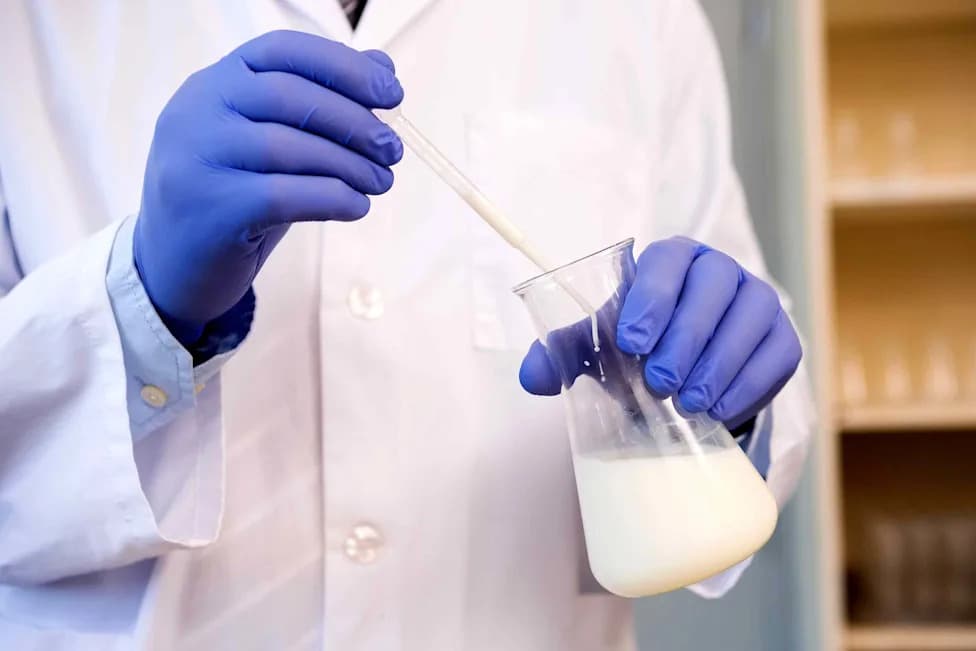
Heriot-Watt University and Take Root Bio have developed a bio-based method to convert salty whey — a high-salt cheese by-product — into bioethanol. The fuel can be blended with petrol or burned in domestic stoves, offering new revenue streams for dairies and reducing disposal costs. The UK produces about 95,000 tonnes of salty whey annually; researchers are also exploring mobile processing units and gas capture to improve efficiency and scalability.
How Cheese Waste Could Heat Your Home — Salty Whey Converted Into Bioethanol

'Every resource matters,' says Kirk Siderman-Wolter - IBioIC/PA
Researchers in Scotland have developed a bio-based process that transforms "salty whey" — a high-salt by-product of cheese production — into bioethanol, a versatile renewable fuel. The work, led by Heriot-Watt University in partnership with Take Root Bio and supported by the Industrial Biotechnology Innovation Centre (IBioIC), aims to turn an expensive disposal problem into a valuable resource for dairy producers and the environment.
How the Process Works
The project targets the sugars present in salty whey and uses biological fermentation to convert them into bioethanol. The resulting fuel can be blended into petrol for vehicles or burned directly in domestic stoves and fireplaces, creating multiple market outlets for producers. The conversion also produces a secondary stream that researchers are investigating for recovery and reuse, improving overall resource efficiency.
"We've always been interested in what happens when you stop looking at something as waste and start asking what else it could become," said Kirk Siderman-Wolter, founder of Take Root Bio.
Why It Matters
Disposal of salty whey is a major challenge for the dairy sector. In the UK alone, cheese production generates roughly 95,000 tonnes of salty whey each year. Its combination of milk sugars and elevated salt content makes treatment and discharge difficult and costly. A single dairy can produce tens of thousands of litres weekly, creating both environmental and economic pressures.
Treating salty whey as a feedstock rather than waste could reduce on-site management costs for dairies while supplying material for new bio-based products. Collaborations between academia and industry, such as this one, aim to unlock commercial value while cutting environmental impact.
Scaling And Future Options
Researchers are considering mobile production units that could be deployed close to dairy sites to lower transport needs and simplify scaling. Take Root Bio is also exploring capture and reuse of gases from fermentation — including methane and hydrogen — which could be repurposed within future food-production or energy systems.
Dr Liz Fletcher of IBioIC emphasised the wider opportunity: "One of the biggest opportunities in industrial biotechnology is finding new uses for materials that are currently treated as waste." Dr Jane White, a waste-valorisation specialist at Heriot-Watt, added that food-and-drink byproducts are prime candidates for bio-based recovery processes.
While further development and commercial testing are required, the approach presents a promising route to reduce dairy waste, create new revenue streams, and produce low-carbon fuel for both transport and heating.
Help us improve.