Researchers found collard greens growing in southern Moroccan oasis gardens and traced linguistic, culinary and botanical clues that point to an earlier North African chapter in the plant’s history. A near‑identical collard preparation appears in a 10th‑century Baghdad cookbook, and botanical references from Oman plus a British explorer’s 1860 notes strengthen the case. The authors propose collards may have reached Morocco with eighth‑century Muslim traders, suggesting Moroccan oases could have been an intermediate stop before the vegetable arrived in the American South. While no direct documentary link to the Americas was found, the culinary parallels prompt a reconsideration of the standard narrative.
How Moroccan Oases, a 10th‑Century Cookbook and an Explorer’s Tale Reframe Collard Greens’ Journey to the U.S. South
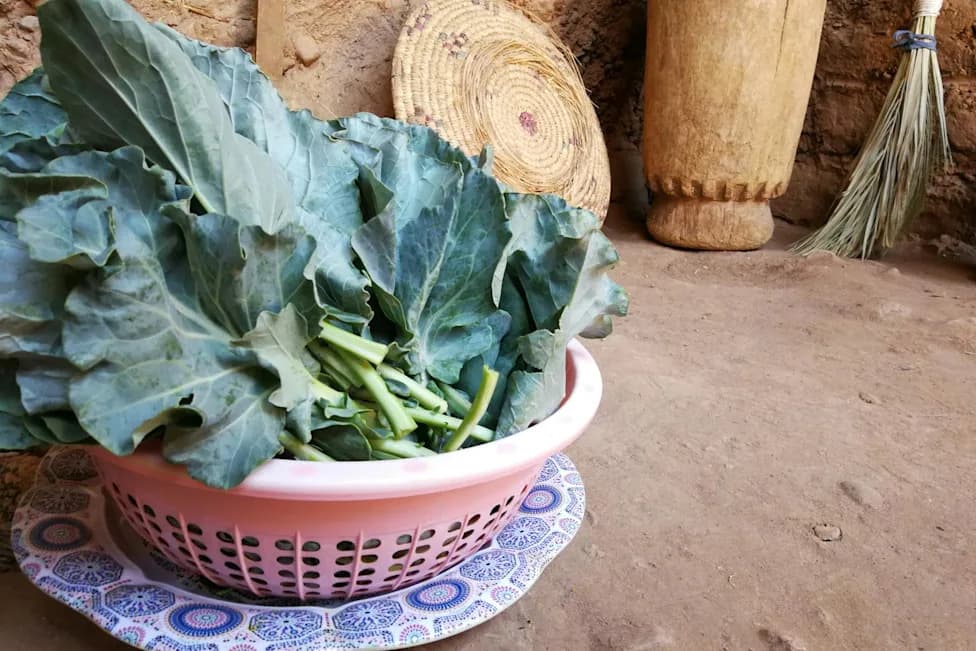
Collard greens − a staple of diets across the African diaspora. Bronwen Powell/Abderrahim Ouarghidi,CC BY
Collard greens have been central to African and African‑diaspora cuisines for centuries. In the United States they are a cornerstone of African American, Southern and "soul" food traditions; in parts of Africa — for example Kenya, where they are called sukuma wiki — they are among the most widely consumed vegetables.
New field research in southern Moroccan date‑palm oases — communities descended from African diaspora groups whose ancestors arrived across the Sahara — uncovered collard greens growing in household gardens. That discovery prompted archival and culinary research that suggests a previously underappreciated chapter in the plant’s history: collards may have reached North Africa with early Muslim traders centuries before they appear in the Americas.
Botanical background
Collard greens are members of Brassica oleracea, the species that also includes cabbage, broccoli, cauliflower, kohlrabi and Brussels sprouts. The species’ extensive genetic diversity complicates efforts to identify the precise place of domestication and the routes by which different cultivars spread. Current evidence points toward domestication somewhere in the Mediterranean, but the path from there to the American South has been unclear.
Clues from language, cookbooks and explorers
Historical sources pose a challenge: many languages used the same words for headed cabbage and non‑heading leafy types such as collards and kale. English and Spanish historical texts often say "cole" or "cabbage" for both; classical Arabic used kornub. In Moroccan Arabic, ordinary headed cabbage is usually called mkouwer or melfouf, while the collard plant appears under the older Arabic name "kornub" in the oasis communities.
Strikingly, we found a recipe in a 10th‑century Baghdad culinary manual that closely matches how collards are prepared in these Moroccan oases today. The Baghdad text describes a smooth‑leaved cabbage called "kurunb Nabati" ("Nabatean cabbage") where only the leaves are eaten — a clear textual signal consistent with collard‑type greens rather than headed cabbage.
Additional evidence includes a 19th‑century British explorer’s notes from Algeria (1860) describing various kinds of "cabbage" and an anecdote about a man hiding a stolen cabbage under his shirt — a detail more consistent with flat leaves than dense heads. Contemporary botanical reports, such as collards reported from oases gardens in Oman’s Hajar mountains, add further corroboration.
A proposed route and historical context
Piecing these botanical, linguistic and culinary threads together, we propose a plausible westward trajectory: collard‑type greens moved from Iraq and Oman into North Africa with early Muslim traders, possibly Kharijite groups active from the eighth century. These traders were involved in founding Sijilmasa and running early trans‑Saharan trade networks that carried gold, enslaved people and other commodities across the Sahara — networks that predated and later linked to transatlantic systems.
Implications for the story of collards in the Americas
Scholars have generally held that collards reached the Americas in the early 16th century with Spanish, Portuguese or English settlers and were then adopted by enslaved Africans. Our findings do not provide direct documentary evidence tying Moroccan oases to the introduction of collards in the New World, so we cannot overturn the prevailing view. However, the culinary similarities — notably, a collard preparation in a 10th‑century Baghdad cookbook that resembles both Moroccan and Southern U.S. methods — suggest that North Africa may have been an intermediate stop and that foodways traveled along far older, interconnected trade routes.
Why the culinary evidence matters: Many West and Central African leafy vegetable dishes incorporate fish, groundnuts or palm oil, while collard recipes common in the U.S. South are closer to the Moroccan and Baghdad preparations described here. Those parallels make it plausible that collard recipes traveled with people and cultural practices, not only with seeds.
In short, the story of collards in Moroccan oases invites a broader view of how plants, recipes and people moved across continents — a history shaped by both trans‑Saharan and transatlantic entanglements.
By Bronwen Powell and Abderrahim Ouarghidi. Republished from The Conversation.
Help us improve.