The Washington National Guard has deployed an Anduril-built counter-drone suite that uses multiple sensors and AI to distinguish drones from birds at long range and fuse telemetry into a unified operator feed. Members of the Counterdrug Program and the 10th Civil Support Team completed two weeks of intensive training and plan to use the system to secure large public events. Guard leaders say the capability is critical given concerns about drones being used to deliver hazardous materials and to help locate likely hostile operators.
Washington National Guard Deploys AI-Powered Anduril System To Distinguish Drones From Birds
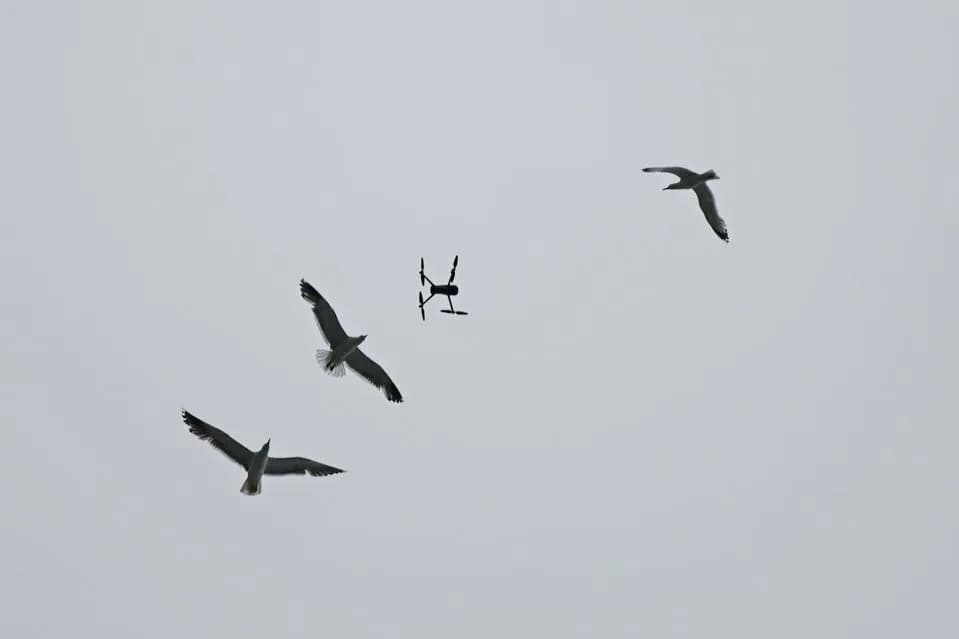
Angry seagulls chase a drone flying through Paris in July 2024. (Photo by Artur Widak/NurPhoto via Getty Images)NurPhoto via Getty Images
Photo note: Angry seagulls were filmed chasing a drone over Paris in July 2024 — a reminder that birds can complicate aerial detection and tracking.
Troops of the Washington National Guard have begun fielding a counter-drone technology suite from Anduril designed to distinguish unmanned aircraft systems from birds and other airborne objects at long range. The capability is intended to improve detection accuracy and reduce false alarms during security operations.
Members of the Guard's Counterdrug Program and the 10th Civil Support Team (CST) completed intensive training on the system, which integrates multiple high-sensitivity sensors with advanced recognition software to detect, track and analyze aerial contacts.
The suite combines hardware and software components identified by the manufacturer as WISP, the Long Range Camera Tower, the Pulsar frequency sensor and Lattice command-and-control software. Sensor telemetry is fused into a single, real-time feed for operators, allowing continuous tracking and clearer differentiation between drones, birds and other objects.
Beyond classification, the system employs sophisticated artificial intelligence to help analysts prioritize threats and estimate likely locations of hostile drone operators, improving response options for security teams.
Lt. Col. Wes Watson, director of the Commander’s Action Group for Counter-Small Unmanned Aircraft Systems, emphasized the concern about delivery of hazardous materials: "CSTs have been exploring ways to defeat this delivery mechanism [drones] for years and would be vital in the response to a downed drone suspected of carrying a WMD [weapon of mass destruction]."
Guardsmen spent two weeks in focused training on the detection suite and plan to deploy the capability to secure large public events and other high-risk venues. The acquisition followed preparatory work tied to FIFA events and the Guard’s Counterdrug program.
Maj. Gen. Gent Welsh, the Washington National Guard’s adjutant general, said: "From our groundbreaking work in our Counterdrug program to the recent acquisition of an Anduril system as a byproduct of FIFA prep, we are getting after the challenges here with law, policy and domestic employment."
The Guard will continue joint training with federal partners, including the FBI and the Department of Homeland Security, to refine tactics, techniques and procedures for using the system to detect and mitigate domestic drone threats.
Originally published on Forbes.com.
Help us improve.