The U.S. has unveiled a plan to cut Colorado River deliveries to Arizona, California and Nevada by up to 3 million acre-feet a year through 2036. Reductions — about 20% of lower-basin entitlements and equivalent to the annual use of nine million households — take effect in October for two years before review. The move aims to protect a river system that supplies drinking water to more than 40 million people, but it has sparked sharp criticism and likely legal challenges.
U.S. Announces Major Colorado River Cuts — Southwest States Brace for Deep Water Reductions
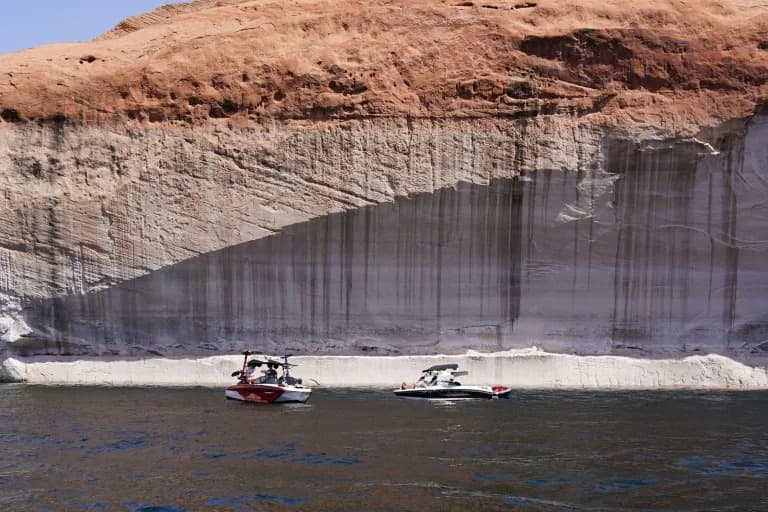
Boaters make their way past bathtub rings, showing the height of the water level in the past, on Lake Powell, Arizona on June 18, 2024 (Bryan R. SMITH)
The U.S. federal government on Friday unveiled a new management plan for the Colorado River that will impose steep water reductions on lower-basin states as record drought and climate change strain supplies.
Under the roadmap, Arizona, California and Nevada could face combined cuts of up to 3 million acre-feet per year through 2036 — roughly 130 billion cubic feet or 3.7 billion cubic meters. Officials say that amount represents about 20% of those states' legally entitled allocation and is approximately equivalent to the annual water use of nine million households.
The exact size of reductions will depend on reservoir reserve levels and other hydrological conditions across the basin. The plan is set to take effect in October and will remain in place for two years before federal officials reassess its impacts and the river's status.
"The Department has a responsibility to ensure the Colorado River system remains reliable and resilient for the millions of Americans, communities and industries that depend on it," Secretary of the Interior Doug Burgum said.
A Question Of 'Survival'
The cuts are designed to blunt an escalating regional water crisis and ease a long-standing dispute between states. In mid-July, the combined water levels of Lake Powell and Lake Mead — the nation's two largest reservoirs on the Colorado River — fell to their lowest combined level in more than 60 years.
The Colorado River supplies drinking water to more than 40 million people, supports agriculture and powers hydropower facilities across seven U.S. states. Federal and academic experts warn that litigation over allocations is likely; Doug Kenney, director of the water policy program at the University of Colorado, told reporters a lawsuit was "undoubtedly" coming and could reach the Supreme Court.
The plan focuses reductions on the lower basin (Arizona, California and Nevada); the upper basin states — Colorado, Utah, Wyoming and New Mexico — will not face the same cutbacks. That disparity is expected to heighten interstate tensions.
Federal officials and water experts say the river has been overdrawn for decades and is now enduring an "unprecedented multi-decade drought" stretching about 25 years. They also stress that significant demand reductions in agriculture will be required to protect the river system.
Sarah Porter of Arizona State University said, "The amounts of water that are needed to save the system can't be achieved without reducing demand for agriculture. It's just a matter of math."
Arizona's Department of Water Resources criticized the plan, saying it "does nothing to elevate expectations around a coherent seven-state plan" and warning the restrictions "would devastate Arizona's water users and its economy." Federal officials said Washington intervened after the states failed to reach agreement on cuts themselves.
Reporting note: Decisions and figures reflect the federal proposal announced in [current report]; reservoir levels and implementation details may change as conditions evolve.
Help us improve.