DARPA will stage its first Lift Challenge next week, offering $6.5 million to teams that build VTOL drones capable of lifting four times their own weight. Entrants must field aircraft under 55 pounds that can carry at least 110 pounds along a 1,000‑foot course back and forth 30 times (about five nautical miles) in under 30 minutes. More than 100 teams from industry, academia and hobbyist communities have registered. The finals are in Dayton, Ohio, beginning Aug. 2; the last four days are open to the public and will be livestreamed.
DARPA's $6.5M Lift Challenge Seeks Drones That Can Haul Four Times Their Weight
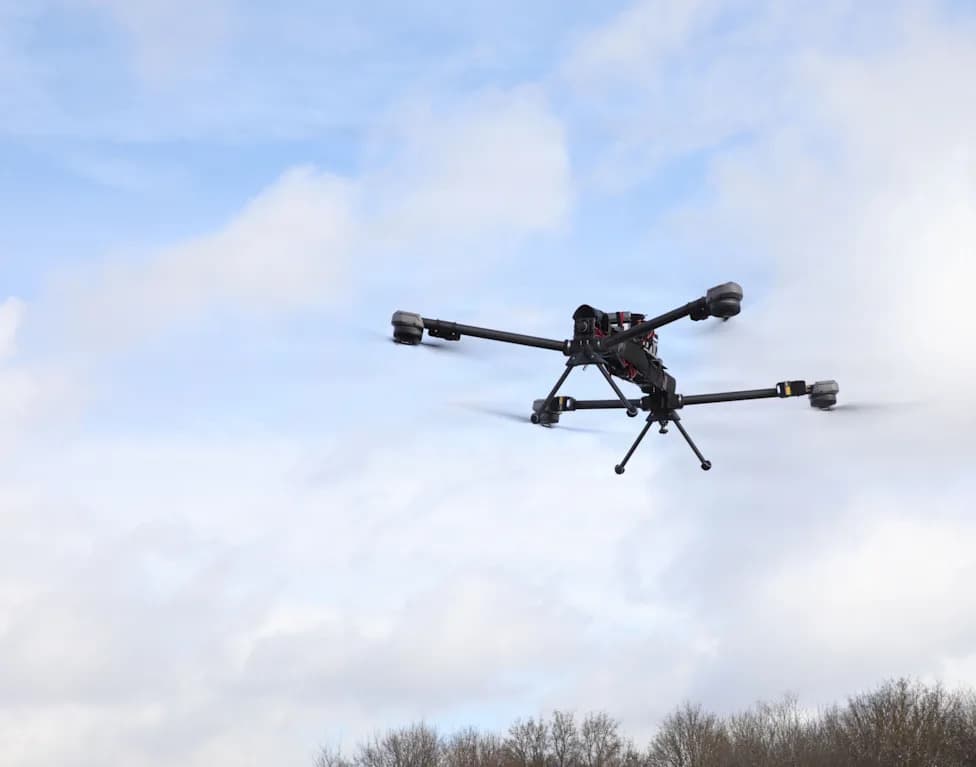
A resupply drone takes off during a heavy unmanned aerial resupply test flight at the Joint Multinational Readiness Center near Hohenfels, Germany, Feb. 18, 2026. (Sgt. Glenn Brennan/U.S. Army National Guard)
The Defense Advanced Research Projects Agency (DARPA) will next week launch its inaugural Lift Challenge, a weeklong contest designed to push the boundaries of heavy vertical‑lift unmanned aircraft. DARPA is offering $6.5 million in prizes for teams that can build a vertical takeoff and landing (VTOL) drone capable of lifting and transporting a payload equal to four times the drone's own weight.
Phillip 'Donna' Smith, the Lift Challenge program manager and a lieutenant colonel in the Marine Corps Reserve, explained that common multirotor drones are constrained by low payload‑to‑weight ratios and therefore become much larger and more expensive as payload requirements increase.
'This means as payload requirements increase, so does the size and the cost of the drone,' Smith said. 'With the Lift Challenge, our goal is to dramatically increase the useful load, which will then drive down the cost per pound of transported cargo.'
Smith described heavy vertical flight as a potential technological inflection point comparable to the automobile assembly line or reusable rockets, with possible toeholds in agriculture, logistics, construction, disaster relief and other industries.
What Competitors Must Do
Each entrant must present a drone that performs a non‑assisted vertical takeoff and weighs less than 55 pounds. During the event, drones must pick up at least a 110‑pound payload and shuttle it back and forth along a 1,000‑foot course 30 times (roughly five nautical miles) within 30 minutes. The combination of relatively light aircraft and heavy, sustained lift is what sets the challenge apart.
Who Is Entering
More than 100 teams have registered, spanning established manufacturers, academic groups, independent engineers, hobbyists and content creators. Entrants highlighted by DARPA include a University of Nevada, Reno academic team led by associate professor Hao Xu and Colorado startup Alpine Combat Systems. YouTuber Hoarder Sam — known for DIY drone projects — is also competing and noted the event's ambitious goals.
'Carrying this much weight for that far of a distance isn't going to be easy, and honestly, I think it might be almost impossible. That's because DARPA is famous for setting the bar extremely high,' said Hoarder Sam, recalling DARPA's early self‑driving car challenge as an example of how such contests can accelerate technology.
Event Details and Impact
The Lift Challenge begins Aug. 2 at the National Museum of the U.S. Air Force in Dayton, Ohio. The final four days of competition will be open to the public, and DARPA will livestream the event on YouTube starting Aug. 3. Organizers say the contest supports the Department of Defense's Drone Dominance initiative, which seeks to accelerate drone innovation while driving down operational costs.
Even if the stated targets prove difficult, DARPA events have a history of catalyzing research and commercial development. The Lift Challenge aims to jump‑start heavier, more efficient electric VTOL systems that could transform how cargo and equipment are moved across civil and military applications.
Help us improve.