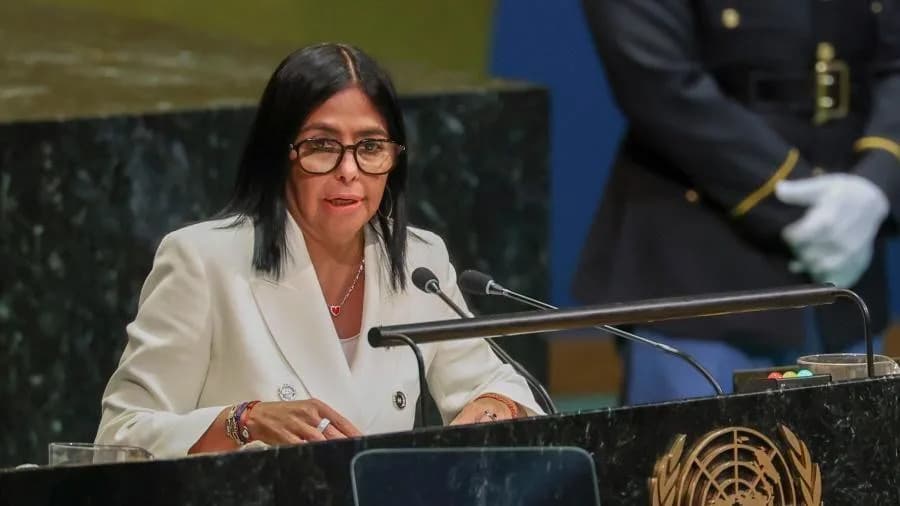
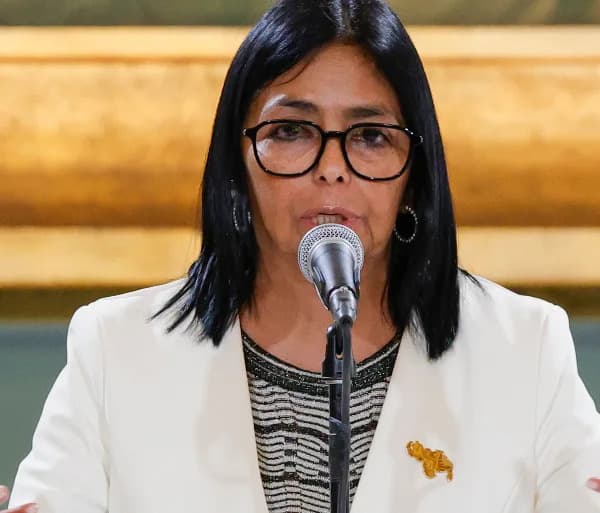
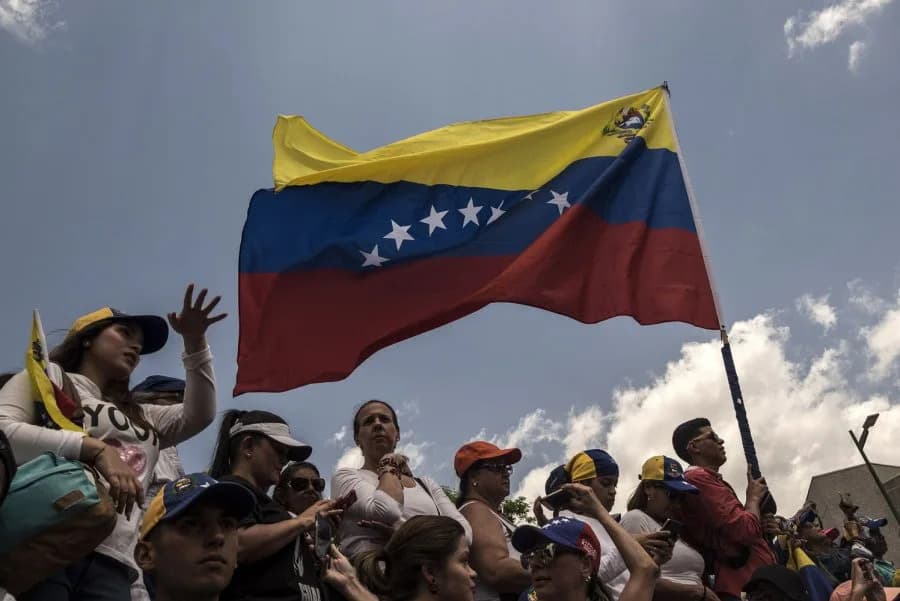
Delcy Rodríguez, acting president of Venezuela, told TIME she views January 3 as a turning point and outlined a pragmatic agenda to rebuild the country. She described legal reforms and an amnesty program that officials say benefited roughly 9,000 people, plans to open the oil sector to private and foreign investment (citing 303 billion barrels in reserves), and efforts to attract Venezuelan professionals abroad (56,000+ registered). Rodríguez says elections will take place when political actors agree, and she supports international election observers who respect Venezuela's sovereignty.
Delcy Rodríguez on Venezuela’s Turning Point: Transcript and Key Takeaways from Her TIME Interview
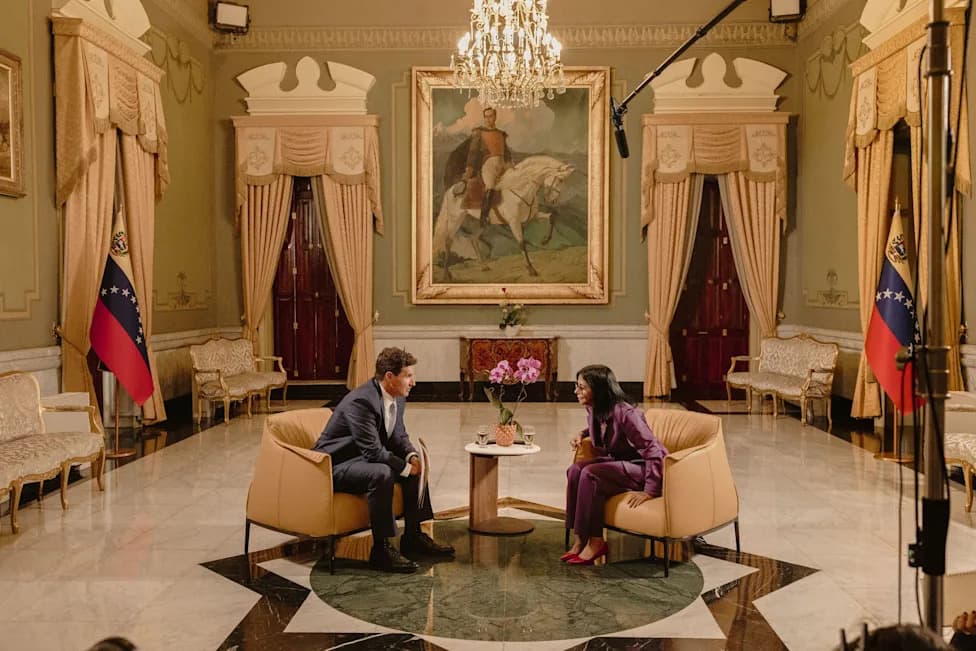
TIME correspondent Eric Cortellessa interviews the Acting President of Venezuela, Delcy Rodríguez, on June 16, 2026 at the Miraflores Palace. —Fabiola Ferrero for TIME
Acting President Delcy Rodríguez met with TIME at Miraflores Palace in Caracas on June 16 for a wide-ranging interview about the January 3 U.S. operation that led to Nicolás Maduro’s capture, her assumption of the interim presidency, relations with U.S. leaders, and plans to reopen Venezuela’s economy.
Edited Transcript (Lightly Edited for Clarity)
TIME: We're in a transitional moment, perhaps a transformational moment. How would you describe your vision for Venezuela, post-Maduro?
Rodríguez: I avoid labeling political moments. January 3 marked a turning point for Venezuela. I felt a profound change: first in the political map, and then in the need to imagine a new Venezuela that corrects past mistakes so we can move forward. My top priority is economic transformation to address Venezuelans' urgent needs. Those political and economic changes, aimed at meeting socioeconomic demands, are preparing a new political era. In just months we have advanced legal reforms, legislative changes and adjustments in the criminal justice system. The flagship initiative is the Program for Democratic Coexistence and Peace, which seeks to steer society away from hatred and intolerance toward mutual understanding rooted in diversity.
TIME: Where were you on the day of the Maduro raid, January 3, 2026?
Rodríguez: I was with him until 8 p.m., then I left for Margarita Island. I arrived at about 11 p.m. The attack occurred at 2 a.m. I was worried because family members remained in Caracas. I had been monitoring radar and noticed many planes before the attack; I called the official in charge of one vice-presidential post. Frankly, we never imagined the capital would be attacked or that the president and first lady would be taken in that way.
TIME: Some suggest you might have known in advance — what do you say?
Rodríguez: That is untrue. I did not have foreknowledge.
TIME: When and how did you learn you would become Venezuela's interim president?
Rodríguez: We initially feared the president and first lady had been killed. Later, when we learned they were being taken to the United States, the situation changed. I spoke with a foreign leader who told me, 'Now the responsibility rests on your shoulders.' That leader was the Emir of Qatar; I had contacted him out of concern. As I understand it, his prime minister spoke with U.S. officials.
TIME: Do you consider Maduro the legitimate president now, even in absence?
Rodríguez: I am the acting president because I served as executive vice president under Nicolás Maduro. The constitutional framework defined the succession in this situation.
TIME: Critics say your government is a continuation of Maduro’s — what do you say?
Rodríguez: Actions matter more than words. There are visible changes: new laws, a peaceful coexistence program, significant releases and an amnesty law. Venezuelan society is changing and should be judged by its actions.
TIME: What was Maduro's greatest mistake?
Rodríguez: Not being more geopolitically open. In my early actions I moved toward a new relationship with the United States. Venezuela's international relations should be more open and diversified; external pressure hurt us.
TIME: Describe your last conversation with Maduro.
Rodríguez: We discussed the economic plan for 2026, noting that Venezuela had been under what we described as a naval blockade and could not sell oil in December and part of January. Since he has been in U.S. custody I have had very little direct communication — only messages through lawyers — and they report he sees recent developments in Venezuela positively.
TIME: How many political prisoners are there?
Rodríguez: The term 'political prisoners' is used in different ways. We passed an amnesty law covering political violence from 1999 onward. Before the law, nearly 900 people had been released; under the amnesty roughly 9,000 people benefited (about 9,400 in total). More than 400 were granted full physical freedom; others remain subject to court-ordered reporting. In addition, there are more than 500 people who benefited from other relief processes but did not qualify fully under the law.
TIME: Would you allow an international audit of those cases?
Rodríguez: Yes. I asked the Human Rights Commission about it and support independent review that respects Venezuelan sovereignty.
TIME: When will Venezuela hold elections?
Rodríguez: Elections will be held when the country is ready — when political actors reach an understanding and can assure the nation they are prepared. The Coexistence Program has engaged more than 30 economic, political and social sectors to help build that groundwork. Venezuela has a tradition of international observers, and I would accept observers who respect the country's sovereignty and do not attempt to make decisions on its behalf.
TIME: Will María Corina Machado be allowed to return and run?
Rodríguez: Venezuela belongs to all citizens. I envision a future without sanctions where everyone can participate. Who takes part in elections matters less than creating the conditions for peaceful, inclusive politics.
Economy and Investment
Rodríguez: The economic blockade forced us to adopt mechanisms for private participation. Our constitution allows private property and investment. Legal reforms aim to increase returns and provide legal certainty. We signed an agreement with Repsol and are negotiating roughly 30 energy agreements. According to the International Energy Agency figures cited in the interview, Venezuela holds an estimated 303 billion barrels of reserves, much of it in fields with development potential. We have invited U.S. and other foreign companies back — including long-standing firms such as Chevron and service firms such as Halliburton — to invest under new legal frameworks so revenue can flow into healthcare, education and public services.
TIME: How will you attract Venezuelans abroad to return?
Rodríguez: We launched a registry for professionals and entrepreneurs; more than 56,000 people enrolled in a month. The 'Emprender Juntos' program connects registrants with partners and opportunities to start businesses in Venezuela.
Security Cooperation
Rodríguez: We have shared intelligence and operational cooperation with partners to counter transnational organized crime. The operation that targeted a Tren de Aragua leader combined intelligence from partners and actions by Venezuelan security forces. We view cooperation against drug trafficking and organized crime as routine and welcome similar collaboration with the United States, France, Colombia and Mexico.
Legacy and Priorities
Rodríguez: I want to preserve social-protection programs that target the most vulnerable and simultaneously restore services such as reliable electricity and healthcare. Securing agreements with companies like IMPSA and General Electric to rebuild infrastructure is among the most consequential decisions I've made. Success, I said, will mean tangible improvements in Venezuelans' daily lives regardless of politics.
Note: The above is a cleaned and condensed version of the full transcript as published by TIME. Statements and figures reflect what Acting President Delcy Rodríguez said in the interview; some details, such as official titles of foreign officials referenced in the conversation, have been clarified for accuracy where appropriate.
Help us improve.