The U.S. has adopted an Earnings Accountability Test that could strip federal loan eligibility from individual degree programs whose graduates earn no more than same‑aged high‑school graduates. The Department of Education will begin collecting program‑level earnings data in January 2027, and the rule takes effect on July 1, 2027. Critics warn the test prioritizes short‑term earnings over civic, intellectual, and cultural values—putting liberal arts, arts, religion, and teacher‑preparation programs at risk.
The Earnings Accountability Test: How a 'Do No Harm' Rule Could Gut Majors

The Earnings Accountability Test: Is Your Major At Risk?Image from Google Gemini
Last year, tucked inside what lawmakers dubbed the "Big Beautiful Bill," Congress included a provision with potentially sweeping consequences for American higher education. In July 2026 the U.S. Department of Education issued final regulations implementing the policy; the rule is scheduled to take effect on July 1, 2027.
The policy—known as the Earnings Accountability Test—works like this: if graduates of a single academic program (not an entire college) earn, on average, no more than same‑aged peers with only a high‑school diploma, future students in that program could lose eligibility for federal student loans.
What Comes Next
Beginning January 2027, the Department of Education will begin compiling a nationwide dataset to calculate average earnings for graduates of every degree program at accredited institutions. Programs that fail the test risk losing access to federal loan programs for incoming students—an outcome that can sharply reduce enrollment and threaten program viability.
Why This Matters
At first glance the rule is framed as consumer protection. Legislators called it a "Do No Harm" provision, arguing students should not be financially worse off for attending college. But the policy measures "harm" solely by short‑term earnings—an approach critics say misreads the purposes and public value of higher education.
Example: If graduates of an English major at a particular college average $60,000 a year while same‑aged high‑school graduates in that state average $65,000, that English program could lose federal aid eligibility—even if the program provides clear civic, cultural, and intellectual benefits.
Who Is Likely to Be Affected
The Department’s initial estimate suggests roughly 5.1 percent of programs could be affected at first. But more alarming are the specific fields projected to face high failure rates: government data point to elevated risk among religious studies (53% projected to fail), teacher preparation (29%), theater (16%), art (15%), and music (14%).
These are fields that serve civic life, culture, and public service. Critics ask: should programs be judged only by immediate earnings? Should federal policy disincentivize teachers and other public servants whose social value extends beyond paychecks?
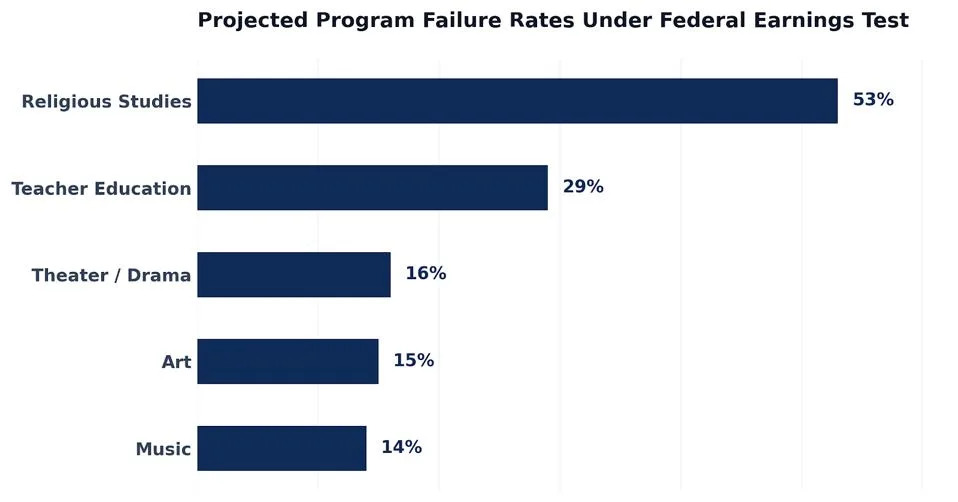
Source: Data from U.S. Department of Education, Inside Higher Ed, Christianity Today
A Flawed Analogy
Supporters invoke the Hippocratic ideal—"Do No Harm." But the analogy breaks down because medicine and education aim at different goods. In medicine the primary measurable benefit is improved health; measuring harm as worse health aligns with the goal. In higher education, many benefits—critical thinking, civic formation, cultural literacy—are not captured by short‑term earnings.
Demanding that every academic program produce graduates who earn more than same‑aged high‑school peers reduces education to an economic transaction and threatens to hollow out liberal arts, arts, and teacher‑preparation programs that historically support civic life and cultural vitality.
What’s at Stake—and What To Do
The regulation could reshape what colleges teach and which programs survive. If federal aid is the lifeline for many students, removing eligibility effectively restricts access and stratifies who can pursue certain majors.
Defenders of liberal education—administrators, faculty, alumni, and public‑interest advocates—must make a clear case for the non‑monetary public goods produced by many programs and press policymakers to adopt broader metrics for evaluating educational value.
Sources: U.S. Department of Education data; Inside Higher Ed; Christianity Today; Forbes.
This article was originally published on Forbes.com.
Help us improve.