Researchers in Queensland have uncovered, for the first time in Australia, a fossilized three‑tier feeding chain: a pterosaur inside a nearly 23‑foot ichthyosaur, which itself shows bite damage matching a 40‑foot Kronosaurus queenslandicus. Hobbyist collectors first found the bones in 2019; museum staff spent over 600 hours preparing the specimens. Synchrotron CT scans revealed cephalopods, fish, and the pterosaur jaw inside rock nodules, while bone damage indicates a later Kronosaurus attack.
Rare Three‑Tier Fossil Food Chain Found: 40‑Foot Kronosaurus Ate a 23‑Foot Ichthyosaur That Had Swallowed a Pterosaur
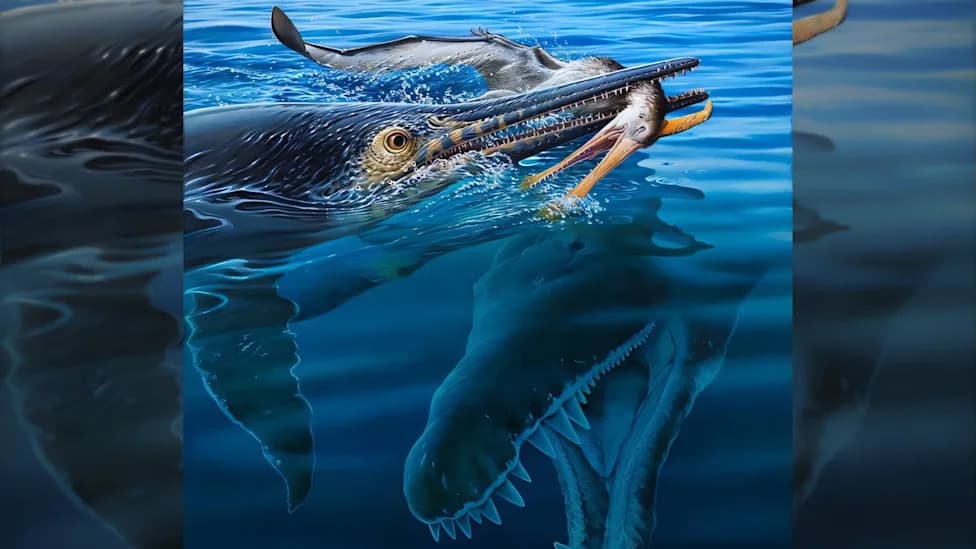
In the Eromanga Sea, it was eat or be eaten.
For the first time in Australia, paleontologists have documented a fossilized three‑tier feeding interaction: a pterosaur found inside a nearly 23‑foot ichthyosaur, which itself shows damage consistent with an attack by a 40‑foot apex predator, Kronosaurus queenslandicus. The discovery provides a striking, direct snapshot of predator‑prey behavior in Cretaceous seas more than 100 million years ago.
“It’s one of the clearest examples ever discovered of a three‑tier predator interaction and offers an unprecedented snapshot of behaviour in Australia’s Cretaceous seas,” said Dean Lomax, a paleontologist and reviewer of the new study.
The fossils were first spotted in 2019 by four amateur fossil hunters near Richmond, Queensland. The group collected several large specimens and stored them in what they dubbed a “Bag of Bones.” Kevin Petersen, curator at the Kronosaurus Korner fossil museum, examined the material, and museum staff and volunteers then spent more than 600 hours excavating and preparing the specimens. Their work revealed a partially articulated ichthyosaur nearly 23 feet long.
Near the ichthyosaur’s skull, excavators found several unusually shaped rock nodules that could contain fragile remains. To avoid damaging potential contents, the team sent the nodules to the Australian Nuclear Science and Technology Organisation for advanced synchrotron CT scanning. The scans revealed an unexpected prehistoric menu: squid‑like cephalopods, fish, and the jaw of a flying reptile — a pterosaur — preserved inside the nodules.
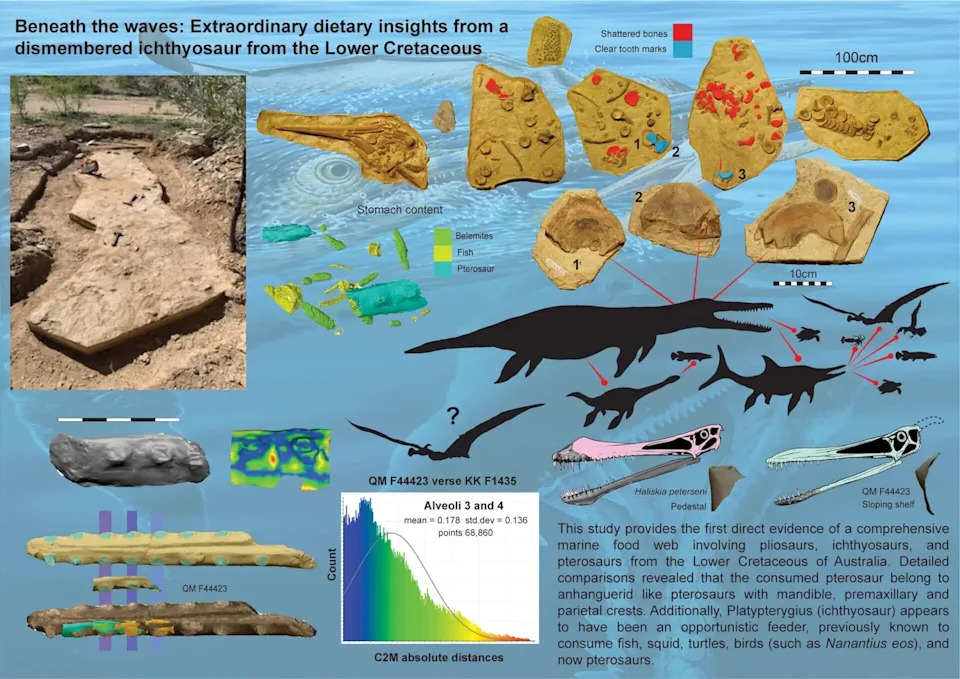
The feeding sequence is the first example of its kind discovered in Australia.
Evidence of a Predator Attack
Although parts of the ichthyosaur were remarkably preserved, its skeleton bore crushing bite marks and missing sections consistent with a later predatory assault. Based on the pattern and magnitude of the damage, the researchers identified the likely assailant as Kronosaurus queenslandicus, an apex pliosaur of the Early Cretaceous.
Kronosaurus was a powerful short‑necked predator that could reach roughly 40 feet in length and is estimated to have weighed between 11 and 13 tons. Bite force estimates for this pliosaur range from about 3,370 to 6,070 pounds of force — sufficient to fracture and dismember even large marine reptiles.
“I was amazed by the size of the ichthyosaur, and shocked to see it littered with bite marks,” said Matt White, a paleontologist at the University of New England and co‑author of the study. “This discovery enriches our understanding of these ancient marine reptiles and illustrates the complex interactions that shaped their prehistoric aquatic environment.”
The find is the first clear fossilized example in Australia of a three‑tier marine food chain — predator eating predator that had itself eaten another animal — preserved in situ. In addition to adding a vivid behavioral snapshot to the fossil record, the discovery highlights the value of careful fieldwork, museum preparation, and modern imaging techniques for revealing hidden details in rock‑encased fossils.
Help us improve.