The Army awarded prototype development agreements to Ford, GM Defense and BC Customs on June 30 to build three each of a new Infantry Squad Vehicle‑Heavy (ISV‑H), with first deliveries due by March 30, 2027. The ISV‑H must carry a 4,000‑lb payload, tow 6,500 lb and export 60 kW of continuous high‑voltage DC power to run systems like counter‑drone and directed‑energy weapons. Additional requirements include recharge to 90% within six hours across temperatures from -25°F to 130°F, drive‑by‑wire readiness and configurable rear seating for casualty evacuation. Fiscal 2027 plans call for an initial 34 vehicles at an estimated $463,000 each and a long‑term buy of 606 units.
Ford, GM Defense and BC Customs Win Army Contracts To Build High‑Power ISV‑H Prototypes
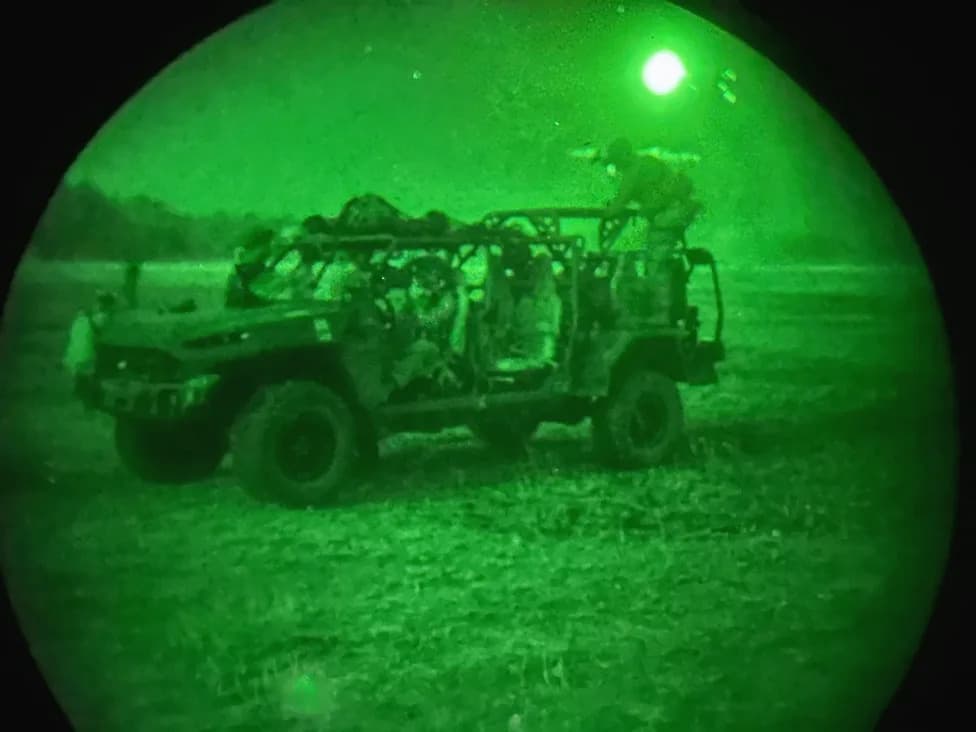
Paratroopers in an Infantry Squad Vehicle at Fort Johnson, Louisiana, in September 2023. (Spc. Hannah Stewart/U.S. Army)
The U.S. Army has tapped three manufacturers—Ford, GM Defense and BC Customs—to build competing prototypes of its next Infantry Squad Vehicle‑Heavy (ISV‑H), the service confirmed. On June 30 the Army awarded firm‑fixed‑price Other Transaction Agreements requiring each company to deliver three prototypes, with the first vehicles due by March 30, 2027. Those six‑seat platforms will be evaluated by the Army Test and Evaluation Command.
Under a Commercial Solutions Opening published in April, the Army set demanding performance requirements. The ISV‑H must carry a 4,000‑pound payload, tow a 6,500‑pound trailer and provide substantial onboard electrical power. Specifically, the vehicle must be able to export 60 kW of continuous high‑voltage DC power to support systems such as counter‑drone sensors, electronic‑warfare suites and directed‑energy weapons.
The service also requires the ISV‑H to be rechargeable—able to restore its energy to 90% within six hours—and to operate reliably across extreme temperatures, from -25°F to 130°F. Planners are preparing the design for future autonomy with a drive‑by‑wire architecture and want flexible interiors: rotating rear seats, ergonomic mobile workstations and tool‑free reconfiguration to accept a litter for casualty evacuation.
The current Infantry Squad Vehicle, produced by GM Defense, was built to move nine soldiers quickly across terrain that is hazardous or impractical for other combat vehicles. The Army has also been experimenting with mounting high‑power directed‑energy systems: it has operationally tested AeroVironment’s 20 kW LOCUST laser on both the ISV and the Joint Light Tactical Vehicle as part of its Multi‑Purpose High Energy Laser effort.
"One of the things that we do have a critical capability gap on right now is power generation at that mobile brigade combat team level," said Jess Tolleson, Principal Deputy Assistant Secretary of the Army for Acquisition, Logistics, and Technology, during a June Senate Armed Services Committee hearing.
Companies gave brief comments after the awards. GM Defense has said it is optimizing a Chevrolet Silverado 3500HD platform; Ford noted that its Super Duty/F‑Series trucks are well suited to military applications; and BC Customs described its entry as a purpose‑built, highly modifiable ground‑up design and said it is partnering with Raglan to supply the electronic infrastructure for its prototypes. The Army did not disclose contract values.
In its Fiscal 2027 budget request, the Army sought funding for an initial purchase of 34 ISV‑H vehicles at an estimated cost of about $463,000 per truck, with a longer‑term goal to procure 606 vehicles.
The ISV‑H competition signals the Army’s increased emphasis on mobile power generation and flexible, future‑proof light tactical vehicles that can host energy‑intensive payloads while remaining transportable and reconfigurable for squad‑level operations.
Help us improve.